Bihar Releases Survey Data Showing EBCs Form Largest Group
Source:morungexpress ↗
Why It Matters
This survey represents a landmark policy development in India regarding state-level caste enumeration, impacting reservation caps, welfare distribution, and electoral politics in Bihar.
Summary
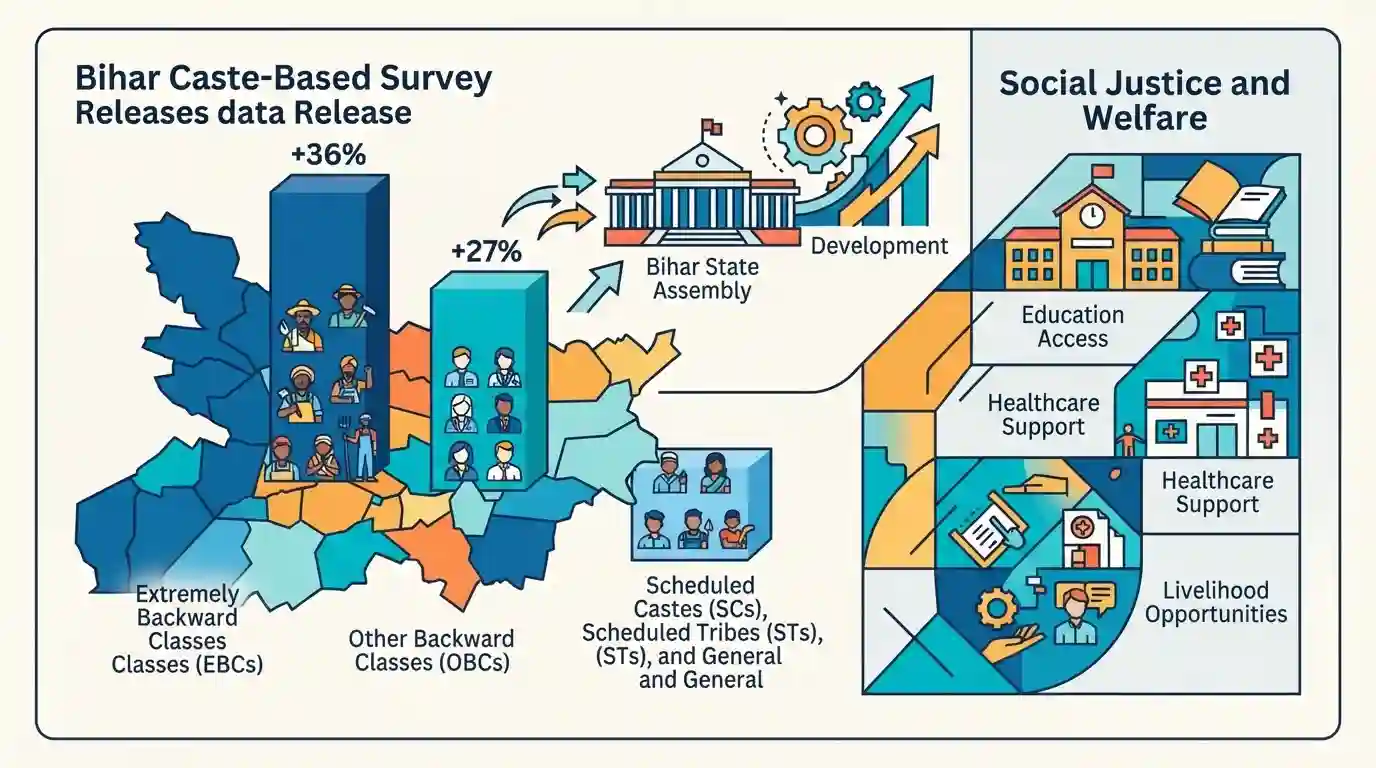
The Bihar government released the long-awaited data from its caste-based survey, showing that Extremely Backward Classes (EBCs) form the largest demographic group at over 36%, followed by Other Backward Classes (OBCs) at over 27%. The comprehensive survey provides detailed demographic insights crucial for social welfare and reservation policy planning in Bihar.
Key Points
- The Bihar government released the findings of its pioneering caste-based survey, revealing that Extremely Backward Classes (EBCs) constitute the largest block of the population at 36.01%.
- Other Backward Classes (OBCs) make up 27.13% of the population, meaning backward classes combined form a significant majority of the state's demographic profile.
- Scheduled Castes (SCs) account for 19.65% and Scheduled Tribes (STs) account for 1.68%, while the unreserved/general category constitutes 15.52%.
- The total population of Bihar was recorded at over 13 crore during the survey.
Important Terms
Bihar Caste-Based Survey

A landmark state-level enumeration initiative undertaken by the Bihar government to map demographic distributions, social strata, and economic conditions across different castes, revealing that EBCs form the largest demographic group.
UPSC context
Crucial for BPSC General Studies Paper II (Social Justice, Governance, and Polity), testing understanding of regional demographics and reservation policy planning.
Prelims Trap
Other Backward Classes (OBCs) form the largest demographic block in Bihar at over 36 percent.
Aspirants often confuse the percentage share of EBCs (36.01%) with OBCs (27.13%) or assume OBCs form the largest block alone.
Static Concepts Connected
What are the constitutional provisions regarding reservation and backward classes in India?
- Enabling Articles: Article 15(4) and 16(4) empower the State to make special provisions for the advancement of any socially and educationally backward classes.
- Article 340: Article 340 provides for the appointment of a Commission to investigate conditions of backward classes.
- EWS Reservation: The 103rd Constitutional Amendment Act inserted Articles 15(6) and 16(6) to provide 10% reservation for Economically Weaker Sections (EWS).
Cross-Topic Patterns
Caste Survey & Judicial Reservation Ceilings
The release of granular demographic data directly impacts state-level reservation caps, intersecting with constitutional debates around the 50% ceiling limit set in the Indra Sawhney case.
Demographics & Targeted Welfare Delivery
Detailed demographic metrics provide evidence for targeted welfare delivery, linking decentralized governance (Panchayati Raj) with equitable resource allocation in Bihar.

Bihar caste survey percentages (EBC 36.01%, OBC 27.13%, SC 19.65%) are prime targets for BPSC prelims matching and direct data questions.
Linked PYQs · 3
Linked PYQs · 3
- 2025BPSC_PRELIMSGS1
Afrikaners indicate the people:
- 2019BPSC_PRELIMSGS1
As per the Census 2011, the child sex ratio in Bihar was
- 2022BPSC_PRELIMSGS1
How many seats are reserved for the SC candidates in the Bihar Legislative Assembly?
