Bihar government issues appointment letters for JEEViKA personnel
Source:The Hindu ↗
Why It Matters
The article focuses on JEEViKA, Bihar's flagship rural livelihoods program, and the state's broader policies for women's empowerment. Questions on JEEViKA, women's reservation in Bihar's Panchayati Raj, and the nature of women's employment in the state are highly recurrent themes in the BPSC Preliminary examination.
Summary
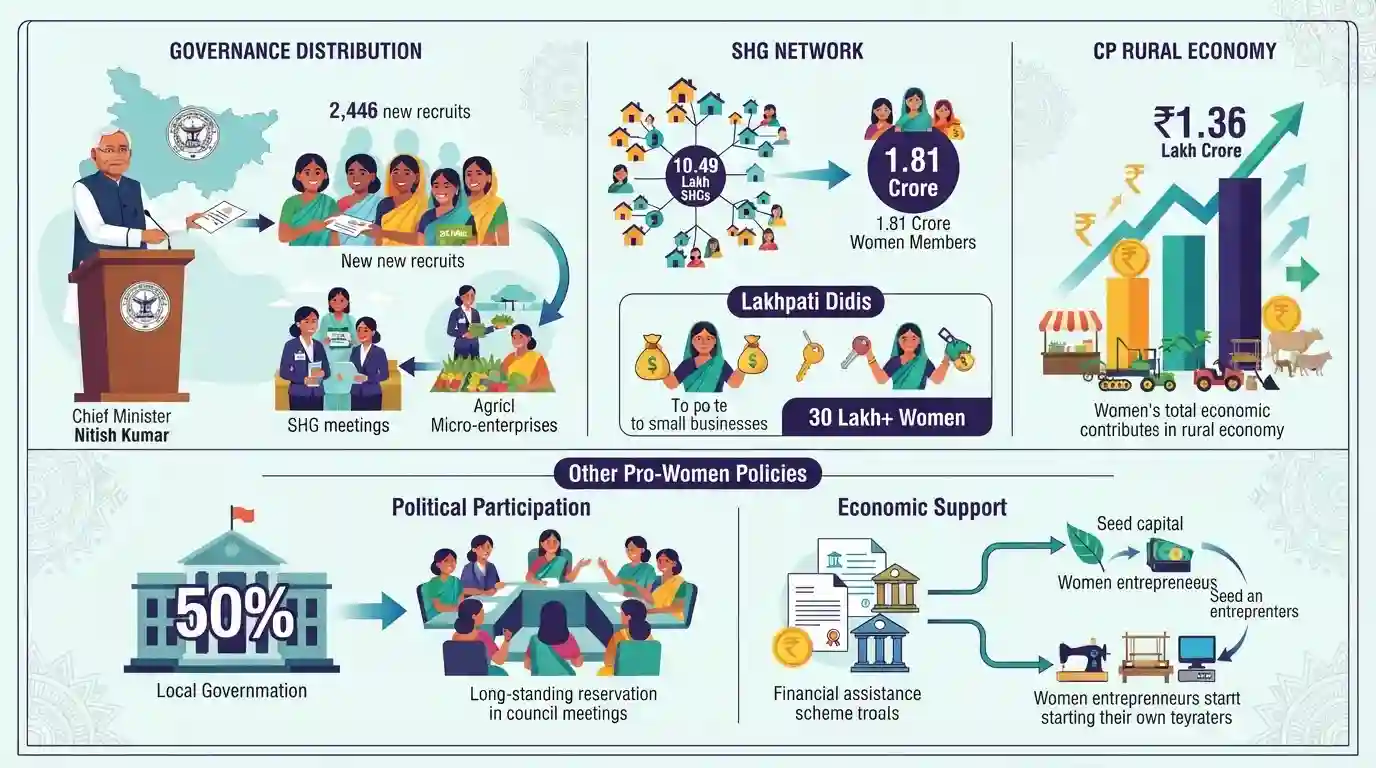
The Bihar government distributed appointment letters to 2,446 candidates recruited into the Bihar Rural Livelihoods Promotion Society (JEEViKA). Chief Minister Nitish Kumar underscored JEEViKA's transformative impact on women's empowerment and the rural economy, noting that over 1.81 crore women are now part of 10.49 lakh Self-Help Groups (SHGs). The initiative has facilitated over 30 lakh women becoming 'Lakhpati Didis' and has driven women's economic contribution in the state to ₹1.36 lakh crore. The event also highlighted ongoing pro-women policies, including 50% reservation in local bodies since 2006 and financial assistance under the Chief Minister's Women's Employment Scheme.
Key Points
- The Bihar government issued appointment letters to 2,446 individuals in the Bihar Rural Livelihoods Promotion Society (JEEViKA) to strengthen rural outreach.
- JEEViKA has empowered over 1.81 crore women in Bihar through the creation of 10.49 lakh Self-Help Groups (SHGs).
- Women's participation in Bihar's economy has expanded significantly, contributing ₹1.36 lakh crore due to the support of JEEViKA.
- More than 30 lakh women involved in the SHG network have achieved the status of 'Lakhpati Didis'.
- The state government reaffirmed its commitment to women's empowerment, noting its 2006 policy of 50% reservation for women in Panchayati Raj and urban local bodies, along with 35% reservation in government jobs.
Important Terms
Bihar Rural Livelihoods Promotion Society (JEEViKA)

A state-led, World Bank-assisted poverty alleviation program mobilizing rural women into Self-Help Groups to improve financial inclusion, livelihood generation, and socio-economic empowerment.
UPSC context
Relevant for GS-II (Poverty Alleviation) and GS-III (Inclusive Growth), serving as a successful regional model for grassroots women's empowerment.
Lakhpati Didi Scheme
A central initiative under DAY-NRLM aiming to empower SHG women to earn a sustainable annual household income of at least ₹1 lakh through skill training, credit access, and market linkages.
UPSC context
Highly relevant for GS-II (Social Justice) and GS-III (Rural Economy), illustrating women-led development and targeted financial self-reliance.
Mukhyamantri Mahila Udyami Yojana
A Bihar scheme offering up to ₹10 lakh (50% grant, 50% interest-free loan) to women and transgender entrepreneurs to promote micro-enterprises, self-employment, and financial independence.
UPSC context
Tests knowledge of state-level welfare initiatives under GS-II (Vulnerable Sections) and GS-III (Women's Entrepreneurship & Employment).
Self-Help Groups (SHGs)
Informal associations of 10-25 individuals, typically women from similar socio-economic backgrounds, who pool savings to provide collateral-free microloans, fostering mutual aid and financial independence.
UPSC context
A core GS-II syllabus topic, testing grassroots governance, rural credit linkage, and participatory development in social justice.
Prelims Trap
"The Constitution mandates 50% reservation for women in Panchayati Raj Institutions."
Article 243D mandates a minimum of one-third (33.33%) reservation. States have the discretion to increase this, which is how Bihar enacted 50% via state legislation.
Static Concepts Connected
What are the constitutional provisions for women's reservation in local bodies?
- Article 243D: Mandates that not less than one-third of the total number of seats to be filled by direct election in Panchayats shall be reserved for women.
- Article 243T: Extends the exact same minimum one-third reservation mandate to Municipalities (urban local bodies).
- State discretion: The Constitution sets a floor (33.33%), but state legislatures possess the authority to increase this quota (e.g., to 50%).
How does the SHG-Bank Linkage Programme (SBLP) function?
- NABARD origin: Launched in 1992 to connect unbanked rural poor (especially women) to the formal banking sector.
- Group guarantee: Banks lend to the SHG as a single entity without collateral, relying on peer pressure and collective responsibility for repayment.
- Revolving fund: An initial corpus provided by schemes like DAY-NRLM to kickstart internal lending within the group before seeking external bank loans.
Cross-Topic Patterns
SHGs driving rural FLFP metrics
The rise of 'Lakhpati Didis' correlates with India's increasing Female Labour Force Participation (FLFP), shifting rural women from unmeasured domestic work to formal economic contributors.
Multilateral funding in state welfare
JEEViKA's success highlights a growing governance trend: multilateral institutions like the World Bank directly backing state-level poverty alleviation societies, bypassing traditional central intermediary schemes.

Expect a 2026 GS2 Mains question evaluating DAY-NRLM and the 'Lakhpati Didi' scheme in transitioning SHGs from micro-survival to micro-enterprises.
Linked PYQs · 4
Linked PYQs · 4
- 2016BPSC_PRELIMSGS1
'JEEVIKA' is an initiative of Bihar Govt for:
- 2025BPSC_PRELIMSGS1
According to PLFS 2023-24, which of the following statements best describe the nature of employment among women in Bihar?
- 2022BPSC_PRELIMSGS1
In which year was 50% reservation to women in Panchayat bodies provided in Bihar?
- 2017BPSC_PRELIMSGS1
50% reservation for women in Panchayati Raj Institutions is legalized in certain States such as 1. Bihar 2. Uttarakhand 3. Madhya Pradesh 4. Himachal Pradesh
