Bihar code on wages rules notification and wage calculation metrics
Source:scconline ↗
Why It Matters
This notification marks a comprehensive modernization of Bihar's labor rules, replacing decades-old colonial and early post-independence frameworks. Given BPSC's history of asking precise factual questions about Bihar's economic indices, employment surveys (PLFS), and welfare policies, the highly specific parameters of Rule 3 (e.g., 2,700 calories, 66 meters of cloth, percentage break-ups) and the designated authorities (Deputy Labour Commissioner, Labour Commissioner) are extremely high-yield targets for upcoming BPSC Prelims.
Summary
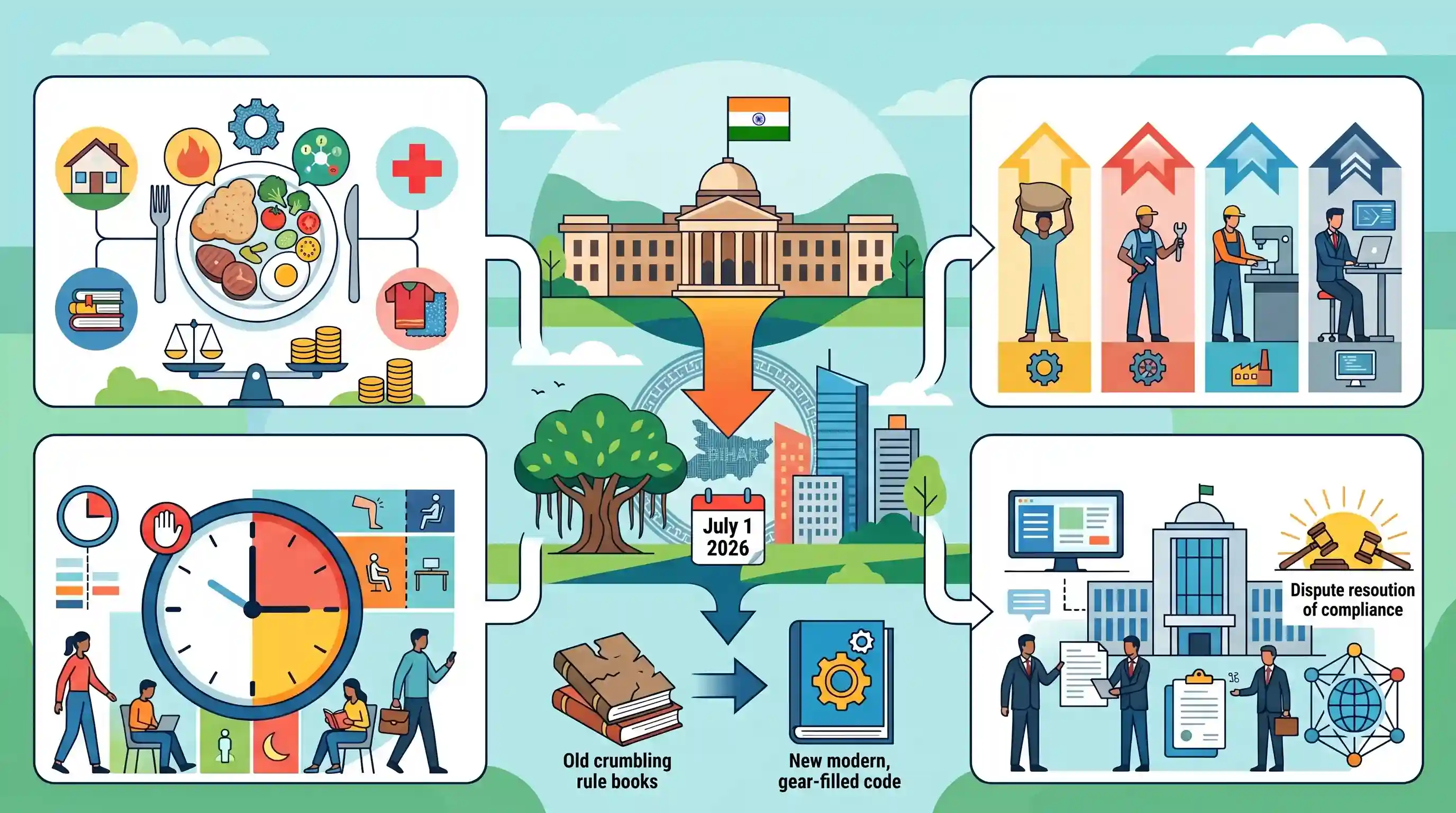
The Bihar Government has notified the Code on Wages (Bihar) Rules, 2026 under Section 67 of the central Code on Wages, 2019, taking effect on July 1, 2026. This landmark notification supersedes the state's decades-old Bihar Payment of Wages Rules, 1937, and Bihar Minimum Wages Rules, 1951. It updates the state's labor regulations with structured minimum wage calculation metrics (including a 2,700-calorie daily consumption standard and specific spending ratios), a four-tier skill categorization, working-hour limits, and modernized administrative authorities for handling wage-related disputes and compliance.
Key Points
- Notified on June 30, 2026, and entered into force on July 1, 2026, superseding the Bihar Payment of Wages Rules, 1937, and the Bihar Minimum Wages Rules, 1951.
- Rule 3 outlines standard minimum wage calculation parameters: standard working-class family (worker, spouse, and two children), 2,700 calories per day per consumption unit, 66 meters of clothing per family per year, housing expenses at 10% of food & clothing expenses, fuel/digital communication at 20% of minimum wages, and education/medical/recreation at 25% of minimum wages.
- Rule 4 categorizes occupations into four skill classes (Unskilled, Semi-skilled, Skilled, and Highly skilled), factoring in geography (metropolitan, non-metropolitan, rural) and experience. Minimum wages cannot fall below the central floor wage.
- Rule 5 directs Variable Dearness Allowance (VDA) to be revised twice a year (prior to April 1 and October 1) according to the Consumer Price Index (CPI) published by the Labour Bureau.
- Rules 6-9 limit the standard working week to 48 hours and restrict quarterly overtime to a maximum of 144 hours, which requires written consent from the employee.
- Rule 13 appoints the Deputy Labour Commissioner as the authority for wage claims, while Rule 42(4) designates the Labour Commissioner (or an officer at/above the rank of Joint Labour Commissioner) as the appellate authority.
- Rule 45 allows the compounding of certain offences at 50% of the maximum prescribed statutory fine under Section 56 of the parent Code.
Important Terms
Code on Wages, 2019

A central Indian legislation consolidating four major labor laws to standardize wage payments, minimum wage calculations, and bonuses across all employment sectors.
UPSC context
GS Paper III (Indian Economy/Labour Reforms): Vital for analyzing legislative consolidation, worker welfare, and economic formalization.
Code on Wages (Bihar) Rules, 2026
State-specific administrative guidelines notified by Bihar under Section 67 of the Central Wage Code, establishing frameworks for minimum wages, working hours, and compliance.
UPSC context
GS Paper II (Federalism/State Policies): Demonstrates state-level execution of central frameworks and localized welfare management.
State Advisory Board
A statutory tripartite body constituted by a state government to advise on minimum wage fixation, gender opportunities, and wage-related disputes.
UPSC context
GS Paper II (Statutory Bodies): Tests understanding of consultative governance mechanisms in labor relations and welfare policies.
Bihar Minimum Wages Rules, 1951
Decades-old state labor regulations framed under the Minimum Wages Act, 1948, to govern and revise wage levels, superseded in 2026.
UPSC context
GS Paper III (Indian Economy): Evaluates the historical evolution and regulatory transition of regional labor protection frameworks.
Bihar Payment of Wages Rules, 1937
Pre-independence state-level rules designed to prevent arbitrary wage deductions and ensure regular disbursements, replaced by the modern 2026 guidelines.
UPSC context
GS Paper I (Modern History) & GS Paper III: Highlights transition from colonial-era labor laws to post-independence reforms.
Prelims Trap
Under the Code on Wages, 2019, the floor wage is determined individually by each State Government to match regional inflation.
The Central Government, not the State, sets the national/regional floor wage. State-notified minimum wages cannot fall below this central baseline.
Static Concepts Connected
What is the tripartite wage hierarchy recognized under Indian labor jurisprudence?
- Minimum Wage: Statutory minimum covering bare subsistence and essential medical/educational needs; must be paid irrespective of the employer's capacity to pay.
- Fair Wage: An intermediate wage above minimum wage but below living wage, adjusted according to the industry's capacity to pay and general economic productivity.
- Living Wage: The ideal standard under DPSP Article 43, providing comfort, social security, and protection against misfortune; represents the highest level in the wage hierarchy.
What is the historical origin of India's need-based minimum wage calculation?
- 15th ILC (1957): Established the foundational scientific formula incorporating 2,700 calories per day, 3 consumption units, and 66 meters of clothing per family per year.
- Reptakos Brett Case: In 1991, the Supreme Court added a 20% to 25% allocation for children's education, medical requirements, and recreation to the ILC formula.
Cross-Topic Patterns
Concurrent List federalism in labor codes
While the Centre consolidates labor laws, states retain rule-making autonomy. This creates policy variations, such as Bihar explicitly codifying welfare parameters the Centre omitted.
DPSP translation to statutory rights
The evolution of Article 43 (living wage) into a justiciable minimum wage ceiling showcases how non-enforceable DPSP principles gradually solidify into rights-based statutory laws.

The legal distinction between Floor Wage (Central) and Minimum Wage (State) under Concurrent List dynamics will be tested in 2026.
Linked PYQs · 2
Linked PYQs · 2
- 2016BPSC_PRELIMSGS1
Which of the following is/are listed among the Directive Principles in Part-IV of the Constitution of India? I. Equal Pay for Equal Work II. Uniform Civil Code III. Small family norm IV. Education through mother tongue at primary level
- 2025BPSC_PRELIMSGS1
According to PLFS 2023-24, which of the following statements best describe the nature of employment among women in Bihar?
