Bihar Moves Supreme Court Against Quota Hike Ruling
Source:The Hindu ↗
Why It Matters
This case has massive implications for affirmative action policies, federal dynamics, and the legal limits of reservations exceeding the 50% cap in India.
Summary
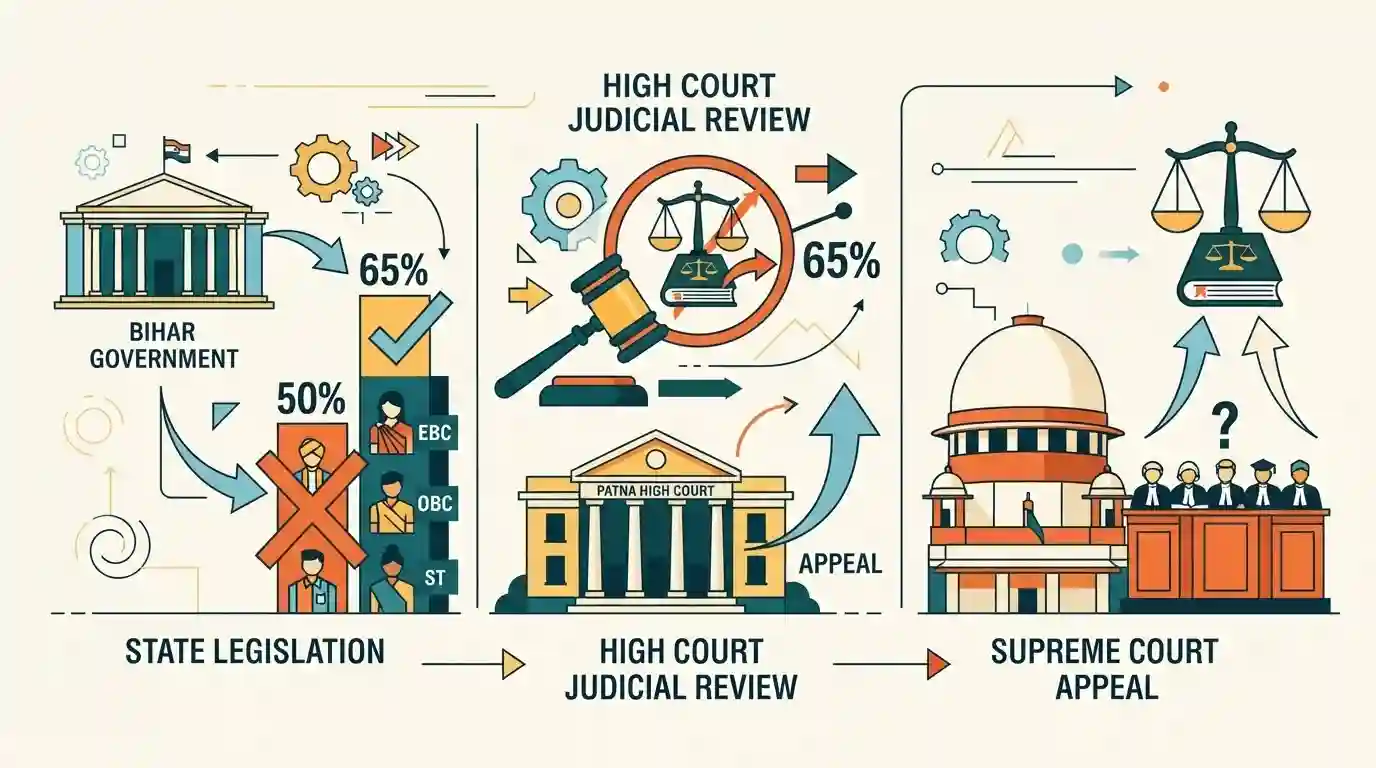
The Bihar government has appealed to the Supreme Court against the Patna High Court order that struck down the State's hike in reservation limits from 50% to 65% for backward classes, SCs, and STs in jobs and educational institutions.
Key Points
- The Bihar government moved the Supreme Court challenging the Patna High Court's decision to set aside the State's increased quota of 65% reservation for Scheduled Castes, Scheduled Tribes, and Other Backward Classes.
- The Patna High Court had earlier struck down the amendments made by Bihar raising reservations from 50% to 65% in educational institutions and government jobs, calling it ultra vires and violative of the equality provisions.
- The legal battle centers around the 50% ceiling limit on reservations established in landmark Supreme Court judgments like Indira Sawhney.
Important Terms
Supreme Court

India's highest judicial tribunal, which holds appellate jurisdiction over high court rulings and interprets constitutional matters like fundamental rights and reservation caps.
UPSC context
Important for GS Paper II (Indian Polity - Judiciary, Judicial Review, and Constitutional Interpretation).
Patna High Court
The highest constitutional court of Bihar, which exercises judicial review over state legislations and executive actions.
UPSC context
Crucial for BPSC and GS Paper II (State Judiciary, High Court Powers, and Centre-State legal disputes).
Bihar Government
The executive and legislative authority administering the state of Bihar, responsible for framing policies, enacting laws, and implementing welfare measures.
UPSC context
Relevant for BPSC Mains and Prelims (Bihar Governance, State Policies, and Reservation Policy).
Static Concepts Connected
What are the key constitutional provisions and judicial precedents governing reservation in India?
- Article 16(4): Article 16(4) empowers the State to make provisions for the reservation of appointments in favor of any backward class of citizens not adequately represented in public services.
- Indira Sawhney Case: Indira Sawhney v. Union of India (1992) established the absolute 50% ceiling limit on reservations, except in extraordinary circumstances like far-flung remote areas.
- Articles 15(4) & (5): Articles 15(4) and 15(5) enable special provisions for advancement of socially and educationally backward classes or SCs/STs in educational institutions.
Cross-Topic Patterns
Reservation Caps vs. EWS Amendments
The 50% ceiling rule under Article 16 is tested alongside the 103rd Constitutional Amendment (EWS quota) which pushed total caps beyond 50% nationally.
Caste Surveys and Federal Data Powers
Caste-based surveys used to justify quota hikes connect directly to Census debates, federal data collection powers, and Article 340 provisions.

Expect a multi-statement question on the 50% ceiling limit from Indira Sawhney and the constitutional validity of breaching it.
Linked PYQs · 1
Linked PYQs · 1
- 2024-EBPSC_PRELIMSGS1
Which community was categorized as Scheduled Caste (SC) by a 2015 Bihar government notification which was quashed in July 2024 by the Supreme Court, ruling that states cannot make changes to the SC list published under Article 341 of the Constitution?
