Darbhanga and Madhubani Sugar Mills: Agro-Industrial Revival in Bihar
Source:newsonair ↗
Why It Matters
This article highlights key state government interventions in multiple sectors—reviving agro-based industries (sugar mills), improving urban water infrastructure (AMRUT 2.0), and promoting agricultural sustainability (PMKSY, biogas). These are highly testable topics for BPSC Prelims, especially regarding regional economic development and specific district-level initiatives.
Summary
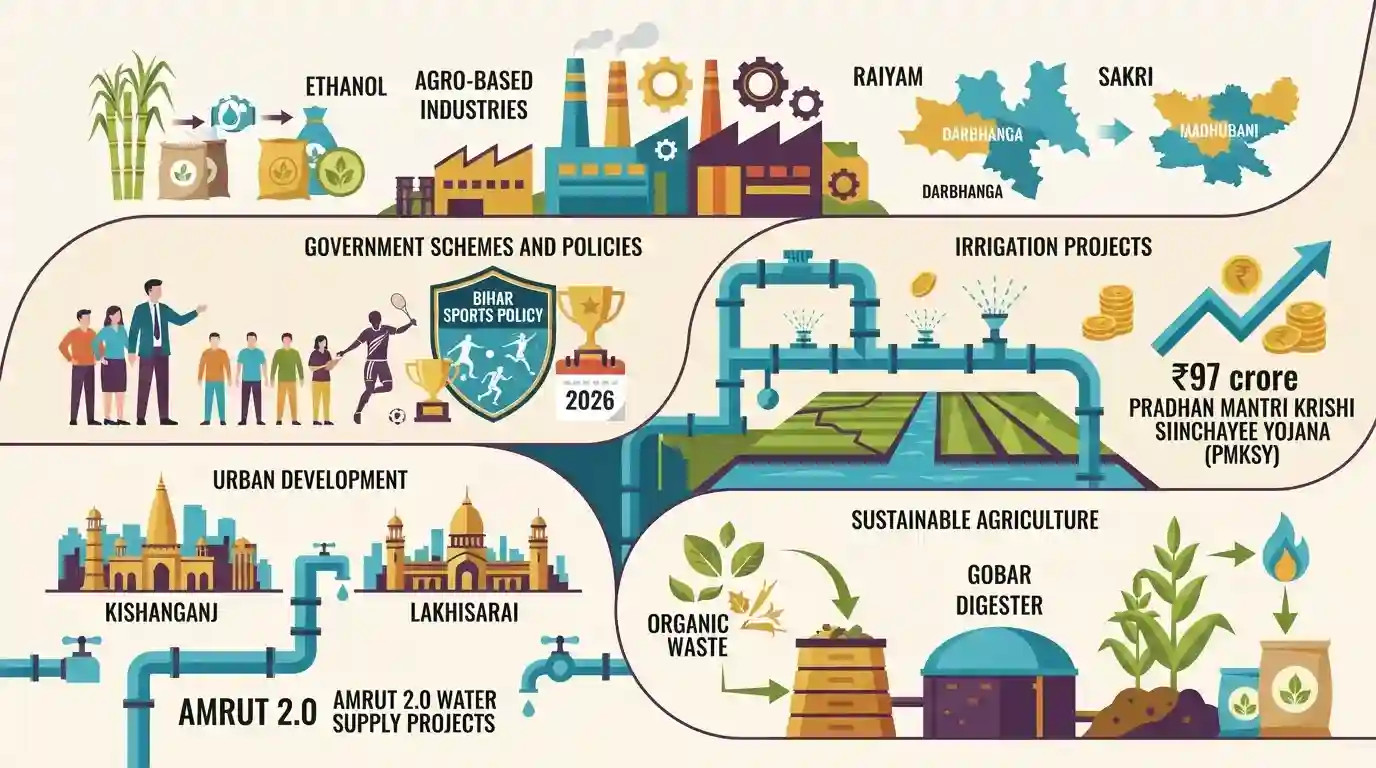
The Bihar Government, led by Chief Minister Samrat Choudhary, has approved the reopening of closed sugar mills at Raiyam in Darbhanga and Sakri in Madhubani. In addition to passing the Bihar Sports Policy 2026, the cabinet cleared projects worth over ₹97 crore under the Pradhan Mantri Krishi Sinchayee Yojana (PMKSY). To bolster urban infrastructure, water supply projects for Kishanganj and Lakhisarai were sanctioned under AMRUT 2.0. The government will also establish vermicompost and gobar biogas units in every district to encourage sustainable agriculture.
Key Points
- The Bihar Cabinet approved the reopening of closed sugar mills located in Raiyam (Darbhanga) and Sakri (Madhubani) to boost local agro-based industry.
- Schemes worth over ₹97 crore were sanctioned under the Pradhan Mantri Krishi Sinchayee Yojana (PMKSY) for the financial year 2026-27.
- Under the AMRUT 2.0 scheme, significant funds were allocated for the Kishanganj and Lakhisarai Water Supply Projects.
- The state government decided to establish pucca vermicompost, commercial vermicompost, and gobar biogas units across all districts to promote sustainable agricultural practices.
- The state cabinet also gave its nod to the Bihar Sports Policy, 2026.
Important Terms
Pradhan Mantri Krishi Sinchayee Yojana (PMKSY)

A centrally sponsored umbrella scheme launched in 2015 to expand agricultural irrigation coverage (Har Khet ko Pani), enhance water-use efficiency (Per Drop More Crop), and promote sustainable conservation, recently extended till 2026.
UPSC context
Crucial for GS Paper 2 & 3 (Agriculture/Government Schemes), testing policies for water management, agricultural productivity, and rural development.
AMRUT 2.0
A centrally sponsored urban infrastructure scheme launched in 2021 targeting universal tap water supply across statutory towns, effective sewerage management, rejuvenation of water bodies, and fostering a circular economy of water.
UPSC context
Relevant for GS Paper 2 (Government Policies) and GS Paper 1 (Urbanization), testing sustainable urban planning and water security initiatives.
Bihar Sports Policy 2026
A state policy aimed at scouting, nurturing, and retaining talent through the Bihar State Sports Scholarship Scheme, a Talent Identification Programme, and comprehensive grassroots infrastructure development to enhance regional sports culture.
UPSC context
Important for GS Paper 2 (Social Sector) and State PSCs, assessing regional capacity-building, youth empowerment, and human resource development strategies.
Prelims Trap
"AMRUT 2.0 aims to provide universal coverage of water supply only in 500 selected cities."
While AMRUT 1.0 targeted only 500 cities, AMRUT 2.0 expanded the mandate to provide universal coverage of water supply to *all* statutory towns in India.
Static Concepts Connected
Why are sugar mills traditionally located in close proximity to sugarcane cultivation areas?
- Weight-losing material: Sugarcane is a weight-losing raw material, meaning the final sugar output weighs significantly less than the bulky cane, making long transport uneconomical.
- Sucrose degradation: The sucrose content in harvested cane begins to decline rapidly, requiring it to be crushed within 24 hours of cutting to maximize yield.
- High transport costs: Transporting bulky sugarcane over long distances costs substantially more than transporting the refined, processed sugar to consumer markets.
What are the core components of the Pradhan Mantri Krishi Sinchayee Yojana (PMKSY)?
- AIBP: Focuses on the rapid completion of ongoing major and medium national irrigation projects.
- Har Khet Ko Pani: Aims at creating new water sources, repairing, restoring, and renovating water bodies, and command area development.
- Per Drop More Crop: Promotes precision water application devices like drip and sprinkler systems to enhance water use efficiency at the farm level.
- Watershed Development: Involves effective management of runoff water, improved soil and moisture conservation, and ridge area treatment.
Cross-Topic Patterns
Sugar Mills & Ethanol Blending Targets
The revival of closed sugar mills strongly aligns with the National Policy on Biofuels, as surplus sugarcane and B-heavy molasses are increasingly redirected to meet the E20 ethanol blending targets.
AMRUT 2.0 & Circular Water Economy
AMRUT 2.0 mandates City Water Balance Plans (CWBPs), marking a major policy shift from merely creating urban water supply infrastructure to establishing a circular economy based on treated wastewater reuse.

Expect a 2026 prelims question linking sugarcane's weight-losing nature to ethanol blending policies and shifting mill locations.
Linked PYQs · 5
Linked PYQs · 5
- 2023BPSC_PRELIMSGS1
Which food industry dominates among the agro-based industries in Bihar?
- 2018BPSC_PRELIMSGS1
Which type of industries has potentials and prospects in Bihar?
- 2020BPSC_PRELIMSGS1
The objective of PM-KUSUM Scheme is
- 2025BPSC_PRELIMSGS1
Which organization jointly developed the National Urban Innovation Stack (NUIS) Digital Blueprint with the Ministry of Housing and Urban Affairs (MoHUA)?
- 2023BPSC_PRELIMSGS1
The first ‘floating solar power plant’ has been built at which place in Bihar?
