NMC Approves Additional MBBS Seats for Bihar Colleges
Source:medical-dialogues ↗
Why It Matters
The significant increase in medical seats reflects the state's focus on building its healthcare and educational infrastructure. For BPSC Prelims, candidates should be aware of major capacity-building measures, state health facilities, and relevant regulatory bodies like the NMC.
Summary
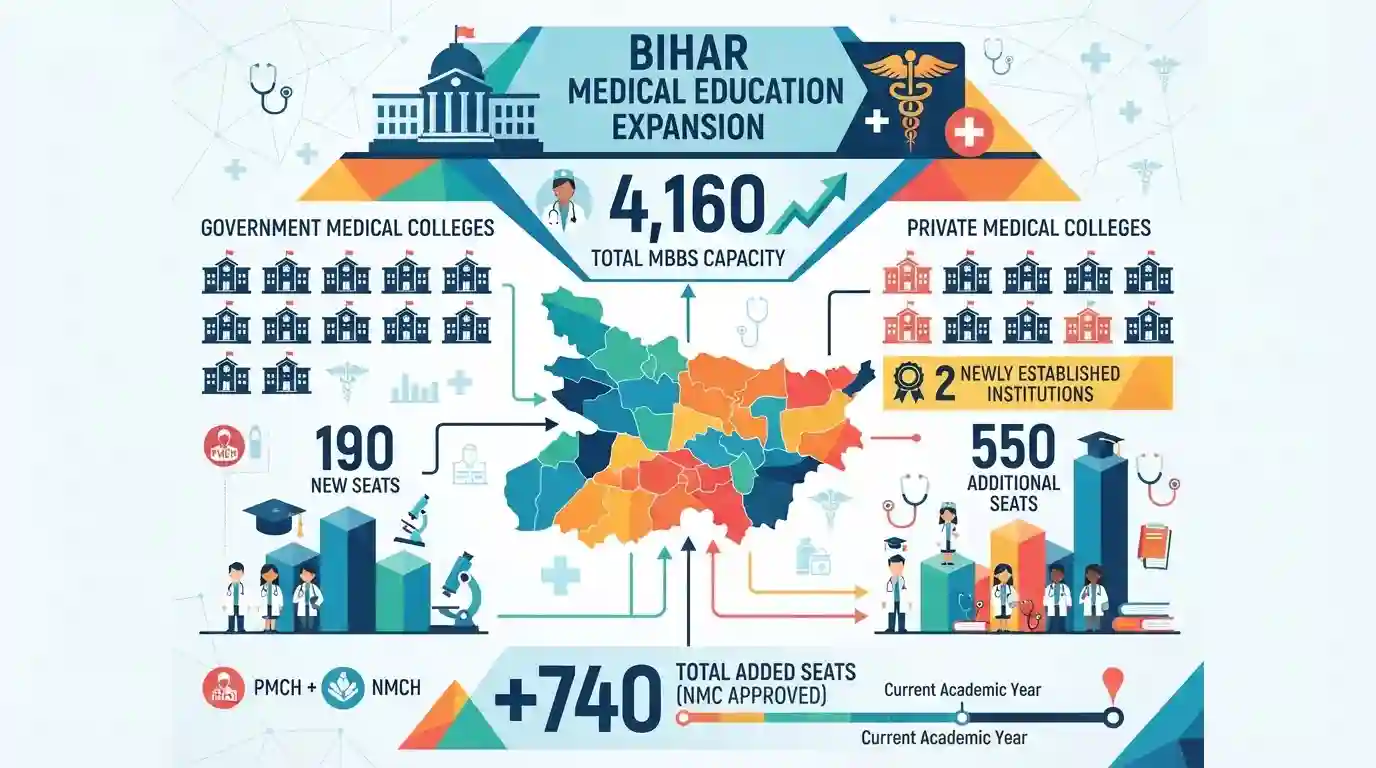
The National Medical Commission (NMC) has approved a significant addition of 740 MBBS seats across 26 medical colleges in Bihar for the current academic session. The increase brings the state's total MBBS capacity to 4,160. Specifically, 190 new seats were distributed among 12 government medical colleges, including PMCH and NMCH in Patna. Meanwhile, 14 private medical colleges received 550 additional seats, which includes the approval of two newly established private medical institutions. This expansion aims to bolster healthcare infrastructure and educational opportunities within the state.
Key Points
- The National Medical Commission (NMC) has approved 740 additional MBBS seats in Bihar.
- This expansion brings the total number of MBBS seats in the state from 3,420 to 4,160.
- 12 government medical colleges added a total of 190 seats, increasing their capacity from 1,520 to 1,710.
- 14 private medical colleges secured 550 additional seats, and two new private medical colleges were approved.
Important Terms
National Medical Commission (NMC)

India's apex statutory regulatory body for medical education and practice, established to replace the Medical Council of India (MCI). It aims to ensure quality, transparency, and the availability of adequate medical professionals nationwide.
UPSC context
Crucial for GS-II (Statutory Bodies, Health, Governance) to analyze medical education reforms, quality standards, and healthcare access regulations.
Patna Medical College Hospital (PMCH)
Established in 1925 as the Prince of Wales Medical College, PMCH is Bihar’s oldest and premier government medical institution. It plays a foundational role in the state's public healthcare delivery and medical education.
UPSC context
Relevant for GS-II (Health, Human Resources) when discussing the historical evolution, capacity building, and infrastructural modernization of state-level public health facilities.
Darbhanga Medical College and Hospital (DMCH)
A major government medical college in Bihar that serves as a critical healthcare and medical training hub. It recently received NMC approval for increased MBBS seats to bolster regional medical infrastructure.
UPSC context
Fits into GS-II (Social Sector, Health) discussions regarding equitable healthcare distribution, regional capacity expansion, and bridging rural-urban medical divides.
Nalanda Medical College Hospital (NMCH)
A significant government medical institution situated in Patna, Bihar. Its recent capacity expansion is part of a broader state initiative to enhance medical education opportunities and augment the regional healthcare workforce.
UPSC context
Useful for GS-II (Health, Governance) context regarding state initiatives to improve the doctor-patient ratio and strengthen tertiary healthcare infrastructure.
Sri Krishna Medical College and Hospital (SKMCH)
A prominent government medical college located in Muzaffarpur, Bihar. Essential for healthcare delivery in North Bihar, its capacity was recently upgraded to improve public health resources and medical training.
UPSC context
Relevant for GS-II (Health) when evaluating state-level health infrastructure, especially in managing regional outbreaks and expanding medical resources.
Prelims Trap
"Both public health and medical education fall under the Concurrent List of the Seventh Schedule."
Public health and sanitation are firmly in the State List (Entry 6). However, medical education falls under the Concurrent List (Entry 25).
Static Concepts Connected
What is the regulatory structure of the National Medical Commission (NMC)?
- Statutory Authority: Established by the NMC Act 2019, it replaced the Medical Council of India (MCI) to serve as the apex statutory regulator for medical education and practice.
- Composition: Features a 33-member commission largely nominated by the central government, pivoting away from the heavily election-based model of the erstwhile MCI to prevent regulatory capture.
- Autonomous Boards: Operates through four autonomous boards: Under-Graduate, Post-Graduate, Medical Assessment and Rating (MARB), and Ethics and Medical Registration.
How does the Seventh Schedule distribute responsibilities for healthcare?
- State List: Public health, sanitation, hospitals, and dispensaries fall under Entry 6 of the State List, giving states primary responsibility for healthcare delivery.
- Concurrent List: Education, including technical and medical education, falls under Entry 25 of the Concurrent List, allowing the Center to set nationwide standards (like NEET/NMC).
- Infectious Diseases: The prevention of infectious diseases spreading from one state to another falls under Entry 29 of the Concurrent List.
Cross-Topic Patterns
Privatization of Medical Education
74% of the new seats in Bihar went to private colleges. This reflects a broader national trend of commercialized medical education, raising concerns over equity and high out-of-pocket healthcare expenditure.
Infrastructure vs. Human Capital in Health
While schemes like PM-ABHIM build physical infrastructure, expanding MBBS seats addresses human resource deficits, targeting the WHO benchmark of a 1:1000 doctor-to-population ratio crucial for Universal Health Coverage.

Expect a GS2 Mains question on the privatization of medical education, commercialization concerns, and the regulatory efficacy of the NMC.
Linked PYQs · 2
Linked PYQs · 2
- 2024-EBPSC_PRELIMSGS1
Which sector received the highest allocation in the Bihar Budget 2024-25?
- 2022BPSC_PRELIMSGS1
The new ministry proposed in the Bihar Budget for the year 2021-22 focuses on
