Bihar Minority Welfare Department Announces New Residential Schools
Source:indianmasterminds ↗
Why It Matters
BPSC frequently asks questions about state-specific welfare schemes, particularly those related to education, minority empowerment, and skill development (e.g., Mission Daksh, Kanya Utthan Yojana). Understanding the Chief Minister Entrepreneur Scheme and the expansion of minority schools is essential for tackling state-current affairs.
Summary
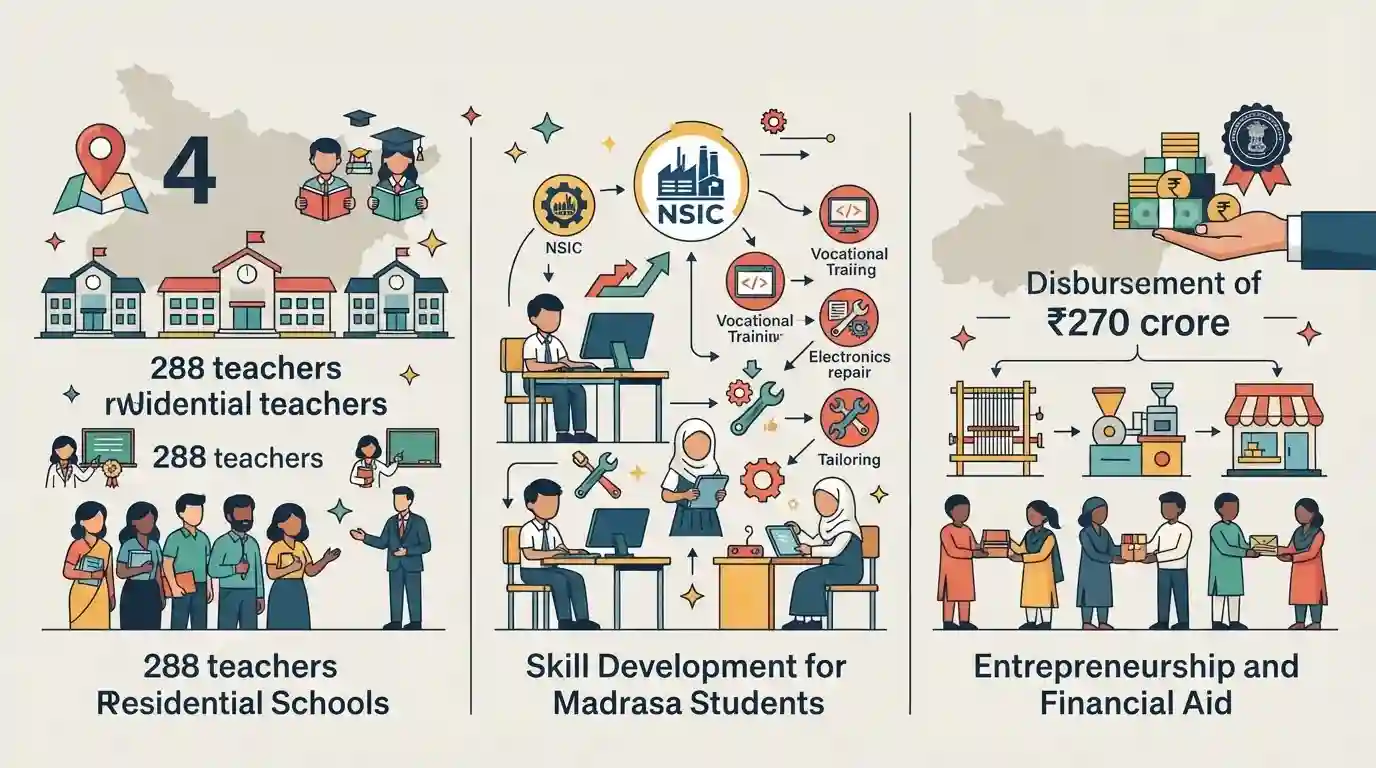
The Bihar government is set to inaugurate four new Minority Residential Schools in Jamui, Nalanda, Kaimur, and Muzaffarpur as part of its initiative to have one such school per district. To support this, 288 teachers are being recruited. Additionally, the state is expanding skill development for madrasa students via NSIC and has disbursed ₹270 crore to minority entrepreneurs under the Chief Minister Entrepreneur Scheme.
Key Points
- The Bihar government will open four new Minority Residential Schools on August 17 in Jamui, Nalanda, Kaimur, and Muzaffarpur.
- This aligns with the state's objective of establishing one minority residential school in each district; two are already functional in Darbhanga and Kishanganj.
- The government has submitted a requisition to BPSC to recruit 288 teachers through TRE-4 specifically for these minority schools.
- A skill development initiative for madrasa students is being developed in collaboration with the National Small Industries Corporation (NSIC).
- Under the Chief Minister Entrepreneur Scheme targeting minorities, loans worth ₹270 crore have been disbursed to 3,741 beneficiaries to promote entrepreneurship.
Important Terms
Mukhyamantri Udyami Yojana

A Bihar state enterprise promotion scheme providing up to ₹10 lakh (50% non-repayable grant, 50% low-or-zero-interest loan) to foster entrepreneurship among youth, women, SC/ST, and minority communities.
UPSC context
GS Paper 2 (Welfare Schemes) and GS Paper 3 (Employment); tests state-level interventions for economic inclusion.
State Coaching Scheme
A Bihar government minority welfare initiative that provides free residential coaching and guidance for major competitive exams (like BPSC, JEE, NEET) to students from minority communities.
UPSC context
GS Paper 2 (Education, Social Justice); highlights state efforts for affirmative action and mainstreaming marginalized communities.
National Small Industries Corporation (NSIC)
A Mini Ratna PSU under the Ministry of MSME that aids the growth of micro, small, and medium enterprises in India by providing marketing, credit, technology, and skill development support.
UPSC context
GS Paper 3 (Industrial Growth, MSME Sector) and Prelims; relevant for topics on PSUs and skill development.
Bihar Public Service Commission (BPSC)
The constitutional body authorized to conduct civil services and allied administrative examinations for the state of Bihar, responsible for merit-based recruitment to state government posts.
UPSC context
GS Paper 2 (Constitutional Bodies, State Administration); tests knowledge of state-level recruitment mechanisms.
Prelims Trap
"Skill development for madrasa students via NSIC is executed under the Ministry of Minority Affairs."
NSIC (National Small Industries Corporation) operates under the Ministry of MSME, not the Ministry of Minority Affairs. UPSC often tests nodal ministry mismatches.
Static Concepts Connected
What are the Constitutional safeguards for minority educational institutions?
- Article 30(1): Grants all minorities, whether based on religion or language, the right to establish and administer educational institutions of their choice.
- Article 30(2): Prohibits the State from discriminating against any educational institution on the ground that it is under minority management when granting financial aid.
- Regulatory Power: The State can still prescribe reasonable regulations regarding academic standards, syllabus, and health/sanitation for these institutions to ensure excellence.
What is the mandate of the National Small Industries Corporation (NSIC)?
- Nodal Ministry: It operates as a Mini Ratna Public Sector Enterprise under the Ministry of Micro, Small and Medium Enterprises (MSME).
- Core Objective: It promotes, aids, and fosters the growth of MSMEs in the country by providing integrated support services in marketing, technology, and finance.
- Skill Development: It runs Technical Services Centres to impart technical training and skill upgrading, bridging the gap between traditional education and modern employability.
Cross-Topic Patterns
Madrasa Modernization + MSME Integration
Linking traditional madrasa education with secular skill development via MSME bodies (like NSIC) offers a replicable governance model for minority inclusion and demographic dividend utilization.
State-led vs Central Minority Welfare
While the Centre focuses on Eklavya schools for STs, states are increasingly launching parallel residential school and entrepreneurship schemes for minorities, showcasing decentralized competitive welfarism.

Mains GS2 may ask to evaluate state-level models integrating traditional minority education (madrasas) with modern MSME skill frameworks.
Linked PYQs · 3
Linked PYQs · 3
- 2025BPSC_PRELIMSGS1
What is the primary objective of Bihar’s Mission Daksh?
- 2022BPSC_PRELIMSGS1
The new ministry proposed in the Bihar Budget for the year 2021-22 focuses on
- 2018BPSC_PRELIMSGS1
Which of the following is not true about Bihar's Mukhyamantri Kanya Utthan Yojana?
