Judicial Commission Inspects Site in Bhojpur Encounter Probe
Source:thehindu ↗
Why It Matters
The article highlights the creation of a judicial commission of inquiry in Bihar, led by former Patna HC Judge and former Bihar Human Rights Commission (BHRC) Chairman Vinod Kumar Sinha. In BPSC Prelims, understanding the background of key judicial figures, state-level commissions (like the BHRC), and the roles of state executives (like CM Samrat Choudhary) is of high importance for state polity questions.
Summary
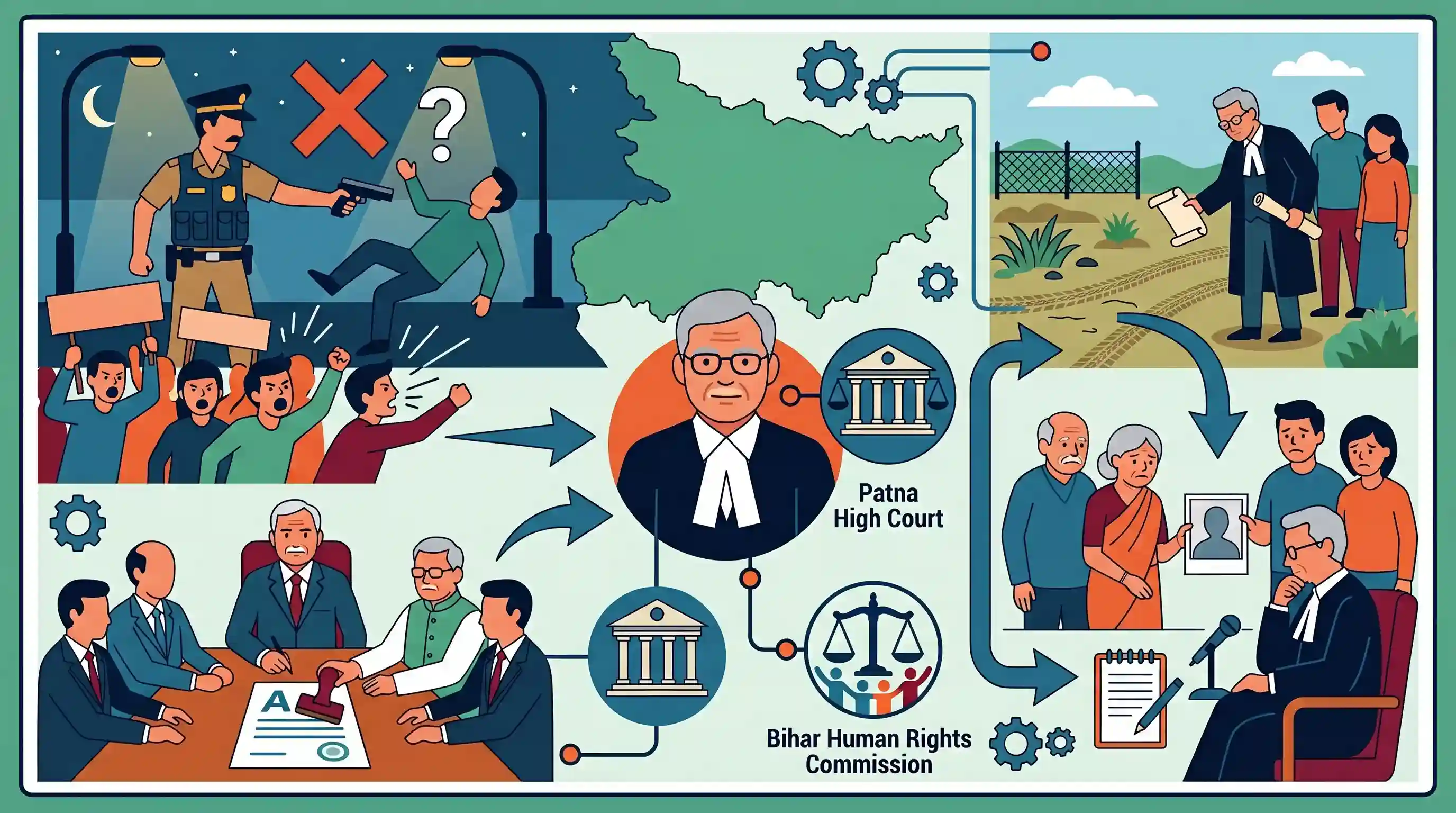
A judicial commission headed by former Patna High Court Judge Vinod Kumar Sinha has commenced an investigation into the alleged fake encounter of 28-year-old Bharat Bhushan Tiwari in Bhojpur, Bihar. The commission was approved by the Bihar cabinet chaired by Chief Minister Samrat Choudhary following intense public and political outcry. Justice Sinha, a seasoned judicial officer who previously served as the chairperson of the Bihar Human Rights Commission, visited the spot and met with the victim's family to record statements.
Key Points
- A 28-year-old youth named Bharat Bhushan Tiwari was killed in an alleged fake encounter by local police on June 17, 2026, in Bilauti village, Bhojpur district, Bihar.
- The NDA-led Bihar government, headed by Chief Minister Samrat Choudhary, approved the constitution of an independent judicial commission on June 24, 2026, to probe the encounter.
- Retired Patna High Court Judge Vinod Kumar Sinha was appointed to head the judicial commission and visited the site and family of the deceased on June 25, 2026.
- Justice Vinod Kumar Sinha graduated from Patna Law College in 1983, joined Bihar Superior Judicial Service in 1997, and served as Registrar General of the Patna HC before his elevation as an Additional Judge in 2016.
- Justice Sinha also previously served as the Chairman of the Bihar Human Rights Commission (BHRC) from July 2020 to July 6, 2023.
Important Terms
Commissions of Inquiry Act, 1952

A central statute empowering Central or State governments to set up formal commissions to investigate definite matters of public importance, granting them civil court powers for summoning and evidence-gathering.
UPSC context
GS Paper II: Polity & Governance; tests knowledge of statutory bodies, investigative commissions, and center-state legislative jurisdictions.
Bihar Human Rights Commission
A statutory body established in 2000 under the Protection of Human Rights Act, 1993, to safeguard human rights and investigate abuses or public negligence in Bihar.
UPSC context
GS Paper II: Statutory Bodies; tests the role, composition, powers, and structural limitations of State Human Rights Commissions.
Patna High Court
The apex judicial institution of Bihar, established in 1916, which exercises original, appellate, and supervisory writ jurisdiction over state subordinate courts under Articles 226 and 235.
UPSC context
GS Paper II: Judiciary; tests understanding of the writ jurisdiction, powers, and administrative control of High Courts over subordinate judiciaries.
Bihar Superior Judicial Service
The higher tier of subordinate judiciary in Bihar, responsible for recruiting District Judges through promotions and direct entry from the bar under Article 233.
UPSC context
GS Paper II: Subordinate Judiciary; tests constitutional provisions on judicial appointments and structural separation of powers at local levels.
Prelims Trap
The Chairperson of a State Human Rights Commission is appointed and can be removed from office by the state Governor.
While the Governor appoints the Chairperson based on a state-level committee's recommendation, only the President of India can remove them.
Static Concepts Connected
What is the appointment and removal process of a State Human Rights Commission (SHRC) Chairperson?
- Appointment Authority: Appointed by the Governor based on recommendations of a committee comprising the Chief Minister, Speaker, State Home Minister, and Leader of Opposition.
- Eligible Candidates: Under the 2019 amendment, a retired Chief Justice or a retired Judge of a High Court is eligible to head the SHRC.
- Removal Safeguard: Can only be removed by the President of India (not the Governor) on grounds of proved misbehaviour or incapacity.
What is the legal status and powers of a Commission of Inquiry under the 1952 Act?
- Judicial Powers: Possesses powers of a civil court under the Code of Civil Procedure (CPC), including summoning witnesses and requisitioning records.
- Legal Nature: Its findings are strictly advisory and recommendatory; they do not constitute a binding judicial verdict on the government.
- Tabling Requirement: The government must lay the report before the legislature within 6 months, accompanied by an action taken memorandum.
Cross-Topic Patterns
Police Reforms + Article 21
Extra-judicial killings violate the right to life and due process, linking state policing machinery to Supreme Court mandates like the PUCL and Prakash Singh directives.
Federalism + Human Rights Administration
The dual structural control of SHRCs—where state leaders recommend appointments but the President retains sole removal power—reflects administrative federalism under the Constitution.

Analytical questions comparing NHRC/SHRC composition pre- and post-2019 amendment, paired with executive removal powers, are highly probable.
Linked PYQs · 1
Linked PYQs · 1
- 2024-EBPSC_PRELIMSGS1
Who presented the Bihar Budget 2024-25 in the State Assembly?
