Supreme Court advises Election Commission on pan-India voter revision
Source:The Hindu ↗
Why It Matters
Electoral integrity is foundational to Indian democracy. The intervention by the Supreme Court to facilitate appeals through legal services highlights the intersection of the right to vote (a constitutional right) and the right to legal aid (Article 39A). This case offers concrete examples for GS-II answers regarding electoral reforms, the functioning of the Election Commission, and access to justice.
Summary
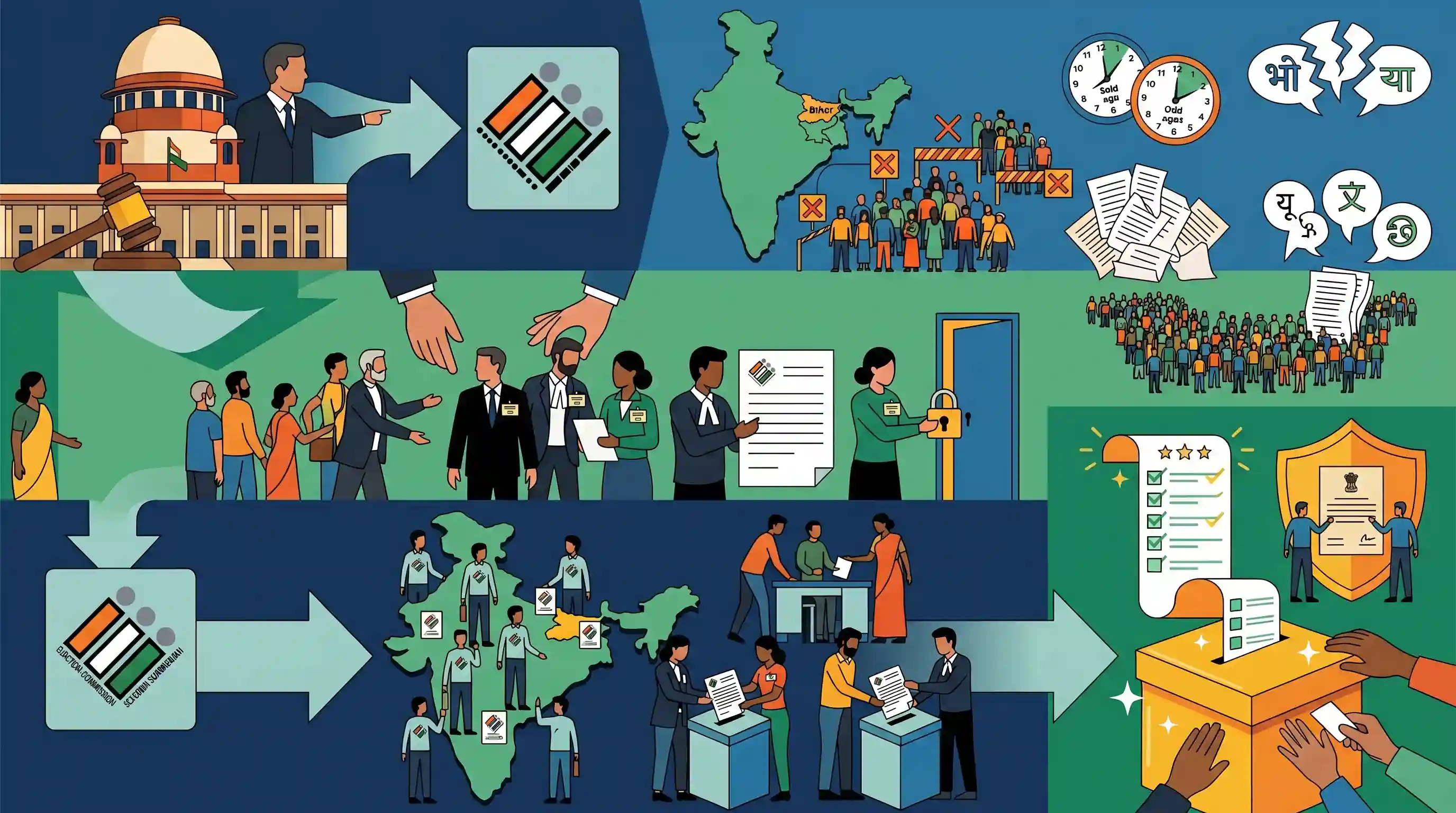
The Supreme Court has instructed the Election Commission of India (ECI) to apply the lessons from the Bihar Special Intensive Revision (SIR) of electoral rolls to the forthcoming pan-India SIR. Following the exclusion of over 3.66 lakh voters in Bihar, the Court intervened by mobilizing paralegal volunteers and legal aid lawyers to assist those excluded in filing appeals. The incident underscores the importance of an error-free electoral roll, highlighting anomalies such as irregular age demographics and language inconsistencies, while showcasing the crucial role of state legal services in safeguarding constitutional rights.
Key Points
- The Supreme Court advised the Election Commission of India (ECI) to utilize lessons learned from the Special Intensive Revision (SIR) of electoral rolls in Bihar for its upcoming pan-India SIR.
- Over 3.66 lakh individuals were excluded from the final voter list in Bihar, raising concerns over anomalies in the electoral roll process.
- To address this, the Supreme Court activated paralegal volunteers and legal aid lawyers via the Bihar State Legal Services Authority to help the excluded citizens file appeals.
- Anomalies pointed out included 100-year-old citizens registering as fresh voters and names appearing in regional languages not native to Bihar (e.g., Kannada, Tamil).
Important Terms
Election Commission of India (ECI)

A constitutional body established under Article 324 to oversee the 'superintendence, direction, and control' of all elections to Parliament and State Legislatures.
UPSC context
GS II (Constitutional Bodies); critical for understanding electoral management and the constitutional independence of the poll panel.
Representation of the People Act, 1950
A 1950 statute providing the legal framework for the preparation and revision of electoral rolls, including the 'Special Intensive Revision' under Section 21(3).
UPSC context
GS II (Electoral Reforms); tests knowledge of the statutory basis for voter registration and constituency delimitation.
Special Intensive Revision (SIR)
A comprehensive, door-to-door verification and update of electoral rolls to ensure accuracy by eliminating duplicates and non-citizens while including all eligible new voters.
UPSC context
GS II (Governance/Elections); highlights administrative processes for maintaining voter list integrity and ensuring inclusive franchise.
State Legal Services Authority (SLSA)
A statutory body under the Legal Services Authorities Act, 1987, providing free legal aid to ensure that opportunities for securing justice are not denied by economic or other disabilities.
UPSC context
GS II (Welfare Schemes/Vulnerable Sections); tests understanding of the institutional mechanism for access to justice and legal empowerment.
Electoral Roll
The official register of all citizens eligible to vote in a specific constituency, updated regularly to uphold the democratic principle of 'one person, one vote.'
UPSC context
GS II (Representation of People); fundamental to the conduct of free and fair elections and protection of voting rights.
Association for Democratic Reforms (ADR)
A non-governmental organization and advocacy group that works for transparency in elections and was a primary petitioner in the Bihar SIR case.
UPSC context
GS II (Role of NGOs/Civil Society); relevant for discussions on electoral transparency and judicial activism in democratic reforms.
Prelims Trap
"The preparation and revision of electoral rolls are governed by the Representation of the People Act, 1951."
RPA 1950 deals exclusively with the allocation of seats, delimitation, and preparation of electoral rolls. RPA 1951 governs the actual conduct of elections and offenses.
Static Concepts Connected
What does the Representation of the People Act, 1950 primarily govern?
- Allocation of Seats: Governs the allocation of seats in the House of the People and State Legislative Assemblies.
- Electoral Rolls: Specifies the preparation, intensive revision, and updating of electoral rolls for Parliamentary and Assembly constituencies.
- Voter Qualifications: Lays down the strict criteria and qualifications of voters for inclusion in the electoral roll.
How do constitutional and statutory frameworks mandate Free Legal Aid in India?
- Article 39A: A Directive Principle (inserted by the 42nd Amendment) mandating the State to provide free legal aid to ensure justice is not denied due to economic disability.
- NALSA 1987: The Legal Services Authorities Act, 1987 created NALSA to establish a nationwide network for providing free, accessible legal services.
- Paralegal Volunteers: Act as community-level intermediaries under NALSA schemes to bridge the gap between marginalized citizens and formal legal institutions.
Cross-Topic Patterns
Judicial Activism + Legal Aid
The Supreme Court using NALSA's paralegals to actively secure a constitutional right (voting) represents a proactive convergence of Article 39A (Free Legal Aid) and Article 326 (Right to Vote).
Voter Roll Anomalies + Aadhaar Linking
Demographic anomalies in Bihar's roll highlight the administrative challenges driving the push for the controversial Aadhaar-Voter ID linkage under the Election Laws (Amendment) Act.

Expect a multi-statement question interlinking RPA 1950 (electoral rolls), Article 326 (Right to Vote), and NALSA's role in securing them.
Linked PYQs · 3
Linked PYQs · 3
- 2017PrelimsGS1
Right to vote and to be elected in India is a
- 2023MainsGS2
Who are entitled to receive free legal aid? Assess the role of the National Legal Services Authority (NALSA) in rendering free legal aid in India.
- 2024MainsGS2
Examine the need for electoral reforms as suggested by various committees with particular reference to "one nation one election" principle.
