Bihar amends Crime Control Act to penalize cyber offenses and leaks
Source:new-indian-express ↗
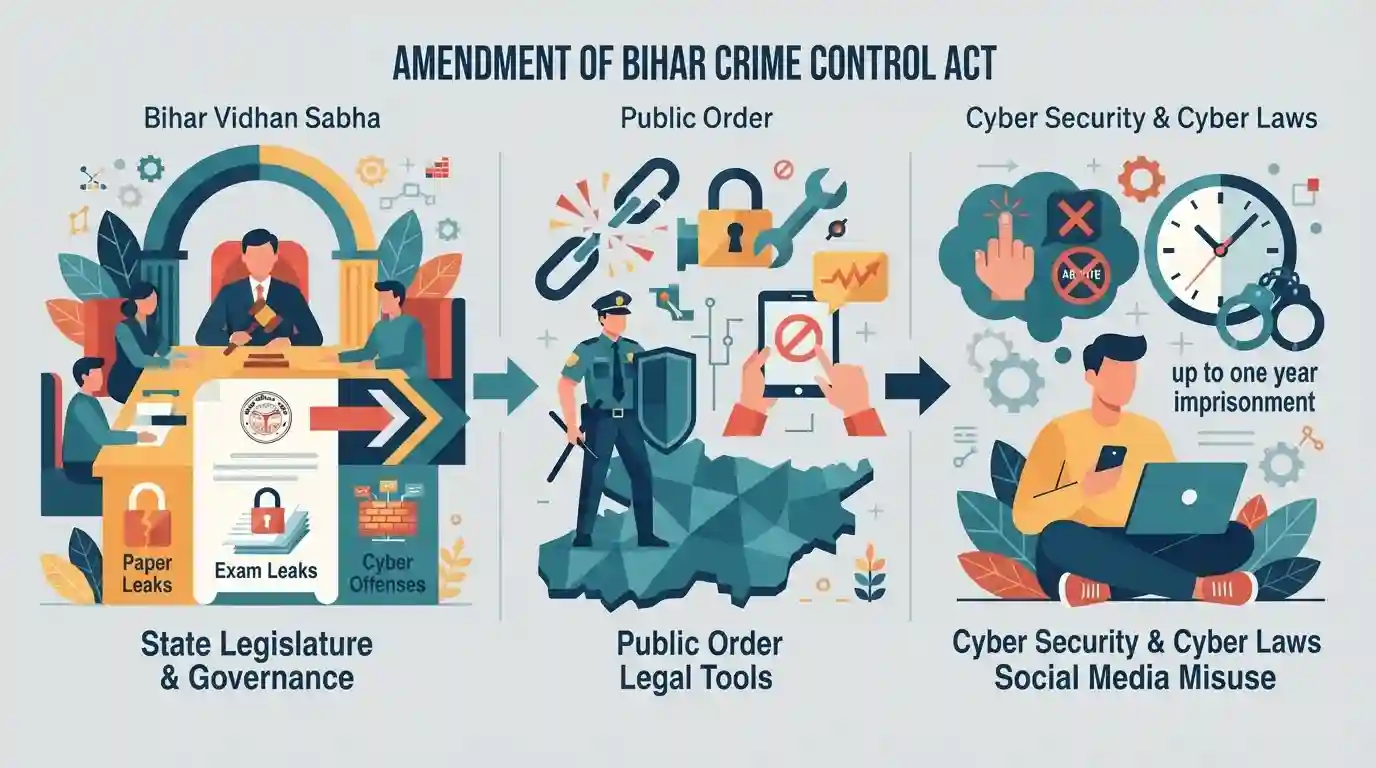
Why It Matters
Paper leaks have become a persistent threat to the integrity of public service and competitive examinations in several states. Bihar's stringent legislative response by expanding the scope of the Goonda Act to cover paper leaks and cyber offences demonstrates an aggressive governance model aimed at protecting youths' career prospects and checking digital misuse.
Summary
The Bihar cabinet, chaired by Chief Minister Samrat Choudhary, has approved an amendment to the Bihar Crime Control Act (CCA), 2024, commonly referred to as the Goonda Act, to include cases of competitive exam paper leaks, cyber offences, and social media misuse. The proposed changes mandate imprisonment of up to one year for making indecent remarks or using abusive language on social media platforms, thereby granting state police stronger legal tools to tackle organized crime and digital offenses.
Key Points
- The Bihar cabinet approved amendments to the Bihar Crime Control Act (CCA), 2024, to bring paper leaks in competitive exams and cybercrimes under the Goonda Act.
- The amendment allows prosecution for using abusive language, obscene words, or indecent remarks on internet-based social media platforms, with imprisonment ranging from six months to one year.
- The move aims to empower police to crack down on organized crime, cybercrimes, and the misuse of digital platforms.
- The Cyber Crime and Security Unit (CCSU) and local cyber police have already been utilizing the Bharatiya Nyaya Sanhita (BNS) and Information Technology Act to register FIRs and remove objectionable social media posts.
Important Terms
Bihar Crime Control Act (CCA) 2024

A state law aimed at curbing organized crime. Recent amendments expanded its scope to include exam paper leaks, cybercrimes, and social media abuse, allowing authorities to use preventive detention to maintain public order.
UPSC context
Relevant for GS-2 (State Legislature) and GS-3 (Internal Security). Highlights state mechanisms addressing organized crime and digital offenses.
Goonda Act
A common designation for state-level preventive detention laws targeting habitual offenders. It empowers authorities to detain anti-social elements without standard trial procedures to prevent activities prejudicial to public order.
UPSC context
Important for GS-2 (Governance). Tests understanding of preventive detention frameworks and their balance with fundamental rights (Article 22).
Bharatiya Nyaya Sanhita (BNS)
India's new official criminal code, effective July 2024, replacing the colonial-era Indian Penal Code (IPC). It modernizes criminal law by introducing distinct offenses for organized crime, terrorism, and community service.
UPSC context
Crucial for GS-2 (Governance). Tests awareness of the recent overhaul of India's criminal justice system and modernization of penal laws.
Information Technology Act
India's primary legislation governing cybercrime, electronic commerce, and digital records. It provides the legal framework to penalize cyber offenses and mandates regulatory compliance guidelines for internet and social media intermediaries.
UPSC context
Vital for GS-3 (Cyber Security) and GS-2 (Governance). Covers digital rights, online platform accountability, and state mechanisms for combating cyber threats.
Prelims Trap
State governments cannot legislate on cyber offences as Information Technology is exclusively within the Union's legislative domain.
While IT is a residuary Union subject, 'Criminal Law' is Concurrent. States can criminalize digital offenses using State laws, provided they receive Presidential assent under Article 254(2).
Static Concepts Connected
How does Article 254(2) handle conflicts between Central and State laws?
- Repugnancy Rule: If a State law on a Concurrent List subject conflicts with a Central law, the Central law generally prevails over the State law.
- Presidential Assent: The State law can prevail within that State if it has been reserved for and received the assent of the President.
- Parliamentary Override: Even after Presidential assent, Parliament can subsequently enact laws to amend, vary, or repeal the repugnant State law.
Why was Section 66A of the IT Act struck down in Shreya Singhal (2015)?
- Vagueness and Overbreadth: The terms used in the section were undefined, creating an overbroad law that criminalized even innocent or constitutionally protected speech.
- Chilling Effect: The unchecked power to arrest for online comments created a severe self-censorship pressure on citizens.
- Article 19(2) Deviation: The Supreme Court ruled that the restriction did not proximately relate to any of the reasonable restrictions under Article 19(2).
Cross-Topic Patterns
Digital policing vs Free Speech
State laws criminalizing online speech to preserve public order risk colliding with Article 19(1)(a) guarantees, reviving constitutional debates on overbroad penal provisions.
Exam leaks & asymmetric federalism
While the Centre targets leaks via the Public Examinations Act 2024, states deploy localized preventive detention, displaying overlapping federal measures to safeguard meritocracy.

2026 Mains: Analyzing state-level 'Goonda Acts' criminalizing online speech under Article 19(1)(a) and federal assent under Article 254(2).
Linked PYQs · 2
Linked PYQs · 2
- 2024-IBPSC_PRELIMSGS1
Which of the following Acts converted Unicameral Legislature of Bihar into Bicameral : Bihar Legislative Assembly and Bihar Legislative Council?
- 2024-IBPSC_PRELIMSGS1
The Vernacular Press Act allowed
