Bihar Launches Online Portal for Electric Vehicle Policy Subsidies
Source:indianmasterminds ↗
Why It Matters
State-level schemes and their specific cutoff dates/components are high-yield for BPSC Prelims. This policy bridges environmental governance (pollution reduction) with economic welfare (employment scheme), aligning with previous questions on Bihar's green initiatives.
Summary
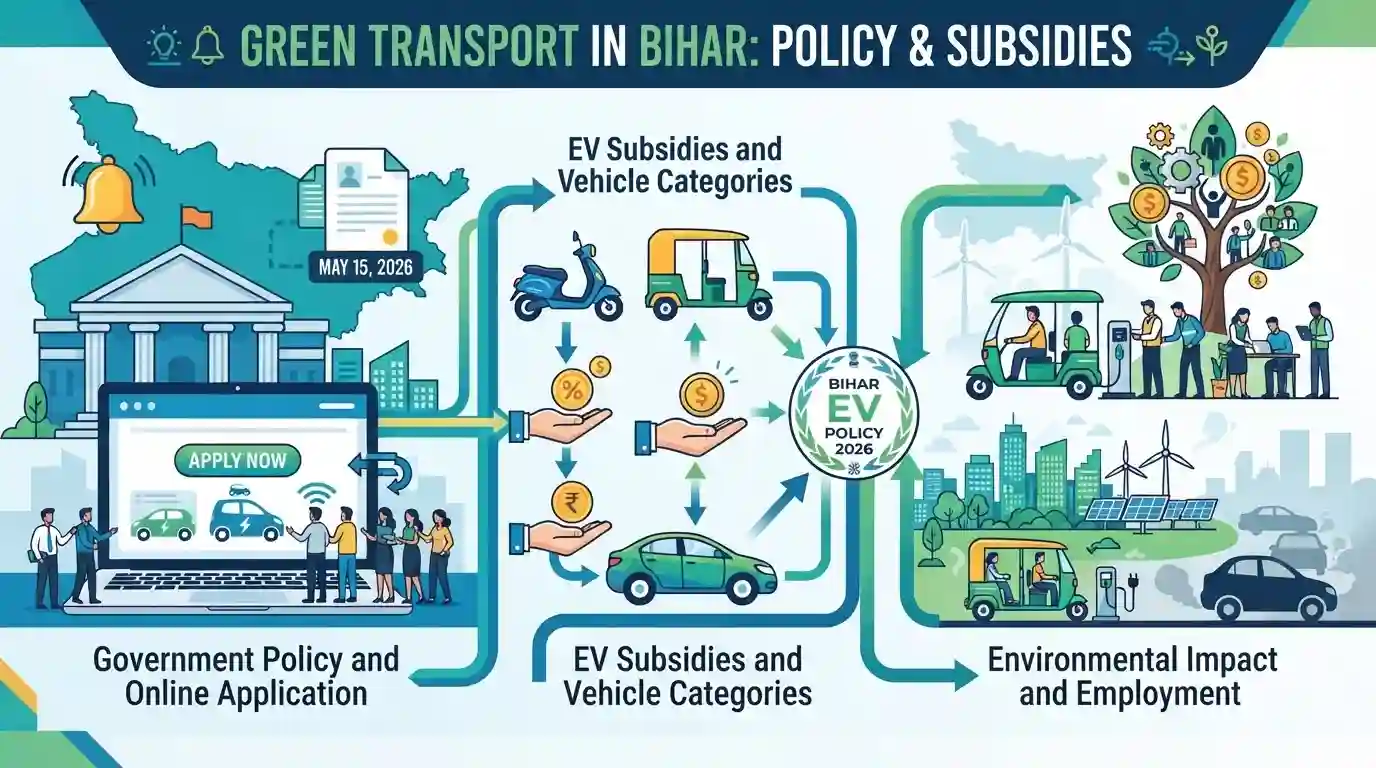
Bihar has opened online applications to disburse subsidies to buyers of electric vehicles under the newly notified Bihar Electric Vehicle Policy 2026. Applicable for EVs purchased from May 15, 2026, the financial benefits cover two-, three-, and four-wheelers and are disbursed under the Mukhyamantri Bihar Eco-friendly Transport Employment Scheme. The initiative underscores Bihar's dual focus on creating self-employment opportunities while systematically shifting towards zero-emission transport to meet its environmental targets.
Key Points
- The Bihar government has launched an online portal for claiming subsidies on Electric Vehicles (EVs) under the Bihar Electric Vehicle Policy 2026.
- Subsidies are applicable for the purchase of electric two-wheelers, commercial three-wheelers, and four-wheelers bought on or after May 15, 2026.
- Financial incentives are provided through the Mukhyamantri Bihar Eco-friendly Transport Employment Scheme, directly linking clean mobility adoption with local employment generation.
- This policy helps align the state's transport infrastructure with its broader goal of achieving a 'pollution-free' status by reducing vehicular carbon emissions.
Important Terms
Bihar Electric Vehicle Policy 2026

A 2026 Bihar government policy targeting 30% electric vehicle adoption by 2030. It provides direct financial subsidies for EV buyers, 50% exemptions on motor vehicle taxes, and incentives for expanding charging infrastructure across the state.
UPSC context
GS Paper 3 (Environment). Tests knowledge of state-level climate action, green mobility transitions, and emission reduction strategies.
Mukhyamantri Bihar Eco-friendly Transport Employment Scheme
A state initiative offering Direct Benefit Transfers (DBT) to purchase electric commercial and passenger vehicles. It specifically incentivizes women and SC/ST buyers, merging green transport adoption with local self-employment generation.
UPSC context
GS Paper 2 & 3 (Welfare Schemes, Employment). Relevant for evaluating socio-economic policies that integrate job creation with inclusive environmental sustainability.
Bihar Electric Vehicle (Amendment) Policy 2026
The official statutory update to Bihar's EV framework, approved in May 2026. It legally formalizes targets like 30% EV registration by 2030, mandates ride-aggregators to electrify fleets, and introduces scrapping incentives for older polluting vehicles.
UPSC context
GS Paper 2 & 3 (Government Policies, Conservation). Important for understanding sub-national statutory amendments supporting India's net-zero goals.
Prelims Trap
"The Mukhyamantri Bihar Eco-friendly Transport Scheme is a dedicated fund for domestic EV manufacturing and battery production."
It is a demand-side subsidy scheme for EV buyers aimed at generating self-employment in transport, not a supply-side manufacturing or infrastructure scheme.
Static Concepts Connected
What are India's core demand and supply-side interventions for EV adoption?
- Demand-side: PM E-DRIVE Scheme (replacing FAME-II) offering Aadhaar-authenticated e-vouchers for buyers, supported by state-level DBT subsidy schemes.
- Supply-side: Production Linked Incentive (PLI) schemes specifically targeting Advanced Chemistry Cell (ACC) battery storage and the broader automotive sector.
- Infrastructure: Delicensing of public charging stations by the Ministry of Power, allowing private individuals to set up EV infrastructure without a license.
How does 'Just Transition' feature in India's transport decarbonization?
- Social Equity: Designing climate interventions that prioritize vulnerable demographic groups, such as targeted subsidies for women or marginalized communities.
- Livelihood Linkage: Coupling emission reduction mandates with direct livelihood creation, such as subsidizing commercial EVs (three-wheelers) to boost self-employment.
Cross-Topic Patterns
Climate Action + Affirmative Action
Bihar’s differential subsidies (e.g., higher aid for women and SC/STs) exemplify a "Just Transition" model, linking emission reduction targets directly with social equity and grassroots self-employment.
Sub-national Climate Federalism
State policies subsidizing EV purchases complement the Centre's PM E-DRIVE scheme, showcasing competitive sub-national federalism in achieving India's Panchamrit and 2070 Net-Zero commitments.

Expect a GS-3 Mains question evaluating how state EV policies (demand-side) complement the Centre's PM E-DRIVE and PLI schemes.
Linked PYQs · 3
Linked PYQs · 3
- 2023BPSC_PRELIMSGS1
Bihar Government has planned to make Bihar State ‘pollution-free’ by reducing carbon emissions by which year?
- 2024-EBPSC_PRELIMSGS1
When did Bihar State introduce the Green Budget for the first time?
- 2022BPSC_PRELIMSGS1
The new ministry proposed in the Bihar Budget for the year 2021-22 focuses on
