Police Encounter and Rescue Operation in Masaurhi Patna
Source:thehindu ↗
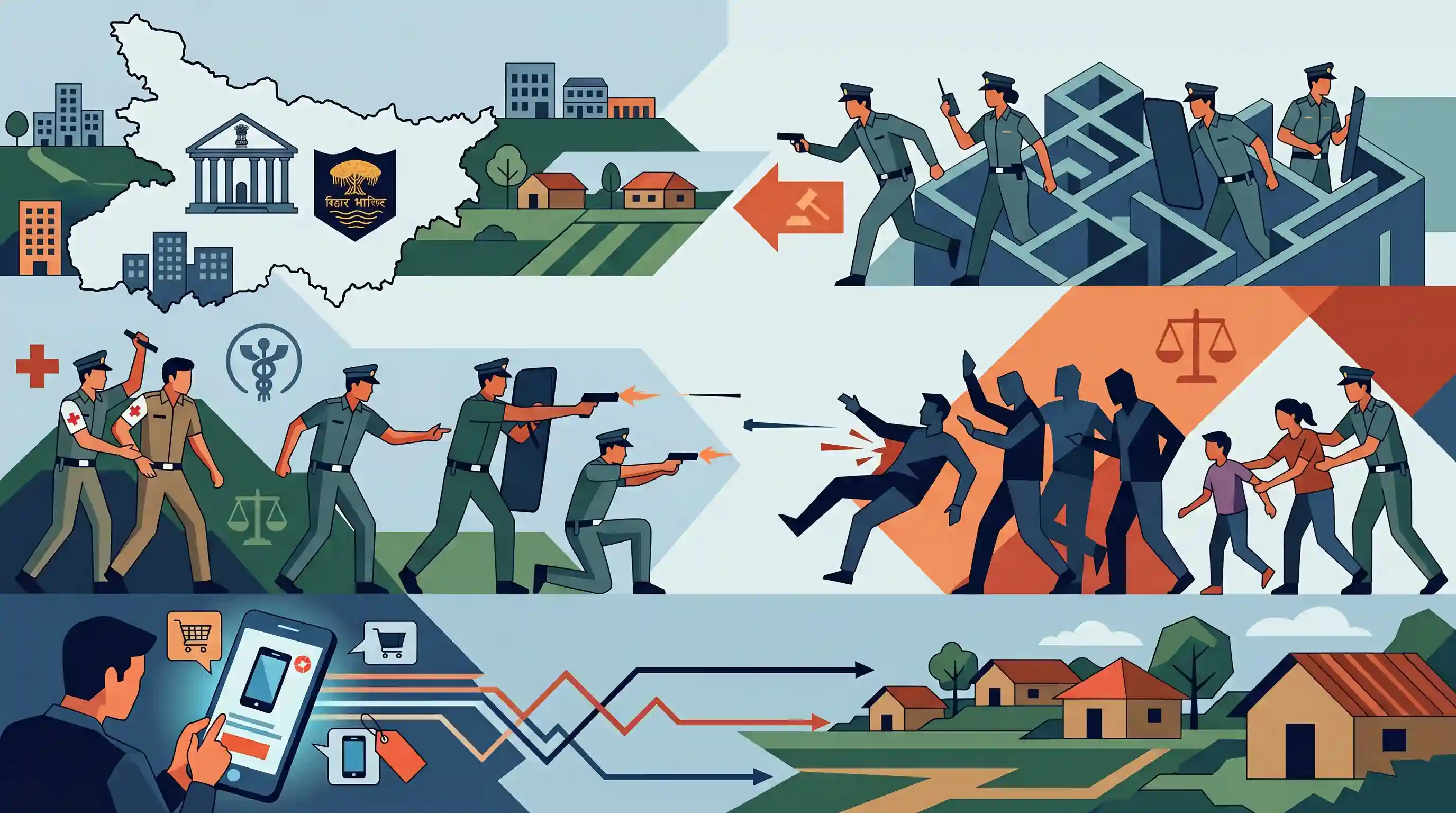
Why It Matters
This incident highlights critical challenges in local policing, the prevalence of online baiting tactics used by criminals, and underscores the constitutional and legal frameworks governing police self-defence, extrajudicial encounters, and protection of fundamental rights like the Right to Life (Article 21).
Summary
On June 12, 2026, a police encounter took place in Manichak village under Masaurhi Police Station in Patna district, Bihar, during a successful operation to rescue a kidnapped youth. In the crossfire, an accused criminal, Md. Haider, was fatally injured by police firing in self-defence and later died. Two police officers, Additional SHO Rahul Kumar and ASI Sanjay, sustained injuries and were treated at Patna AIIMS. The kidnapped youth had been lured to the site through a fraudulent online mobile-purchasing deal.
Key Points
- An encounter occurred in Manichak village under Masaurhi Police Station in Patna district on Friday evening, June 12, 2026.
- The police team raided the village based on information that a group of four to six criminals had kidnapped a youth, assaulted him, and were planning to kill him.
- In the ensuing exchange of fire, one accused criminal named Md. Haider was injured in retaliatory firing by the police and later succumbed to his injuries at a hospital in the city.
- Two police personnel, Additional Station House Officer (SHO) Rahul Kumar (bullet wound in the leg) and Assistant Sub-Inspector (ASI) Sanjay (hand injury), were injured in the encounter.
- The injured police officers were admitted to Patna AIIMS for treatment, where their conditions were reported to be out of danger.
- The kidnapped youth was successfully rescued; he revealed to investigators that he was lured to the location under the pretext of buying a mobile phone through an online platform.
- The deceased, Md. Haider, had a criminal record and was previously jailed in a murder case registered in Masaurhi, from which he was released three to four months prior.
Important Terms
Bihar Police

The primary law enforcement agency of Bihar, established under the Police Act of 1861, responsible for maintaining public order, investigating crimes, and ensuring state security.
UPSC context
GS Paper II: State Police Forces, law and order administration, and Police Reforms.
Patna AIIMS
An autonomous medical research university and public hospital of national importance in Patna, Bihar, operating under the Union Ministry of Health and Family Welfare.
UPSC context
GS Paper II: Health infrastructure, public health, and government welfare institutions.
Police Encounters
A term used in India to describe extra-judicial killings by police, which are legally subject to strict investigation guidelines laid down by the Supreme Court and the NHRC.
UPSC context
GS Paper II: Human rights, judicial guidelines (PUCL case), and police accountability.
Right of Private Defence
A legal exception under Bharatiya Nyaya Sanhita (BNS) Sections 34-44, allowing individuals to use proportionate and necessary force to protect body and property from imminent unlawful harm.
UPSC context
GS Paper II & Law Optional: Criminal law, general exceptions, and police operational powers.
Cyber-crime
Criminal activities carried out using computers or the internet, including fraudulent online transactions and cyber-enabled schemes to kidnap or extort victims.
UPSC context
GS Paper III: Cybersecurity, cyber-crime challenges, and law enforcement technology.
Prelims Trap
NHRC guidelines on police encounters carry constitutional status and automatically grant police officers absolute immunity from criminal prosecution.
While the Supreme Court guidelines (PUCL v. State of Maharashtra) carry the force of law under Article 141, NHRC guidelines are recommendatory. Additionally, private defense is not an absolute right; it is subject to the strict limitations of proportionality and necessity under BNS/IPC.
Static Concepts Connected
What is the legal framework governing police encounters in India?
- Article 21: Protects the right to life; any deprivation of life by the state must follow a fair, just, and reasonable procedure established by law.
- Right of Private Defence: Sections 34 to 44 of BNS, 2023 permit causing death in self-defence only under reasonable apprehension of death or grievous hurt.
- PUCL Guidelines: Supreme Court's 2014 judgment mandates 16 procedures, including independent investigations (by State CID) and compulsory magisterial inquiries for encounter deaths.
What is the role and setup of the Indian Cyber Crime Coordination Centre (I4C)?
- MHA Nodal Agency: An attached office under the Ministry of Home Affairs (MHA) that acts as the national nodal point to combat cybercrime.
- Golden Hour Helpline: Operates the 1930 helpline and the Citizen Financial Cyber Fraud Reporting System to block siphoned funds during the critical 'golden hour'.
- National Portal: Manages cybercrime.gov.in, allowing citizens to report cyber threats, online financial fraud, and cyber-enabled crimes across India.
Cross-Topic Patterns
Police accountability vs. State internal security
Analyzes how aggressive field operations for hostage rescue must strictly adhere to Article 21 standards and the PUCL 2014 judicial mandates to avoid extrajudicial excesses.
Digital luring and hybrid organized crime
Exposes how e-commerce platforms are exploited for physical abductions, requiring seamless integration between local state police and the centralized Indian Cyber Crime Coordination Centre (I4C).

Mains 2026 may contrast BNS provisions on private defense with the PUCL guidelines to evaluate police accountability during encounters.
Linked PYQs · 2
Linked PYQs · 2
- 2025BPSC_PRELIMSGS1
Which one of the following subjects fall within the jurisdiction of both High Court and Supreme Court?
- 2025BPSC_PRELIMSGS1
The constitution of India provides for reasonable restrictions on Fundamental Rights but reasonableness must keep in mind that: 1. The restrictions must be necessary for the protection of the rights of others. 2. The restrictions must be proportionate to the end sought. 3. The restrictions must be reasonable in the light of the circumstances. 4. The restrictions must be in the public interest.
