Patna District Police Encounter During Kidnapping Rescue Mission
Source:The Hindu ↗
Why It Matters
This article highlights the ground-level challenges in policing, law enforcement, and crime prevention in Bihar. It sheds light on how online marketplaces are increasingly misused for abduction schemes and details the physical security risks faced by state police personnel during tactical rescue operations.
Summary
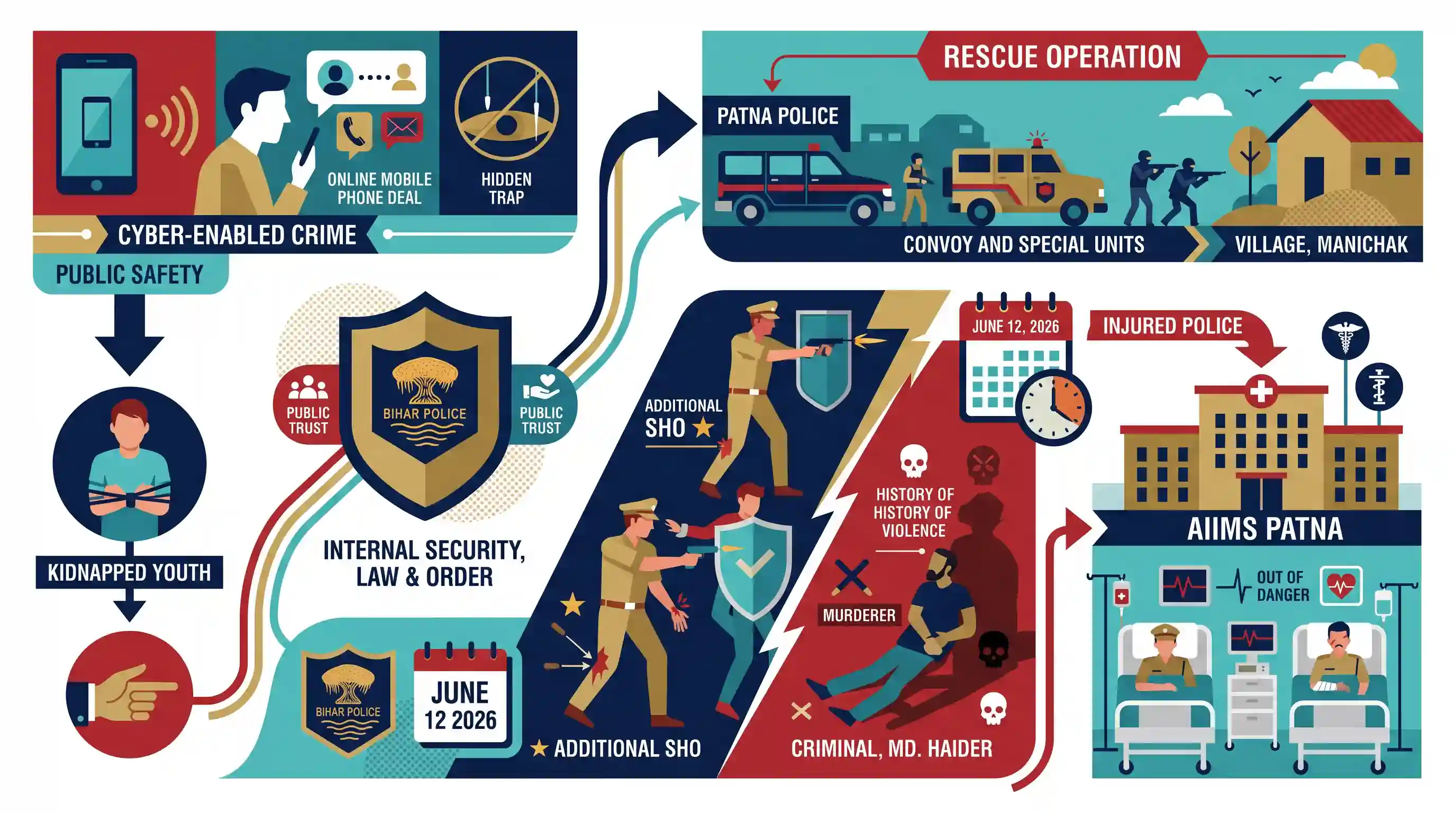
On June 12, 2026, a police encounter occurred in Manichak village under Masaurhi Police Station in Patna district, Bihar, during a successful operation to rescue a kidnapped youth. The victim had been lured to the location under the guise of an online mobile phone transaction. A criminal with a history of murder, Md. Haider, was killed in retaliatory fire. Meanwhile, two police officers—Additional SHO Rahul Kumar and ASI Sanjay—were injured and underwent treatment at AIIMS Patna.
Key Points
- An encounter took place on June 12, 2026, in Manichak village under the Masaurhi Police Station limits of Patna district, Bihar.
- The police team was acting on intelligence to rescue a kidnapped youth who had been lured to the location on the pretext of purchasing a mobile phone via an online platform.
- During the encounter, a criminal with a prior murder record, Md. Haider, was killed in retaliatory police firing.
- Two Bihar Police personnel, Additional SHO Rahul Kumar (bullet wound to leg) and Assistant Sub-Inspector Sanjay (hand injury), were injured and hospitalized at AIIMS Patna.
- Patna City Superintendent of Police (SP) Parichay Kumar confirmed that the youth was successfully rescued and raids are underway to arrest the remaining suspects.
Important Terms
Bihar Police

The law enforcement agency of Bihar, responsible for maintaining law, order, and crime prevention under the Seventh Schedule of the Indian Constitution, where policing is a State subject.
UPSC context
GS Paper III: Internal Security; tests knowledge of state-level law enforcement challenges and police reforms.
Encounter Killing
The use of lethal force by law enforcement resulting in death, legally permissible only under private defense or specific arrest provisions, governed by strict Supreme Court guidelines.
UPSC context
GS Paper II: Human Rights (Article 21); tests legal limits on the executive's use of force and judicial guidelines.
Cyber-Enabled Crime
Conventional criminal activities, such as kidnapping or fraud, that are facilitated or scaled up using computers, the internet, or modern communication applications as a tool.
UPSC context
GS Paper III: Cyber Security; tests understanding of technology-facilitated crime vectors and security threats.
All India Institute of Medical Sciences (AIIMS) Patna
A premier autonomous public medical university in Patna, established under the Pradhan Mantri Swasthya Suraksha Yojana (PMSSY) and designated as an Institute of National Importance.
UPSC context
GS Paper II: Health and Education; tests awareness of tertiary public healthcare infrastructure in India.
Prelims Trap
The PUCL (2014) encounter guidelines are advisory frameworks that states may choose to adopt depending on regional law and order situations.
Under Article 141 of the Constitution, the 16-point PUCL guidelines issued by the Supreme Court hold the force of law and are mandatory, not merely advisory or optional.
Static Concepts Connected
What are the mandatory legal safeguards governing police encounters in India?
- SC Guidelines: In PUCL v. State of Maharashtra (2014), the SC issued 16 mandatory guidelines, including independent CID/police investigation and mandatory magisterial inquiry.
- Statutory Limit: Section 46 of CrPC (now Section 43 of BNSS) permits force to arrest, but prohibits causing death unless the person is accused of an offense punishable by death/life imprisonment.
- Private Defense: Sections 96-106 of IPC (now BNS Sections 34-44) establish the right of private defense, protecting officers if lethal force is used to prevent imminent death or grievous hurt.
What is the role of the Indian Cyber Crime Coordination Centre (I4C)?
- Nodal Agency: Established in 2018 under the Ministry of Home Affairs (MHA) to act as the national nodal agency for coordinating cybercrime investigations.
- Core Infrastructure: Operates key components like the National Cybercrime Threat Analytical Unit (TAU) and the National Cyber Crime Forensic Laboratory.
- Financial Fraud Control: Manages the '1930' helpline and the national Suspect Registry to facilitate real-time sharing of fraudulent account details with banks.
Cross-Topic Patterns
Police Reforms + Human Rights Protection
The operational tension between immediate threat response and human rights compliance under PUCL (2014) guidelines is a frequent theme in governance, federal policing, and administrative ethics.
E-Commerce Scams + Cyber Security Architecture
Cyber fraud luring victims into physical ambushes highlights a dangerous convergence of digital vulnerability and physical security, testing the operational integration of state police and federal agencies like I4C.

Mains GS-II/IV may analyze the constitutional balance between law enforcement's right of private defense and NHRC/PUCL guidelines on encounters.
Linked PYQs · 1
Linked PYQs · 1
- 2024-EBPSC_PRELIMSGS1
Manvi Madhu Kashyap recently became Bihar’s first transgender
