Bihar Plans Madarsa Verification and Sanskrit School Revival
Source:Indian Express ↗
Why It Matters
Highlights the ongoing debate between cultural revivalism under the NEP and the constitutional principles of secularism in the administration and funding of educational institutions (madrasas vs. Sanskrit schools).
Summary
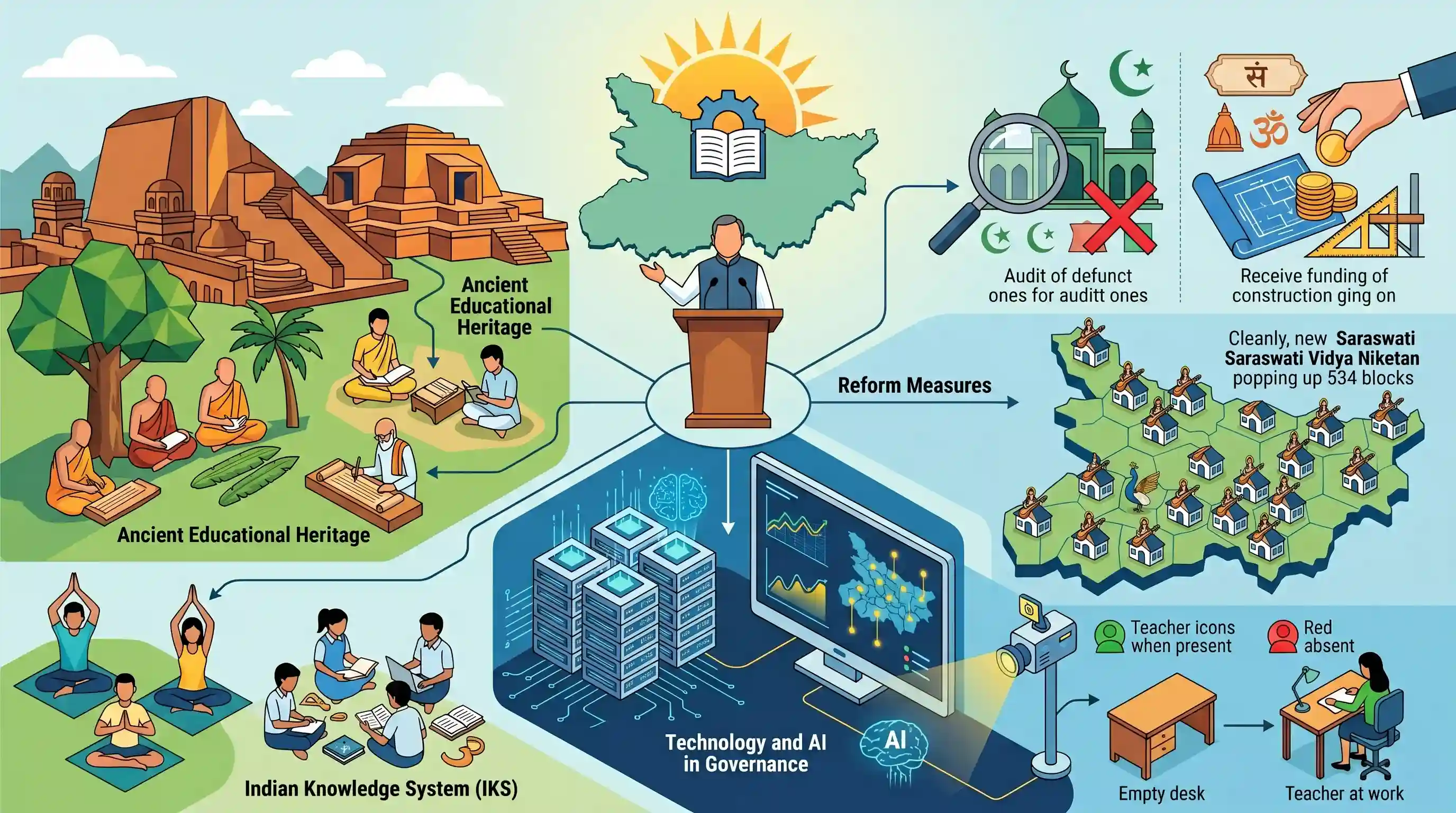
Bihar's Education Minister Sunil Kumar has announced plans to physically verify state-funded madrasas to weed out non-functional ones, while simultaneously proposing the reconstruction of Sanskrit schools. Emphasizing the integration of the Indian knowledge system as envisioned in the National Education Policy (NEP), the state also plans to introduce Yoga in schools and name select model schools 'Saraswati Vidya Niketan'. The opposition RJD has criticized the proposals, accusing the government of attempting to 'saffronise' education and polarise voters ahead of the assembly elections instead of focusing on broader infrastructure development.
Key Points
- The Bihar Education Minister announced a physical verification of over 2,000 state-funded madrasas to identify and screen out defunct institutions receiving government grants.
- The government plans to reconstruct and repair long-neglected Sanskrit schools to revive the Indian knowledge system and value-based education.
- There is a proposal to name select model schools as 'Saraswati Vidya Niketan' and integrate Yoga into the curriculum, aligning with the National Education Policy (NEP).
- Opposition parties criticize the moves as an attempt at the 'saffronisation' of education and a polarising tactic ahead of upcoming assembly elections.
Important Terms
National Education Policy (NEP) 2020

A comprehensive framework (2020) aimed at transforming India’s education system by 2040 through universal access, multidisciplinary learning, and the integration of traditional Indian knowledge with modern science.
UPSC context
GS Paper II (Social Justice/Education): Tests understanding of policy shifts towards skill-based, flexible, and culturally-rooted education.
Bihar State Madrasa Education Board
A statutory body responsible for regulating, funding, and conducting examinations for state-aided madrasas in Bihar, ensuring a curriculum that balances religious studies with general education.
UPSC context
GS Paper II (Governance/Minorities): Relevant for discussions on state-funded religious education and secularism in institutional management.
Bihar Sanskrit Education Board
An autonomous body overseeing Sanskrit-medium schools in Bihar. Recently restructured under the 2024 Amendment Act to modernize curricula and align with the National Education Policy.
UPSC context
GS Paper II (Education): Concerns the state's role in promoting classical languages and balancing heritage with modern pedagogy.
Indian Knowledge System (IKS)
An NEP 2020 initiative to incorporate ancient and traditional wisdom (e.g., sciences, arts, and languages) into mainstream curricula to foster national pride and holistic learning.
UPSC context
GS Paper I (Culture) and II (Education): Evaluates the integration of traditional values with modern educational frameworks.
Rashtriya Janata Dal (RJD)
A major regional political party in Bihar that currently serves as the primary opposition, often critiquing education reforms for alleged ideological bias and polarization.
UPSC context
GS Paper II (Governance/Political Parties): Illustrates the role of the opposition in scrutinizing government policy and protecting secularism.
Prelims Trap
Minority educational institutions receiving state aid are immune from state administrative regulations.
The Supreme Court clarified that autonomy under Art 30(1) is not absolute. State-funded minority institutions are subject to reasonable regulations to ensure academic standards.
Static Concepts Connected
What are the Constitutional provisions regulating minority educational institutions?
- Establishment Right: Article 30(1) grants religious and linguistic minorities the right to establish and administer educational institutions of their choice.
- Non-discrimination: Article 30(2) prohibits the State from discriminating against minority institutions while distributing educational grants.
- Reasonable Regulation: Autonomy is not absolute; the State can enforce regulations to ensure academic standards, proper service conditions, and prevent maladministration.
How does NEP 2020 approach the Indian Knowledge System (IKS)?
- Curriculum Integration: Mandates embedding ancient Indian contributions in mathematics, astronomy, philosophy, and arts into the modern educational framework.
- Institutional Support: A dedicated IKS Division under the Ministry of Education was established in 2020 to facilitate authentic, interdisciplinary research.
Cross-Topic Patterns
Harmonious reading: Art 30 & RTE
The SC mandates balancing Article 30 autonomy with the RTE Act (Article 21A) to ensure students receive secular, modern education alongside religious instruction.
NEP 2020 vs Constitutional Secularism
Moves to rename schools and introduce Yoga under the guise of NEP's 'Indianisation' map directly to Mains GS-1 secularism and GS-2 education governance questions.

Expect a 2026 Prelims statement testing if minority institutions receiving state grants are completely exempt from state regulations.
Linked PYQs · 2
Linked PYQs · 2
- 2020MainsGS2
National Education Policy 2020 is in conformity with the Sustainable Development Goal-4 (2030). It intends to restructure and reorient education system in India. Critically examine the statement.
- 2024MainsGS2
Discuss India as a secular state and compare with the secular principles of the US constitution.
