Bihar Education Minister Announces Madrasa and Sanskrit Reform
Source:indianexpress ↗
Why It Matters
This article connects Bihar's active policy reforms in the education sector (such as school audits, block-level model schools, and NEP integration) with historical legacies (Nalanda and Vikramshila) and administrative facts (like Bihar's 534 development blocks), both of which are high-yield areas for BPSC Prelims.
Summary
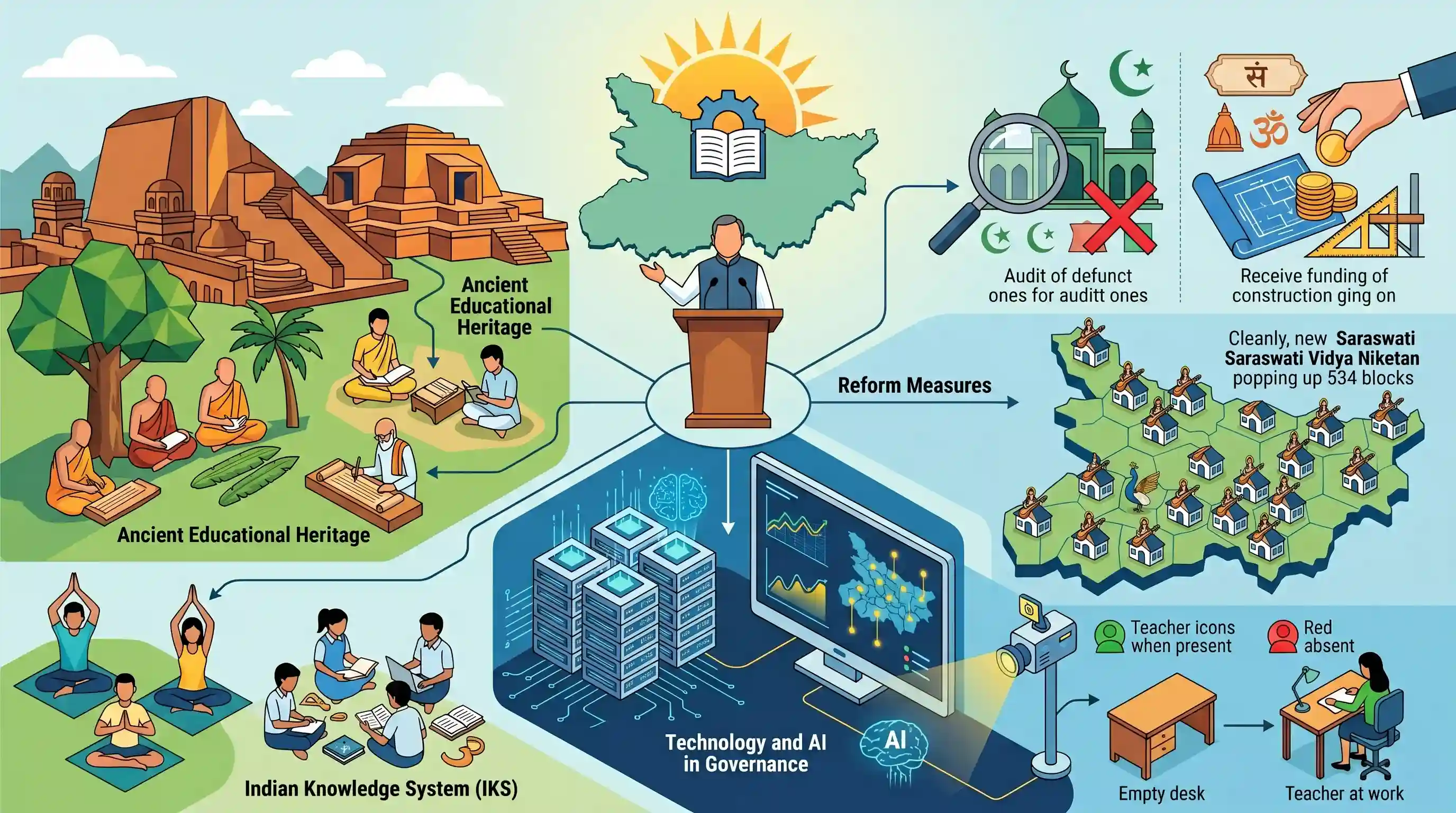
An interview with Bihar's Education Minister Mithilesh Tiwari outlines the NDA government's plans to reform the state education system under the National Education Policy (NEP). Key steps include auditing defunct madrasas, providing infrastructure development funds to Sanskrit schools, establishing 'Saraswati Vidya Niketan' model schools across all 534 blocks of Bihar, and implementing real-time AI monitoring to reduce teacher absenteeism. The reforms focus heavily on the Indian Knowledge System (IKS), introducing Yoga into the curriculum, and drawing inspiration from Bihar’s ancient learning centers like Nalanda and Vikramshila.
Key Points
- Bihar Education Minister Mithilesh Tiwari announced a comprehensive reform roadmap targeting government-aided madrasas, Sanskrit schools, and overall school governance.
- The state is carrying out physical verifications of 1,900+ government-aided madrasas and 600+ Sanskrit schools to identify 'ghost' schools, check enrolment, and reduce teacher absenteeism.
- While madrasas have historically received infrastructure repair funds, Sanskrit schools (under the Sanskrit Education Board) will now also receive structural funding in addition to teacher salaries.
- The government plans to launch the 'Saraswati Vidya Niketan' model school project (for Classes 9 to 12) across all 534 development blocks of Bihar to offer free preparation for competitive exams.
- Yoga will be introduced as a subject starting next academic session, an initiative aligned with the National Education Policy (NEP) and announced by Chief Minister Samrat Choudhary.
- Technology-driven administrative tools, including real-time attendance reporting and future AI-based school monitoring, are being planned to curb high teacher absenteeism.
- The policy discourse invokes Bihar's ancient legacy of educational excellence, specifically referencing the Nalanda and Vikramshila models of education.
Important Terms
National Education Policy (NEP)

A comprehensive national framework launched in 2020 aiming to transform India's education system by promoting multidisciplinary learning, foundational literacy, regional language instruction, and aligning education with global standards.
UPSC context
GS Paper II (Governance & Social Justice - Education). Tested in analysis of educational reforms and standard policies.
Saraswati Vidya Niketan Model School Project
An initiative by the Bihar government under its 'Saat Nischay-3' programme to establish high-quality, tech-enabled model schools in every block, offering smart classes and labs comparable to Kendriya Vidyalayas.
UPSC context
GS Paper II (State Governance, Welfare Initiatives). Evaluates regional educational infrastructure models and federal governance.
Indian Knowledge System (IKS)
An initiative under the Union Ministry of Education promoting interdisciplinary research and the integration of traditional Indian scientific, mathematical, and philosophical heritage into contemporary school and higher education curricula.
UPSC context
GS Paper I (Indian Culture) and GS Paper II (Education Policy). Tests understanding of cultural preservation and curriculum decolonization.
Sanskrit Education Board
A state-level educational authority (such as the Bihar Sanskrit Shiksha Board) responsible for regulating, standardizing, and conducting examinations for traditional secondary and senior secondary Sanskrit educational institutions.
UPSC context
GS Paper II (Educational Governance, Linguistic Minorities). Tests policies managing traditional and indigenous systems of instruction.
Madrasa Board
A statutory state-level body (such as the Bihar State Madarsa Education Board) established to manage, fund, and standardize Islamic educational institutions, while integrating modern academic curricula with traditional religious instruction.
UPSC context
GS Paper II (Governance, Minority Rights). Assesses minority education governance, mainstreaming of traditional schools, and administrative accountability.
Prelims Trap
Article 30 grants absolute immunity to minority-run educational institutions from state administrative audits or physical verifications.
While Article 30 protects administration, the Supreme Court has ruled that regulatory measures ensuring academic standards, audits, and physical verifications do not violate minority rights.
Static Concepts Connected
What is the historical significance of Vikramshila University?
- Royal founder: Established by Pala King Dharmapala in late 8th/early 9th century in Bihar to promote Buddhist learning.
- Academic focus: Served as a global premier center specializing in Vajrayana (Tantric) Buddhism and logic.
- Destruction: Destroyed by Bakhtiyar Khalji around 1193 AD, accelerating the decline of Buddhism in India.
What constitutional rights govern minority educational institutions?
- Article 30(1): Guarantees religious and linguistic minorities the right to establish and administer educational institutions of their choice.
- Non-discrimination: Article 30(2) prevents the state from discriminating during aid distribution based on minority management.
- State regulation: The Supreme Court permits reasonable state regulations to maintain academic excellence and prevent financial mismanagement.
Cross-Topic Patterns
Article 30 vs State Administrative Audits
Explores the balance between constitutional protections for minority-run institutions and the state’s regulatory powers to curb administrative malpractices and ensure fiscal accountability.
AI Governance and Public Sector Accountability
Examines how emerging technologies like real-time AI tracking are deployed to resolve systemic administrative challenges like public school teacher absenteeism.

UPSC 2026 may link Article 30 boundaries with state funding of minority institutions alongside questions on ancient educational centers.
Linked PYQs · 3
Linked PYQs · 3
- 2023BPSC_PRELIMSGS1
Consider the following statements regarding the Vikramshila University in Bihar: 1. It was located in the present-day Banka district of Bihar. 2. It was established by King Gopala I of the Pala dynasty. 3. The ‘Vajrayana’ sect of Buddhism flourished here. 4. Other subjects like Astronomy, Logic, Law, Grammar and Philosophy were also taught here. Which of the above statements are incorrect?
- 2023BPSC_PRELIMSGS1
The Vikramshila University was established by
- 2025BPSC_PRELIMSGS1
What is the primary objective of Bihar’s Mission Daksh?
