Bihar Earth Day 2026 Afforestation Drive and 11-Point Pledge
Source:patna-press ↗
Why It Matters
BPSC Prelims frequently tests candidates on Bihar-specific environmental policies, forest cover data (ISFR), and state government targets (e.g., pollution-free by 2030). Understanding the focus areas of Bihar Earth Day helps in questions related to state environmental governance, afforestation drives, and sanitation milestones like Open Defecation Free (ODF) status.
Summary
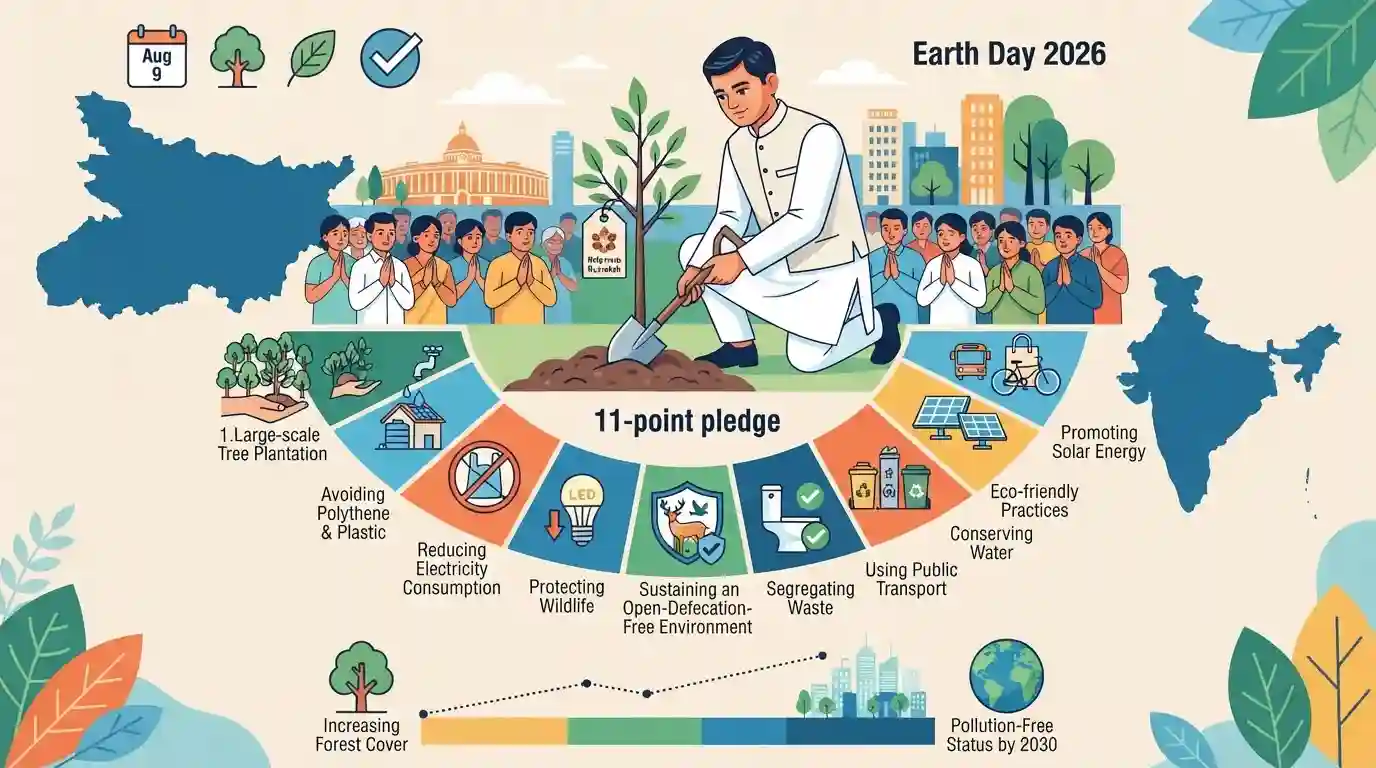
On August 9, Bihar celebrated Earth Day 2026 with a strong call for environmental conservation led by Chief Minister Samrat Choudhary. At an event in Patna, he planted Kalpataru and Rudraksh saplings and unveiled an 11-point pledge designed to encourage citizen participation in combating climate change. The pledge outlines crucial sustainability measures including large-scale tree plantation, rainwater harvesting, avoiding polythene and plastic, reducing electricity consumption, protecting wildlife, and sustaining an open-defecation-free environment. This initiative aligns with Bihar's broader ecological goals, including increasing the state's forest cover and moving toward a pollution-free status by 2030.
Key Points
- Bihar Earth Day 2026 was observed on August 9, reinforcing the state's commitment to environmental sustainability.
- Chief Minister Samrat Choudhary planted Kalpataru and Rudraksh saplings at the Public Servant Residence complex in Patna to mark the occasion.
- The state issued an 11-point environmental conservation pledge focusing on practical citizen-led actions.
- Key focus areas of the pledge include afforestation, rainwater harvesting, eliminating single-use plastics, energy conservation, and maintaining open-defecation-free (ODF) sanitation standards.
Important Terms
Swachh Bharat Abhiyan

A nationwide cleanliness campaign initiated by the Government of India in 2014 to eliminate open defecation, improve solid waste management, and ensure a healthy, sustainable environment.
UPSC context
Crucial for GS-II (Governance) and GS-III (Environment); tests knowledge on sanitation infrastructure, public health, and ODF+ sustainability.
Jal Jeevan Hariyali Abhiyan
A flagship environmental initiative launched by the Bihar government in 2019 focusing on climate resilience, water conservation, afforestation, and the restoration of traditional water bodies.
UPSC context
Relevant for GS-III (Environment) and State PCS exams; highlights sub-national climate action, resource management, and sustainable development.
Bihar Prithvi Divas (Bihar Earth Day)
An annual event celebrated in Bihar on August 9 to raise mass awareness about climate change, encouraging citizen participation in large-scale tree plantation and water conservation drives.
UPSC context
Significant for GS-III (Environment) and BPSC exams; tests knowledge of localized ecological awareness campaigns and state-led biodiversity targets.
Bihar Government
The sub-national administrative authority of Bihar. In this context, it implements state-specific ecological policies, such as driving afforestation, enforcing environmental pledges, and aiming for pollution-free status by 2030.
UPSC context
Important for GS-II (State Governance) and GS-III (Environment); illustrates federalism in implementing localized climate action and sustainable development goals.
Prelims Trap
Bihar Earth Day aligns with the global Earth Day on April 22 and targets Net-Zero carbon emissions by 2070.
Global Earth Day is April 22, but Bihar observes its state-specific Earth Day on August 9. Furthermore, Bihar aims for Net-Zero by 2040, ahead of India's 2070 target.
Static Concepts Connected
What constitutes 'Forest Cover' in India under the ISFR methodology?
- Canopy density: Includes all lands greater than one hectare in area with a tree canopy density of more than 10%.
- Status agnostic: It includes all lands fulfilling the density/area criteria irrespective of their legal ownership, land use, or recognized legal forest status.
What differentiates ODF, ODF+, and ODF++ sanitation statuses under Swachh Bharat?
- ODF: At any point of the day, not a single person is found defecating in the open.
- ODF+: Public and community toilets are functional, well-maintained, and open urination is eliminated.
- ODF++: Fecal sludge/septage and sewage are safely managed and treated, with no untreated discharge into the environment.
Cross-Topic Patterns
Sub-national Net-Zero climate targets
Bihar aiming for Net-Zero by 2040 alongside UNEP illustrates a trend of states bypassing national timelines (India's 2070 goal) to launch aggressive, localized climate action plans.
Water-Energy-Vegetation Nexus
The state's 'Jal-Jeevan-Hariyali' mission merges rainwater harvesting, solar adoption, and afforestation, offering a prime Mains GS-3 case study on a holistic, decentralized climate resilience approach.

Expect Prelims statements mixing state-level climate targets (Bihar's 2040 net-zero) with national Panchamrit goals (2070) to test clarity.
Linked PYQs · 3
Linked PYQs · 3
- 2023BPSC_PRELIMSGS1
Bihar Government has planned to make Bihar State ‘pollution-free’ by reducing carbon emissions by which year?
- 2020BPSC_PRELIMSGS1
What is the percentage of all types of forest area to the total geographical area of Bihar State?
- 2016BPSC_PRELIMSGS1
Which State has been declared India's first 'Open Defecation Free State'?
