Bihar Draft Electoral Roll Errors Prompting Election Commission Action
Source:Indian Express ↗
Why It Matters
The integrity of the electoral process relies heavily on the accuracy of electoral rolls. Administrative lapses in voter registration directly impact citizens' constitutional right to vote and highlight the operational challenges faced by the Election Commission.
Summary
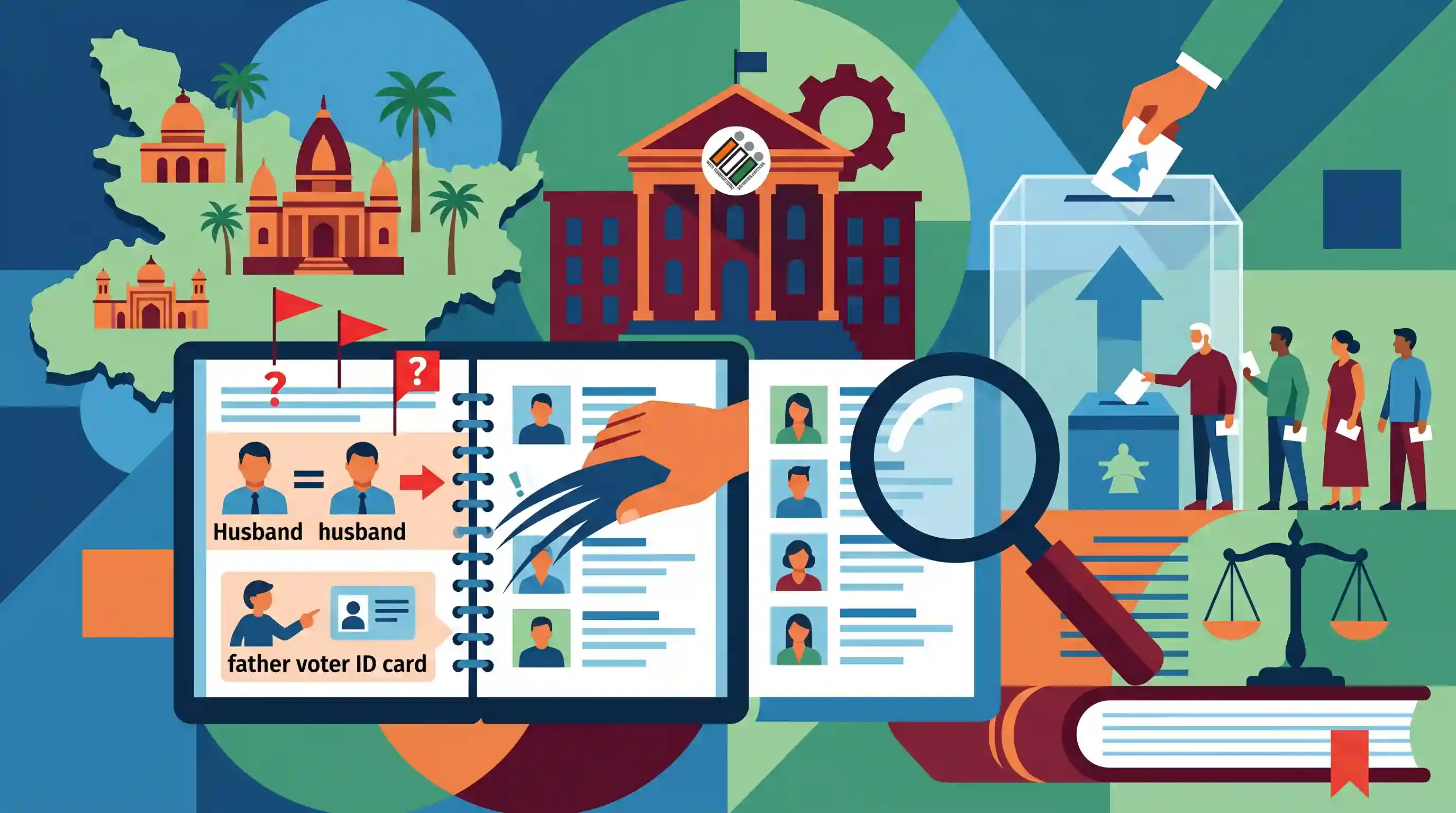
Draft electoral rolls in Bihar were found to have bizarre errors, with entries like 'Husband husband' and 'father voter ID card' replacing actual names. The Election Commission of India (ECI) promptly took action upon these errors being flagged. This incident underscores the ongoing challenges in maintaining accurate voter lists, a crucial prerequisite for conducting free and fair elections under the Representation of the People Act.
Key Points
- The Election Commission took action after significant errors were flagged in Bihar's draft electoral rolls.
- Errors included bizarre entries such as 'Husband husband' and 'father voter ID card' printed in place of actual voter names.
- This highlights the administrative challenges and potential for human or technical error in the digitisation and preparation of electoral rolls.
- Accurate electoral rolls are fundamental to ensuring free and fair elections, emphasizing the critical oversight role of the ECI under the Representation of the People Act.
Important Terms
Election Commission of India (ECI)

An autonomous constitutional authority established under Article 324 to administer Union and State election processes in India, including the offices of President and Vice-President.
UPSC context
GS Paper II: Constitutional Bodies; crucial for topics on electoral integrity and democratic governance.
Representation of the People Act (RPA)
Statutory laws (1950 and 1951) providing the legal framework for seat allocation, registration of voters, preparation of electoral rolls, and the actual conduct of elections in India.
UPSC context
GS Paper II: Salient features of the Representation of People’s Act; tests legislative underpinnings of democracy.
Article 324
Constitutional provision vesting the superintendence, direction, and control of the preparation of electoral rolls and the conduct of elections in the Election Commission.
UPSC context
GS Paper II: Constitutional Provisions; fundamental to the independence and powers of the ECI.
Electoral Roll
The official constituency-wise register of all individuals eligible to vote, maintained and updated by the ECI to ensure free and fair elections.
UPSC context
GS Paper II: Governance/Elections; accuracy is essential for preventing disenfranchisement and electoral malpractice.
Special Intensive Revision (SIR)
A rigorous, time-bound verification process involving house-to-house visits by Booth Level Officers to update voter data and eliminate duplicate or ineligible entries.
UPSC context
GS Paper II: Governance/Electoral Reforms; tests understanding of administrative processes for maintaining electoral integrity.
Model Code of Conduct (MCC)
A set of guidelines issued by the ECI to regulate the conduct of political parties and candidates during elections to ensure fairness and prevent abuse of power.
UPSC context
GS Paper II: Governance/Elections; focuses on ECI's regulatory role and political ethics.
Universal Adult Suffrage
The democratic principle, guaranteed by Article 326, granting every citizen aged 18 and above the right to vote without discrimination based on caste, race, religion, or gender.
UPSC context
GS Paper II: Constitutional Values; represents the foundational pillar of Indian representative democracy.
Prelims Trap
"The preparation and revision of electoral rolls are exclusively governed by the Representation of the People Act, 1951."
False. The preparation of electoral rolls, delimitation, and allocation of seats fall under RPA 1950. RPA 1951 deals with the actual conduct of elections and disqualifications.
Static Concepts Connected
What are the core functions of the Representation of the People Act (RPA), 1950?
- Allocation of seats: Determines the allocation of seats in the Lok Sabha and State Legislative Assemblies.
- Electoral rolls: Provides the legal framework for the preparation, revision, and updating of electoral rolls by Electoral Registration Officers (EROs).
- Delimitation: Lays down procedures for the delimitation of Parliamentary and Assembly constituencies.
Which Constitutional Articles directly govern the electoral roll and the right to vote?
- Article 325: Mandates one general electoral roll per constituency, prohibiting exclusion based purely on religion, race, caste, or sex.
- Article 326: Establishes universal adult suffrage. The UPSC officially recognizes the Right to Vote derived from this as a Constitutional Right.
Cross-Topic Patterns
Electoral purification vs Privacy
Links administrative errors to the Election Laws (Amendment) Act, 2021, which allows voluntary Aadhaar linking to weed out fake entries, balancing electoral integrity with Puttaswamy privacy norms.
E-Governance and data quality
Bizarre auto-fill errors in government databases highlight the limits of digitisation (GS2 Governance) at the grassroots, requiring robust manual audits to protect citizen rights.

Expect a prelims question testing the exact differences between RPA 1950 (electoral rolls) and 1951 (conduct), paired with Aadhaar rules.
Linked PYQs · 4
Linked PYQs · 4
- 2022MainsGS2
Discuss the procedures to decide the disputes arising out of the election of a Member of the Parliament or State Legislature under The Representation of the People Act, 1951. What are the grounds on which the election of any returned candidate may be declared void ? What remedy is available to the aggrieved party against the decision ? Refer to the case laws.
- 2020MainsGS2
There is a need for simplification of procedure for disqualification of persons found guilty of corrupt practices under the Representation of Peoples Act". Comment.
- 2017PrelimsGS1
Consider the following statements: 1. The Election Commission of India is a five-member body. 2. Union Ministry of Home Affairs decides the election schedule for the conduct of both general elections and bye-elections. 3. Election Commission resolves the disputes relating to splits/mergers of recognised political parties. Which of the statements given above is/are correct?
- 2017PrelimsGS1
Right to vote and to be elected in India is a
