Bihar Upgrades District Hospitals to Super Speciality Status
Source:patnapress ↗
Why It Matters
Strengthening district-level healthcare infrastructure addresses the critical gap of tertiary-care access in rural and semi-urban areas. Aligning with Indian Public Health Standards (IPHS) helps standardize care quality, reduce patient out-of-pocket expenditure, and prevent healthcare-induced poverty in Bihar.
Summary
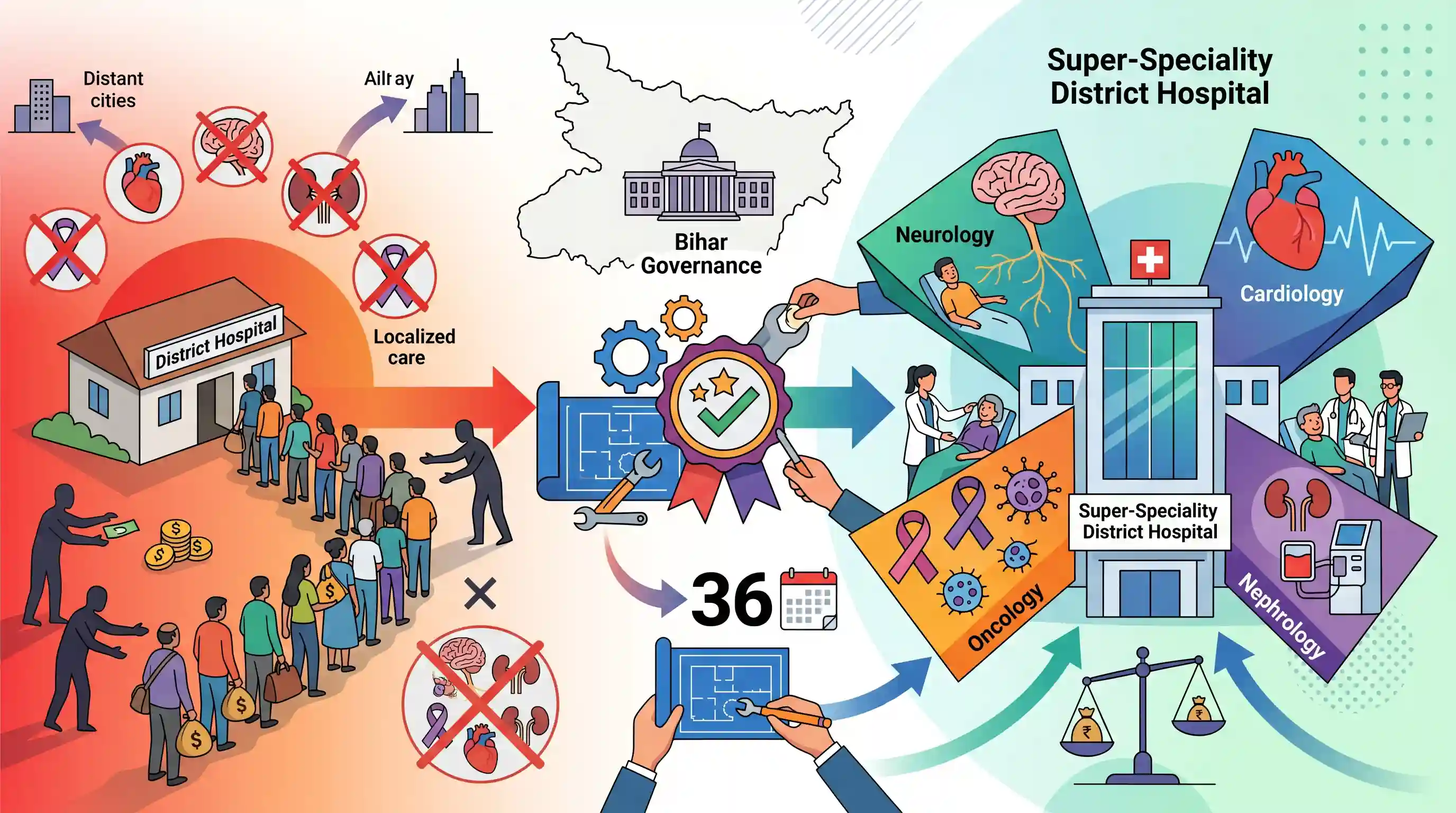
The Bihar Health Department, under the guidance of Deputy Chief Minister Samrat Chaudhary and Health Minister Nishant Kumar, is rapidly upgrading 36 district hospitals to super-speciality status by August 15. This initiative aligns with the Indian Public Health Standards (IPHS) to provide localized tertiary-level treatment in Neurology, Cardiology, Oncology, and Nephrology, thereby curtailing high referral rates, reducing the financial burden on patients, and bypassing middle-men exploitation.
Key Points
- The Bihar Health Department is accelerating plans to upgrade 36 district hospitals to offer super-speciality medical services.
- The upgrade targets the deployment of specialist doctors, advanced medical equipment procurement, and infrastructure enhancements.
- Super-speciality focus areas include Neurology, Cardiology, Oncology, and Nephrology.
- The infrastructural upgrades align with the Indian Public Health Standards (IPHS) and feature advanced ICUs, modular OTs, cath labs, dialysis units, and rehabilitation centers.
- The deadline set for completing these healthcare system upgrades is August 15.
- The core policy objective is to significantly reduce patient referral rates to larger public or private facilities, preventing exploitation by middle-men and cutting down out-of-pocket expenditures.
Important Terms
Indian Public Health Standards (IPHS)

A set of national benchmarks prescribing infrastructure, human resources, drugs, and equipment requirements to ensure uniform, quality essential healthcare delivery across public facilities in India.
UPSC context
GS Paper 2: Social Sector and Health. Crucial for understanding quality standards in public health administration.
Tertiary Healthcare
The highly specialized, super-speciality medical tier (e.g., oncology, cardiology) utilizing advanced technology and expert specialists, typically accessed via referral for complex or life-threatening conditions.
UPSC context
GS Paper 2: Health Infrastructure. Tests knowledge of healthcare tiers, referral bottlenecks, and tertiary treatment affordability.
Secondary Healthcare
The intermediate medical tier focusing on specialized consults, diagnostics, and inpatient services at facilities like Community Health Centres and District Hospitals, bridging primary and tertiary care.
UPSC context
GS Paper 2: Social Sector (Health). Essential for analyzing referral pathways and gaps in specialized human resources.
District Hospitals
Public secondary-level health institutions located at district headquarters, serving as the critical hub for specialist treatment, diagnostics, and secondary care for the regional population.
UPSC context
GS Paper 2: Decentralized Health Governance. Tests understanding of local administrative hubs and efforts to reduce tertiary hospital referral burdens.
National Health Mission (NHM)
A flagship centrally sponsored initiative launched in 2013 (subsuming NRHM and NUHM) to provide equitable, affordable, and quality healthcare across rural and urban India.
UPSC context
GS Paper 2: Welfare Schemes. Important for evaluating healthcare interventions, cooperative federalism, and public expenditure.
Prelims Trap
Compliance with IPHS bed-strength ratios is legally binding on states, and District Hospitals are classified as tertiary care centers.
Public health is a State subject, making IPHS recommendatory, not statutory. Additionally, District Hospitals are classified as the apex of secondary care, not tertiary care.
Static Concepts Connected
What is the five-tier public healthcare hierarchy under IPHS 2022?
- Five-Tier Structure: Organizes India's public health delivery from Sub-Health Centres (Tier 1) up to District Hospitals (Tier 5).
- Secondary Apex: District Hospitals (Tier 5) are designated as the apex of the secondary healthcare network.
- Bed-Strength Target: Prescribes a minimum essential 1 bed per 1,000 population and a desirable 2 beds per 1,000.
How is healthcare legislative power divided in the Seventh Schedule?
- State List: Entry 6 places 'Public health and sanitation; hospitals and dispensaries' under the exclusive legislative domain of states.
- Concurrent List: Entries 26 and 29 cover medical education, professions, and prevention of infectious diseases, allowing joint center-state legislation.
Cross-Topic Patterns
Federalism + Public Health Guidelines
Central targets like IPHS require state fiscal space to succeed. Weak state health allocations often conflict with ambitious national health goals due to federal divisions.
Spike in OOPE + Poverty Traps
Rising Out-of-Pocket Expenditure (to 44% in FY23) undermines state welfare efforts, demonstrating how secondary healthcare gaps drive vulnerable families back into poverty.

A 2026 Prelims question is highly likely to test the recommendatory nature of IPHS guidelines alongside the 5-tier health structure.
Linked PYQs · 1
Linked PYQs · 1
- 2024-EBPSC_PRELIMSGS1
Which sector received the highest allocation in the Bihar Budget 2024-25?
