Bihar Police Ban on Automatic Assault Weapons for Crowd Control
Source:The Hindu ↗
Why It Matters
Important for understanding administrative and policing policy changes in Bihar, particularly concerning law enforcement guidelines and human rights protection during public protests.
Summary
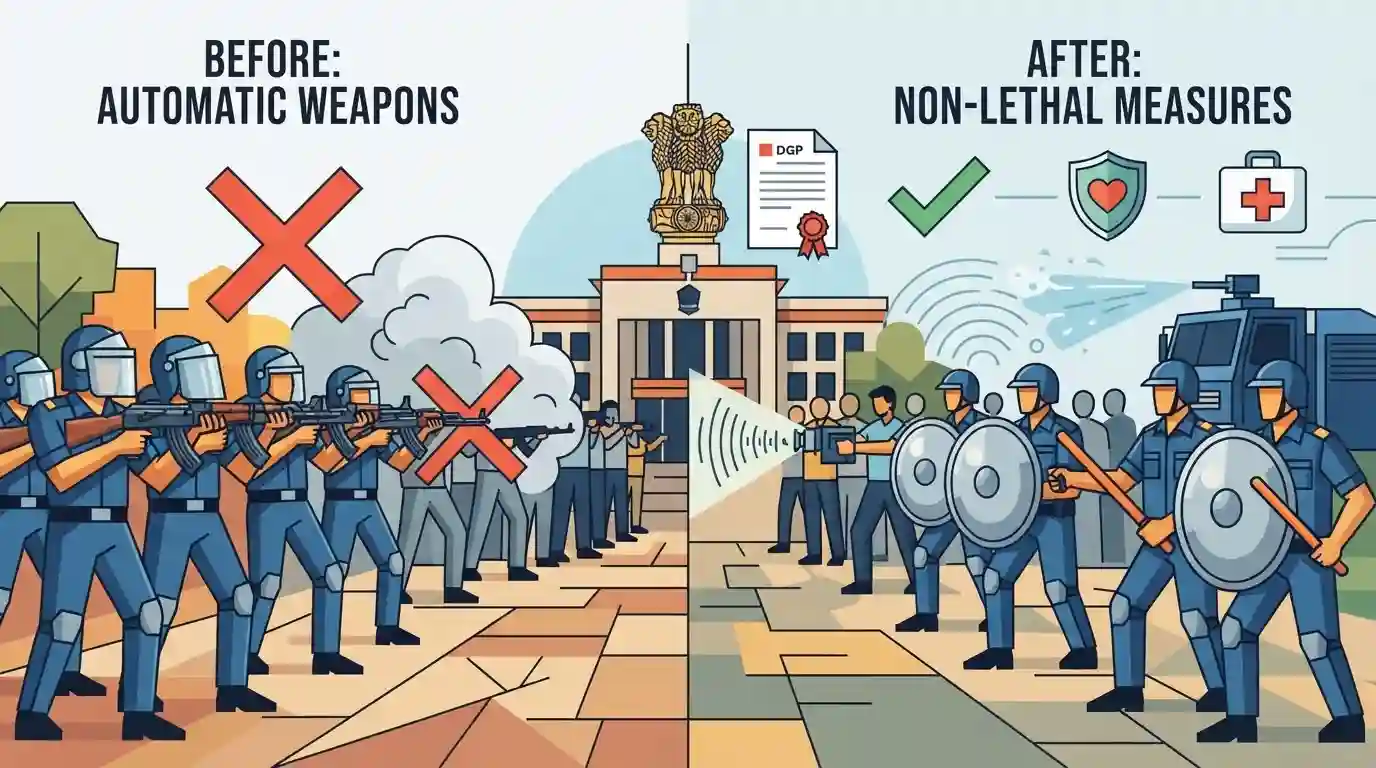
The Bihar DGP has issued a ban on the use of automatic assault weapons by police personnel during law and order maintenance, prioritizing non-lethal crowd control measures and minimizing civilian casualties.
Key Points
- The Director General of Police (DGP) of Bihar banned the use of automatic assault weapons by policemen during law and order control operations.
- The move aims to minimize collateral damage and prevent disproportionate use of force during protests, riots, or public assemblies in the state.
- Police personnel have been directed to rely on non-lethal or less-lethal methods for crowd control.
Important Terms
Bihar Police

The state-level law enforcement agency in Bihar, functioning under the Department of Home Affairs, Government of Bihar, tasked with maintaining internal security, crime prevention, and public order across all 38 districts.
UPSC context
Important for BPSC General Studies (Paper II - Polity & Governance), testing knowledge of state administration, police reforms, and law and order machinery.
Prelims Trap
Bihar police have been completely prohibited from possessing or using automatic assault weapons under any operational context.
Aspirants might assume automatic weapons are banned entirely across all police operations, whereas they remain permitted for counter-terrorism and anti-Naxal/insurgency missions.
Static Concepts Connected
What are the key statutory provisions and committees guiding police reforms and use of force in India?
- Prakash Singh Case: Supreme Court in Prakash Singh v. Union of India (2006) issued mandatory directives for structural police reforms, including stable tenures and state security commissions.
- Model Police Act: Model Police Act of 2006 emphasizes democratic policing, community engagement, and clear protocols for crowd management and proportionate use of force.
- Legal Proportionality: Criminal Procedure provisions (now BNSS 2023) mandate that force used to disperse unlawful assemblies must be the minimum necessary and proportionate.
Cross-Topic Patterns
Police Reforms + Criminal Law Overhauls
Police modernisation grants and model police acts frequently highlight non-lethal crowd control as a core pillar of administrative accountability.
Human Rights + BNSS 2023 Proportionality
The shift from military-grade weapons to proportionate force mirrors international human rights frameworks integrated into the new criminal codes.

Expect questions linking police standard operating procedures, minimum force principles, and the new criminal laws (BNSS 2023).
Linked PYQs · 1
Linked PYQs · 1
- 2024-EBPSC_PRELIMSGS1
Manvi Madhu Kashyap recently became Bihar’s first transgender
