Socio Economic Transformation of Bihar and Internal Migration Policy
Source:Indian Express ↗
Why It Matters
The article provides a critical analysis of welfare populism versus genuine economic development in state elections. It also introduces a fresh sociological perspective on internal migration, urging policymakers to view migrants as a strategic 'diasporic asset'—a concept highly relevant for GS1 (Society), GS2 (Governance), and GS3 (State Finances).
Summary
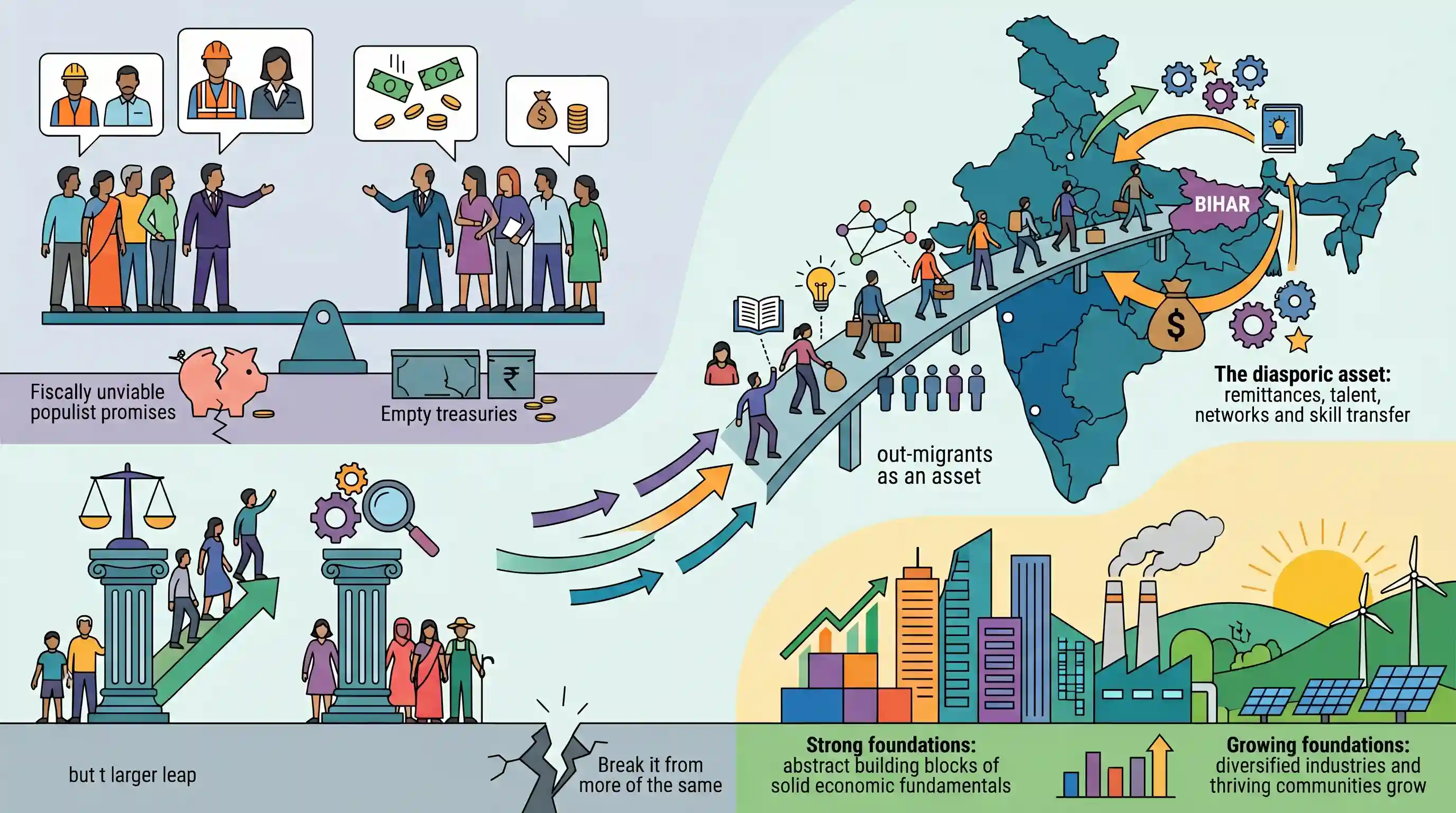
The editorial critiques the prevailing political narratives in the run-up to the Bihar assembly elections, noting that both the NDA and the Mahagathbandhan rely on fiscally unviable populist promises like public jobs and cash transfers. While acknowledging the historical milestones of social justice under Lalu Prasad and Nitish Kumar's targeted governance models, the piece emphasizes that Bihar needs a substantial economic transformation. Crucially, it advocates for a shift in perspective regarding internal migration—treating the 7.4 million out-migrants not as a 'brain drain' but as a diasporic asset whose talent, networks, and remittances can connect rural Bihar with advanced urban economies. Ultimately, the state demands a departure from "more of the same" welfare politics in favor of solid economic fundamentals.
Key Points
- The impending Bihar assembly elections feature competing alliances offering fiscally unviable populist promises, such as massive public employment and enhanced cash transfers.
- Lalu Prasad's tenure gave a political voice to marginalized communities but failed to build institutional capacity, while Nitish Kumar linked social justice with targeted welfare interventions but fell short of achieving a transformative economic leap.
- Bihar's 7.4 million-strong out-migrant population should be viewed as a diasporic asset rather than a 'brain drain' (palayan), capable of connecting the unviable rural sector with advanced urban systems.
- The state requires a paradigm shift away from traditional identity politics and freebie culture toward building robust economic fundamentals, utilizing remittances, and fostering structural transformation.
Important Terms
Mukhyamantri Balika Cycle Yojana

A flagship Bihar government scheme providing financial grants to girls in Class IX to purchase bicycles. It aims to boost secondary school enrollment, reduce dropouts, and improve mobility and empowerment.
UPSC context
GS Paper II: Social Justice; an example of successful conditional cash transfers and gender-based educational interventions.
Jeevika
The Bihar Rural Livelihoods Project (BRLP), a World Bank-supported initiative that empowers rural women through Self-Help Groups (SHGs). It focuses on financial inclusion, livelihood diversification, and poverty alleviation.
UPSC context
GS Paper II: Role of SHGs and NGOs in development; vital for poverty reduction and rural governance studies.
Jan Suraaj Party
A political party launched by former strategist Prashant Kishor in 2024. It emphasizes a grassroots 'padyatra' to build a governance roadmap and advocates for economic transformation over traditional identity-based politics.
UPSC context
GS Paper II: Electoral Politics and Pressure Groups; examines new political movements and the shift toward governance-centric electoral narratives.
Mahagathbandhan
A major opposition coalition in Bihar, currently led by the Rashtriya Janata Dal (RJD) and Indian National Congress. It emphasizes social justice, public sector job creation, and increased reservations.
UPSC context
GS Paper II: Indian Constitution and Federalism; illustrates coalition dynamics and regional party alliances in a multi-party system.
NDA (National Democratic Alliance)
A center-right political coalition in India, led by the BJP. In Bihar, it includes the JD(U) and focuses on infrastructure, 'Sushasan' (good governance), and national-state policy alignment.
UPSC context
GS Paper II: Governance and Political Parties; tests understanding of alliance politics and the impact of 'double-engine' governance.
Prelims Trap
"The Election Commission holds statutory authority to penalize or deregister parties for making unviable electoral freebie promises."
The ECI cannot deregister parties for freebies. Under a Supreme Court directive, it only requires parties to explain the financial rationale of promises under the Model Code of Conduct guidelines.
Static Concepts Connected
What provisions govern internal migration and migrant rights in India?
- Constitutional Right: Article 19(1)(d) and (e) guarantee citizens the fundamental right to move freely and reside anywhere within the territory of India.
- Census Measurement: Migrants are enumerated using two criteria: 'Place of Birth' (different from enumeration place) and 'Place of Last Residence' (different from current residence).
- Regulatory Law: The Inter-State Migrant Workmen Act (1979) regulates wages and conditions but specifically targets contractor-hired labor, often bypassing informal individual migrants.
How does the Constitution and law limit State government borrowing?
- Article 293(3): A State cannot raise loans without the Centre's consent if there is any outstanding loan or guarantee previously given by the Government of India.
- State FRBM Acts: States enact their own Fiscal Responsibility and Budget Management Acts, generally capping their fiscal deficits at around 3% of their Gross State Domestic Product (GSDP).
- Finance Commission: The FC recommends specific state borrowing ceilings and often ties additional borrowing space to state-level performance, such as power sector reforms.
Cross-Topic Patterns
Internal migration as a domestic diaspora
Reframing distress migration (palayan) into a 'diasporic asset' links demography to spatial economics. Like NRIs, domestic migrants integrate rural distress zones with urban capital markets through remittances.
Freebies vs. Capital Expenditure limits
Subsidies and unviable promises directly crowd out State Capex. This links Polity (electoral compulsions) with Economy (State borrowing limits under Article 293 and FRBM constraints).

Expect a Mains GS1/3 question asking to re-evaluate internal migration: not as a rural 'brain drain' but as a beneficial domestic diaspora.
Linked PYQs · 3
Linked PYQs · 3
- 2025MainsGS3
Explain how the Fiscal Health Index (FHI) can be used as a tool for assessing the fiscal performance of states in India. In what way would it encourage the states to adopt prudent and sustainable fiscal policies?
- 2022MainsGS2
Besides the welfare schemes, India needs deft management of inflation and unemployment to serve the poor and the underprivileged sections of the society. Discuss.
- 2015MainsGS1
Discuss the changes in the trends of labour migration within and outside India in the last four decades.
