Bihar Clarifies Creamy Layer Rules for Quota Eligibility
Source:Indian Express ↗
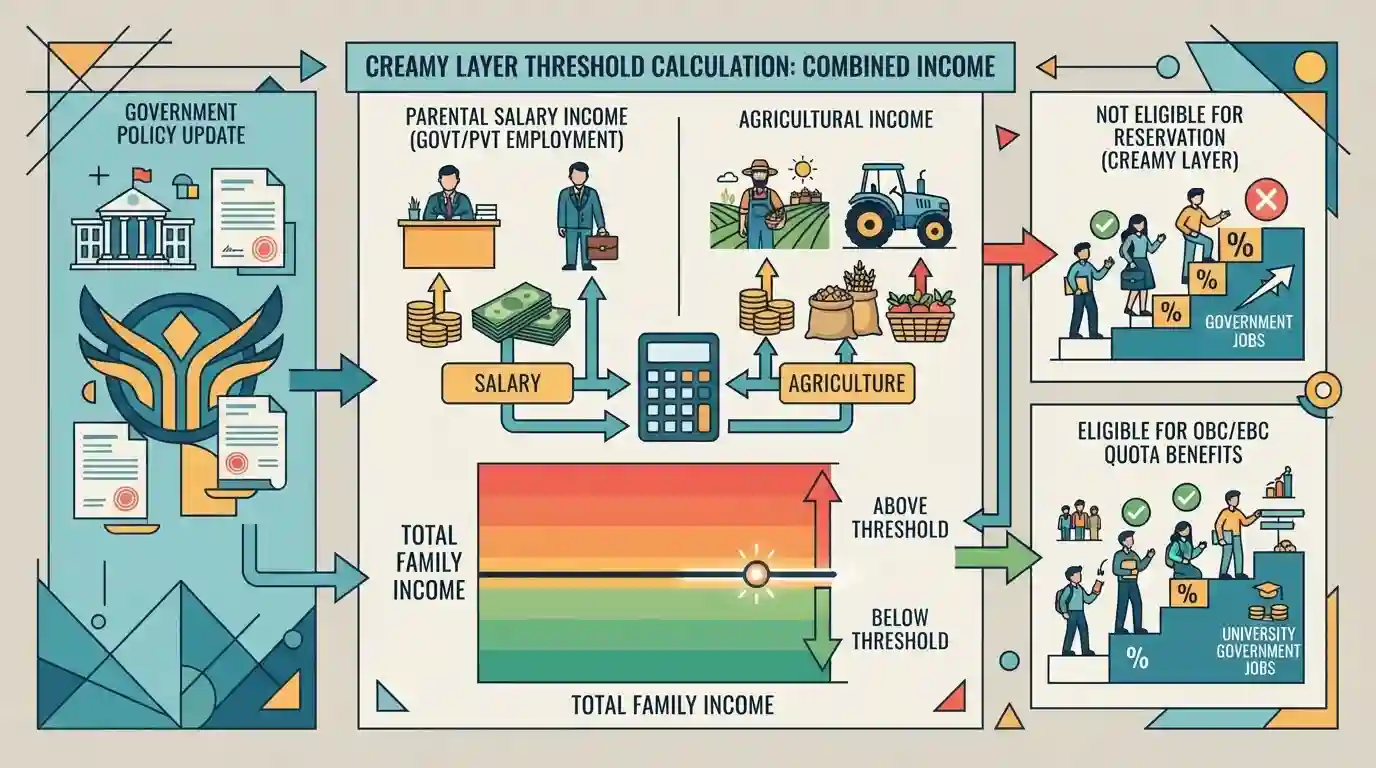
हे का महत्त्वाचे आहे
The determination of creamy layer criteria—especially concerning the inclusion or exclusion of salary and agricultural income—is a vital policy question touching upon social justice, federal principles, and the equitable distribution of reservation benefits under the Indian Constitution.
सारांश
An overview of the Bihar government's updated guidelines regarding the creamy layer criteria for reservations, specifically detailing how parents' salaries and agricultural incomes are factored into the threshold calculation to govern eligibility for OBC/EBC quotas.
मुख्य मुद्दे
- Bihar government clarified rules regarding the calculation of the 'creamy layer' threshold for reservation benefits, addressing how parents' salary and agricultural income are treated.
- The policy aims to fine-tune the exclusion principle to ensure that benefits of affirmative action reach the most deserving sections among Backward Classes (OBC/EBC).
- Issues surrounding the exclusion of agricultural income and salary components in computing gross annual income for creamy layer determination have long been contentious in reservations jurisprudence.
- The framework balances constitutional mandates of social justice with equitable distribution of state-sponsored opportunities.
महत्त्वाच्या संज्ञा
Creamy Layer

A threshold economic criteria used to exclude economically advanced individuals among Other Backward Classes (OBCs) from availing reservation benefits in public employment and educational institutions.
UPSC context
Crucial for GS Paper II (Social Justice, Reservation & Affirmative Action Issues). Tests understanding of equitable distribution of affirmative action benefits.
Bihar Government
The executive body of the state of Bihar, which recently issued guidelines clarifying that parents' salaries and agricultural earnings must be excluded from OBC creamy layer calculations.
UPSC context
Important for state-level social welfare policies and administrative guidelines under GS Paper II (Polity and Governance).
Supreme Court of India
The apex judicial body in India that interprets constitutional provisions on reservation and has recently pronounced key judgments addressing creamy layer criteria and anti-discrimination tests.
UPSC context
Vital for GS Paper II (Indian Constitution, Judicial Review, and Reservation Jurisprudence).
पूर्वपरीक्षा सापळा
Salary and agricultural income are always included when calculating the gross annual income threshold for creamy layer determination across all states.
Under DoPT rules and standard jurisprudence, salary and agricultural income are traditionally excluded from the gross annual income calculation for creamy layer determination, though states may adopt varying interpretations.
संबंधित स्थिर संकल्पना
What are the constitutional provisions and judicial milestones governing reservations and the creamy layer in India?
- Constitutional Basis: Constitutional Basis: Articles 15(4), 16(4), and 16(4A) empower the State to make special provisions for the advancement of any socially and educationally backward classes of citizens.
- Landmark Judgment: Indra Sawhney (1992): The Supreme Court upheld the 27% quota for OBCs but introduced the 'creamy layer' concept to exclude economically advanced members from reservation benefits.
- Exclusion Principle: Exclusion Principle: The creamy layer ensures that affirmative action targets genuine social and structural backwardness rather than mere economic hardship.
आंतर-विषय नमुने
State Reservations + Judicial Review Limits
State-level reservation enhancements intersect with Article 16(4) judicial limits and the 50% ceiling rule set in Indra Sawhney.
Fiscal Income Thresholds + Affirmative Action Jurisprudence
Clarifying agricultural and salary incomes in creamy layer calculations bridges fiscal federalism with Article 15/16 social justice mandates.

Indra Sawhney creamy layer rules vs. state income criteria changes likely to feature in a multi-statement polity/governance question.
संबंधित PYQ · 2
संबंधित PYQ · 2
- 2026PrelimsGS1
Consider the following statements about the provisions pertaining to the Scheduled Castes and the Scheduled Tribes in India : 1. Provisions regarding the administration of the Tribal Areas in the States of Assam, Meghalaya, Tripura and Mizoram are given in the Fifth Schedule of the Constitution of India. 2. Some tribes of India are entitled to exemption from paying Income Tax on certain incomes. 3. The Constitution of India provides for reservation of seats in Panchayats for women belonging to the Scheduled Castes and the Scheduled Tribes. Which one of the following conclusions based on the above statements is correct ?
- 2018PrelimsGS1
As per the NSSO 70th Round "Situation Assessment Survey of Agricultural Households", consider the following statements: 1. Rajasthan has the highest percentage share of agricultural households among its rural households. 2. Out of the total agricultural households in the country, a little over 60 percent belong to OBCs. 3. In Kerala, a little over 60 percent of agricultural households reported to have received maximum income from sources other than agricultural activities. Which of the statements given above is/are correct?
