Bihar cooperative policy 2026 launched to boost rural employment
Source:indian-masterminds ↗
Why It Matters
State-specific government policies (Saat Nischay-3), cooperative reforms, and schemes like PM Fasal Bima Yojana rollout are highly relevant for the BPSC Prelims, where the state's agriculture-dominated economy and allied sectors form a substantial portion of the syllabus.
Summary
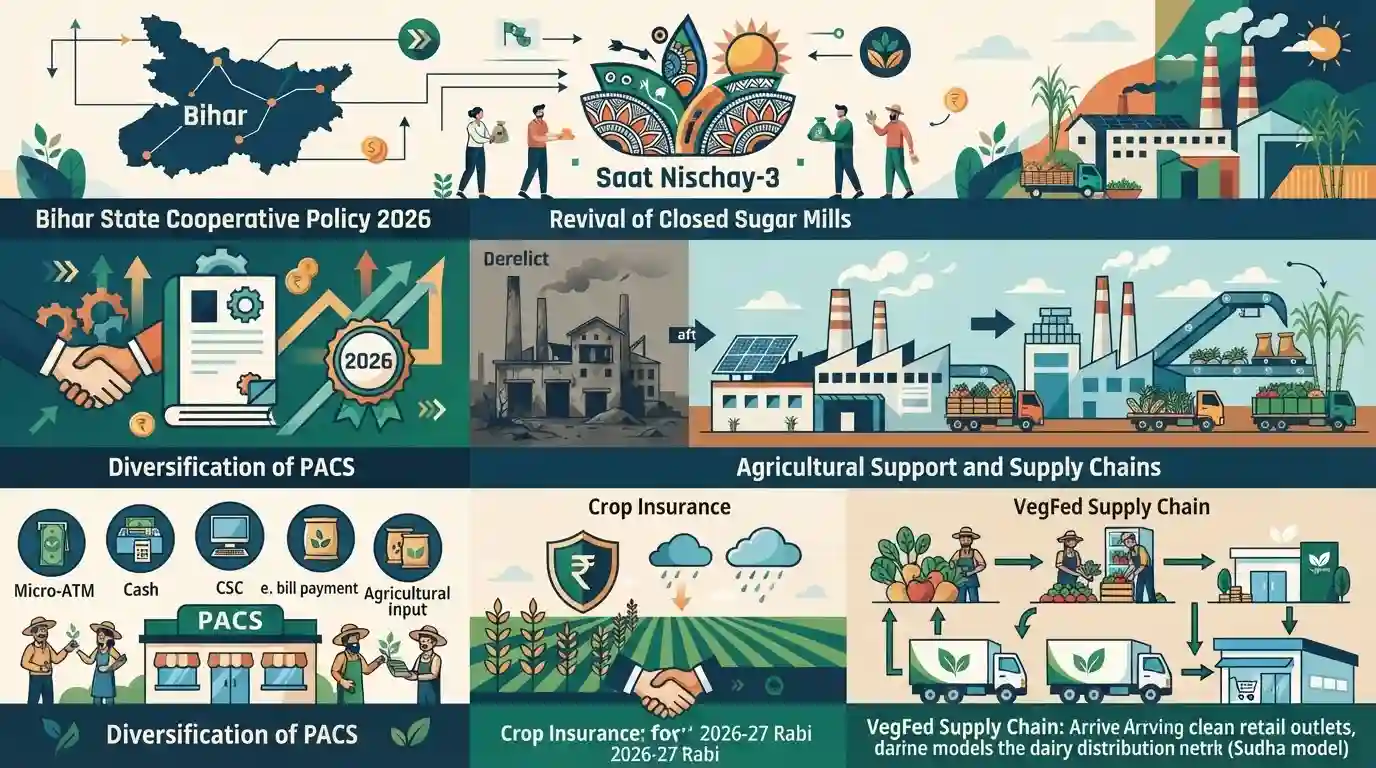
Bihar's Cooperation Minister Ramkripal Yadav has outlined comprehensive plans to revitalize the state's cooperative sector and rural economy under the "Samriddh Udyog-Sashakt Bihar" agenda of Saat Nischay-3. Initiatives include the introduction of the Bihar State Cooperative Policy 2026, the revival of closed sugar mills in Sakri and Raiyam into multi-functional complexes, and the diversification of Primary Agricultural Credit Societies (PACS) to offer services like micro-ATMs and CSCs. The push also focuses on agricultural support by rolling out the Pradhan Mantri Fasal Bima Yojana starting from the 2026-27 Rabi season and developing robust vegetable supply chains through VegFed, mirroring the Sudha dairy model.
Key Points
- Bihar aims to strengthen its rural economy through a major cooperative push under the 'Samriddh Udyog-Sashakt Bihar' vision of the Saat Nischay-3 scheme.
- Defunct sugar mills are slated for revival, including a cooperative mill at Sakri (Madhubani) and a model sugar complex at Raiyam (Darbhanga) partnering with India Potash Limited.
- The Bihar State Cooperative Policy 2026 is being drafted to modernize the sector with digital integration, while PACS are expanding services to function as Common Service Centres (CSCs) and Jan Aushadhi Kendras.
- The Pradhan Mantri Fasal Bima Yojana (crop insurance) will be implemented in the state beginning with the Rabi season of 2026-27.
- To enhance agricultural supply chains, vegetable collection centres and booths will be established across panchayats via VegFed, following the successful Sudha dairy model.
Important Terms
Saat Nischay-3

Bihar’s third multi-year development and governance framework (2025–2030) focusing on seven core resolves, including employment generation, industrial growth, agricultural progress, and infrastructure expansion.
UPSC context
GS Paper II: State-led welfare delivery models, cooperative federalism, and sub-national development planning.
Samriddh Udyog-Sashakt Bihar
One of the seven core resolves under Bihar’s Saat Nischay-3 programme, focusing on rapid industrial development, encouraging entrepreneurship, and reviving closed sugar mills to boost local employment.
UPSC context
GS Paper III: Industrial growth, employment generation, and regional economic development.
Bihar State Cooperative Policy 2026
A framework approved by the Bihar Cabinet in 2026 to modernize, digitize, and expand the cooperative sector, targeting inclusive participation of youth and women while promoting "Cooperative Villages."
UPSC context
GS Paper II/III: Government policies, rural development, and cooperative-led economic growth.
Primary Agricultural Credit Societies (PACS)
Village-level cooperative credit institutions that act as the grassroots arm of the cooperative banking system, now being diversified to offer multipurpose services like micro-ATMs and CSCs.
UPSC context
GS Paper III: Agricultural finance, cooperative credit structures, and rural financial inclusion.
VegFed
The Bihar State Vegetable Processing and Marketing Cooperative Federation, which is building a cooperative-led marketing and supply chain network for vegetables, modeled after the successful Sudha dairy system.
UPSC context
GS Paper III: Agricultural marketing, supply chain management, and reducing intermediary exploitation.
Sudha dairy
The popular brand of milk and dairy products operated by the Bihar State Co-operative Milk Producers’ Federation (COMFED), functioning as a successful cooperative dairy model in eastern India.
UPSC context
GS Paper III: Cooperative models, dairy sector development, and rural livelihood generation.
Pradhan Mantri Fasal Bima Yojana
A centrally sponsored crop insurance scheme launched in 2016 to shield farmers from climatic risks, which Bihar is set to rejoin starting from the Rabi 2026-27 season.
UPSC context
GS Paper III: Government schemes, crop insurance, and agricultural risk mitigation.
Prelims Trap
Primary Agricultural Credit Societies (PACS) are licensed and directly regulated by the Reserve Bank of India under the Banking Regulation Act.
PACS are registered under State Cooperative Societies Acts and are not directly licensed by the RBI, unlike State and District Central Cooperative Banks.
Static Concepts Connected
What is the constitutional status of Cooperative Societies in India under the 97th Amendment?
- Fundamental Right: Article 19(1)(c) was amended to protect the right to form cooperative societies as a fundamental right.
- DPSP Directive: Article 43B was added, directing the State to promote voluntary formation and professional management of cooperatives.
- Part IXB Limitation: Inserted Part IXB, though the Supreme Court later struck it down for state-subject cooperatives due to lack of state assembly ratification.
Cross-Topic Patterns
Cooperatives vs. Corporate Farming
Using cooperative dairy models for vegetable supply chains highlights how collective bargaining secures smallholder incomes and prevents agrarian distress without corporate land consolidation.
PACS as digital service nodes
Diversifying PACS into Common Service Centres aligns rural credit infrastructure with Digital India, converting traditional credit societies into multi-service e-governance nodes.

Modernization of PACS and constitutional limits on regulating state cooperative societies remain a high-probability 2026 Prelims theme.
Linked PYQs · 3
Linked PYQs · 3
- 2022BPSC_PRELIMSGS1
Which type of banks is proposed to be established for agriculture and rural development in Bihar?
- 2023BPSC_PRELIMSGS1
Which food industry dominates among the agro-based industries in Bihar?
- 2018BPSC_PRELIMSGS1
Which scheme was recognized as world's largest insurance scheme launched in India in September 2018?
