Bihar Introduces Policy to Tackle River Silt Accumulation
Source:etvbharat ↗
Why It Matters
Crucial for BPSC aspirants tracking Bihar's regional geography, environmental policy frameworks, riverine management issues, and infrastructure impacts like the Farakka Barrage.
Summary
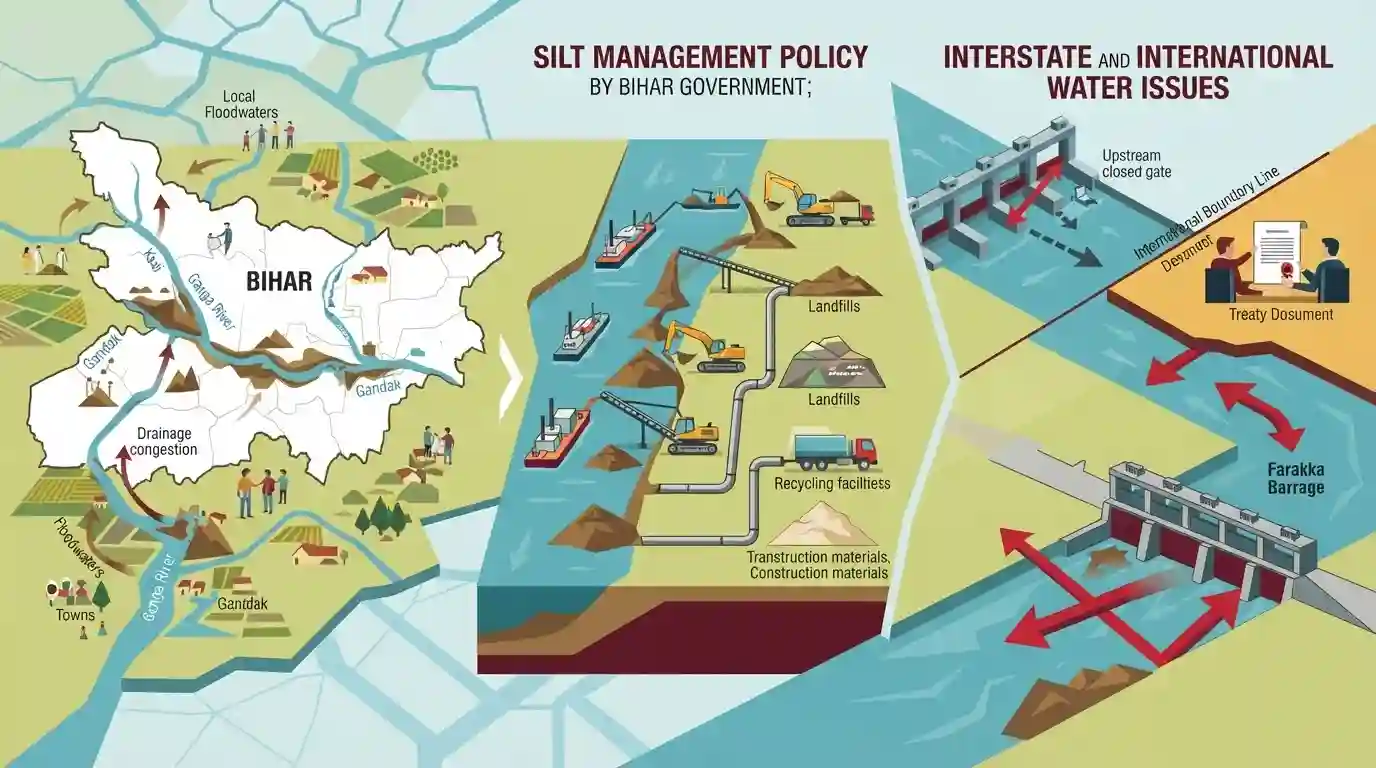
The Bihar government has introduced a Silt Management Policy to tackle the rising accumulation of silt in the state's rivers, particularly the Ganga. This policy arrives in the backdrop of widespread protests against the Farakka Barrage and the Ganga Water Sharing Treaty with Bangladesh, with stakeholders raising concerns over how upstream barrages and international water agreements impact siltation, drainage congestion, and flood patterns in Bihar.
Key Points
- Bihar has introduced a new Silt Management Policy to address severe siltation issues in its river systems, particularly the Ganga.
- The policy comes amid growing political and public protests in Bihar against the Farakka Barrage and the bilateral Ganga Water Sharing Treaty with Bangladesh, which critics argue worsen upstream silt accumulation and flooding.
- Siltation in the Ganga basin has severely impacted river flow dynamics, navigation, and agricultural productivity in Bihar, aggravating flood vulnerabilities.
Important Terms
Silt Management Policy

A policy introduced by the Bihar government to tackle rising silt accumulation in rivers like the Ganga, aiming to improve river capacity, reduce drainage congestion, and utilize dredged silt for infrastructure projects.
UPSC context
Important for BPSC (General Studies Paper-II: Geography and Economy of Bihar, Disaster Management). Tests knowledge of state-level environmental and river management initiatives.
Ganga Water Sharing Treaty
A 30-year bilateral agreement signed in 1996 between India and Bangladesh governing the sharing of Ganga waters at the Farakka Barrage during the dry season, currently nearing its expiration.
UPSC context
Relevant for BPSC (General Studies Paper-II: Indian Polity and International Relations, Bihar Geography). Tests understanding of transboundary water diplomacy and its impact on Bihar.
Farakka Barrage
A barrage constructed in 1975 on the Ganga River in West Bengal to divert water into the Hooghly River, which is blamed by Bihar for causing severe upstream siltation and increased flooding.
UPSC context
Important for BPSC (General Studies Paper-I & II: Bihar Geography and Interstate Water Disputes). Tests awareness of major river infrastructure and regional grievances.
Static Concepts Connected
What are the primary ecological and geographical challenges caused by siltation in Bihar's northern rivers?
- River Aggradation: Aggradation of river beds reduces carrying capacity, causing rivers like the Kosi and Gandak to frequently change their courses.
- Drainage Congestion: Silt accumulation blocks natural drainage channels, creating extensive waterlogging and drainage congestion in South and North Bihar plains.
- Flood Amplification: Reduced channel depth worsens monsoon overflow, severely aggravating flood vulnerabilities across districts adjacent to the Ganga.
Cross-Topic Patterns
Farakka Barrage: Interstate vs International Hydro-Diplomacy
The debate over Farakka Barrage bridges interstate river management (Bihar-West Bengal) with bilateral hydro-diplomacy (India-Bangladesh), a recurring theme in South Asian water security questions.

Bihar's Silt Management Policy + Farakka Barrage impact on Ganga will be framed as a multi-statement assertion question in BPSC Prelims.
Linked PYQs · 3
Linked PYQs · 3
- 2024-IBPSC_PRELIMSGS1
Which river is known as the ‘Sorrow of Bihar’?
- 2025BPSC_PRELIMSGS1
Which districts in Bihar will benefit from the Kosi Mechi Link Project?
- 2024-EBPSC_PRELIMSGS1
Which of the following drainage systems drains the lands of Bihar?
