Bihar Silt Management Policy and Farakka Barrage
Source:etvbharat ↗
Why It Matters
Crucial for BPSC aspirants tracking state-specific environmental and geographical governance, river management policies, and interstate/international water disputes affecting Bihar's flood dynamics.
Summary
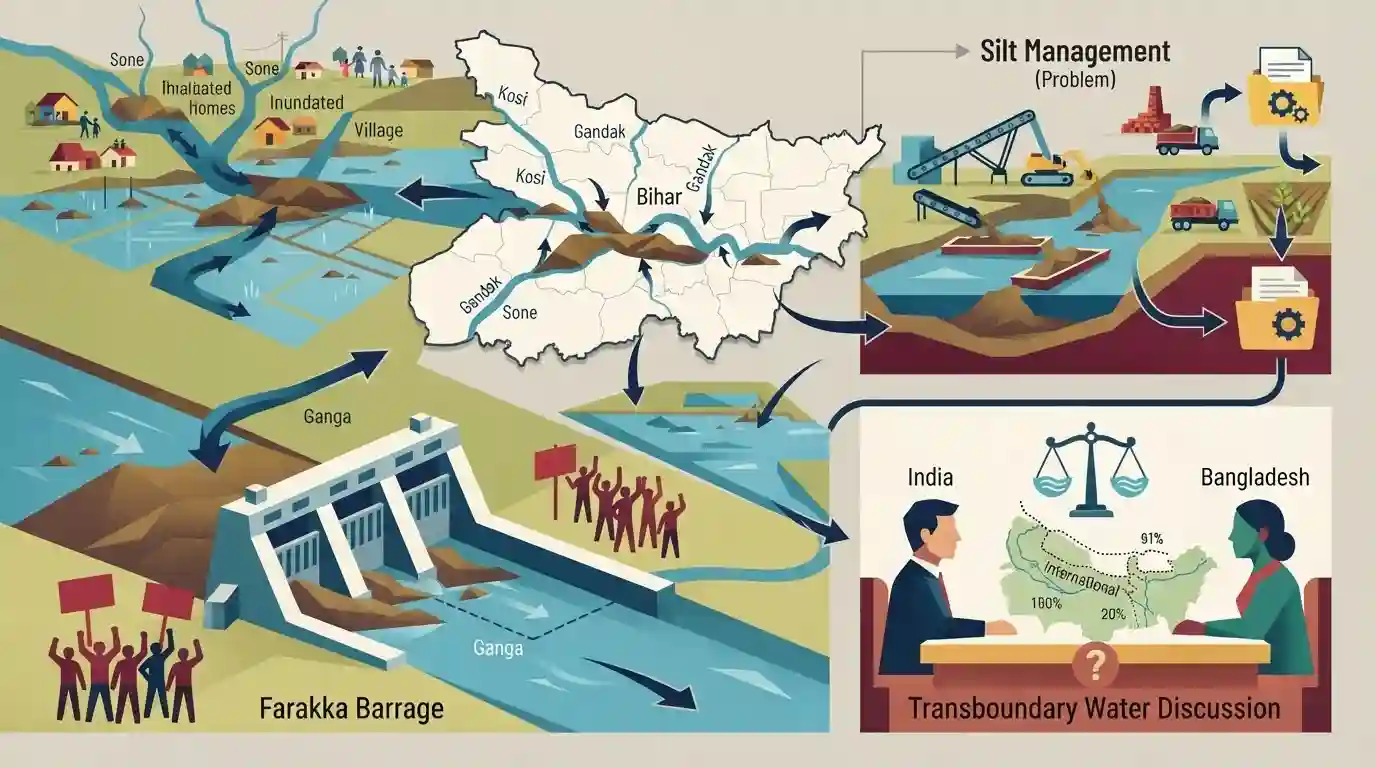
The Bihar government has formulated a Silt Management Policy to counter the severe challenge of river siltation and sedimentation, which has worsened flooding across the state. This policy arrives amidst rising protests and concerns regarding the Farakka Barrage's impact on river morphology and ongoing discussions surrounding the Ganga Water Sharing Treaty with Bangladesh.
Key Points
- The Bihar government has introduced a new Silt Management Policy to address the growing concern of heavy siltation, sedimentation, and rising riverbeds, which exacerbate floods in the state.
- The policy comes amid local protests and political debates regarding the adverse impacts of the Farakka Barrage on Bihar's drainage system and ecology.
- Concerns are also raised over the bilateral Ganga Water Sharing Treaty with Bangladesh and its implications for water availability and sediment flow in Bihar.
- Heavy silt accumulation reduces the carrying capacity of rivers like the Ganga, Kosi, and Gandak, necessitating systematic dredging and scientific sediment management.
Important Terms
Silt Management Policy

A state policy formulated by Bihar to manage, extract, and utilize accumulated river silt and sediment to mitigate severe annual flooding, restore river capacity, and supply material for infrastructure projects.
UPSC context
BPSC Paper II (Geography & Polity) / Disaster Management: Important for questions on Bihar's perennial flood menace and state-level river restoration policies.
Ganga Water Sharing Treaty
A bilateral 30-year treaty signed in 1996 between India and Bangladesh to regulate dry-season water sharing of the Ganges River at the Farakka Barrage, nearing expiration.
UPSC context
BPSC Paper II (International Relations & Geography): Tests knowledge of India-Bangladesh transboundary river diplomacy, hydro-politics, and regional state interests.
Farakka Barrage
A crucial water diversion structure on the Ganges River in West Bengal, whose upstream siltation impact on the Ganga has triggered major political protests and debates in Bihar.
UPSC context
BPSC Paper I/II (Bihar Geography & Interstate Relations): Tests understanding of river morphology, dams/barrages, and inter-state environmental contentions.
Static Concepts Connected
What are the key provisions and historical background of the Ganga Water Sharing Treaty (1996)?
- Timeline and Renewal: Signed in December 1996 for a 30-year period between India and Bangladesh, set to expire around 2026.
- Lean Season Sharing: Specifies water-sharing formulas at the Farakka Barrage during the lean period (January 1 to May 31).
- Guarantee Clause: Guarantee clause historically assured a minimum flow to Bangladesh, a point of continuous political contention for upstream Bihar.
Cross-Topic Patterns
Interstate Barrages and International Treaties
The Farakka Barrage dispute bridges interstate water management under Entry 56 of the Union List with international river diplomacy.
Circular Infrastructure and Sediment Economics
The economic reuse of extracted river sediment for national highway construction links state-level flood management with the PM Gati Shakti framework.

BPSC frequently combines interstate river disputes (Farakka) with state policy initiatives like the Silt Management Policy in multi-statement MCQs.
Linked PYQs · 2
Linked PYQs · 2
- 2024-EBPSC_PRELIMSGS1
Which of the following drainage systems drains the lands of Bihar?
- 2020BPSC_PRELIMSGS1
Which of the following rivers flowing in Bihar is a north flowing river?
