Bihar Silt Management Policy and Farakka Barrage Concerns
Source:etvbharat ↗
Why It Matters
Crucial for BPSC aspirants as it directly addresses Bihar's state-specific geography, river management, flood vulnerabilities, and major infrastructure disputes like the Farakka Barrage which affect regional ecology and state economy.
Summary
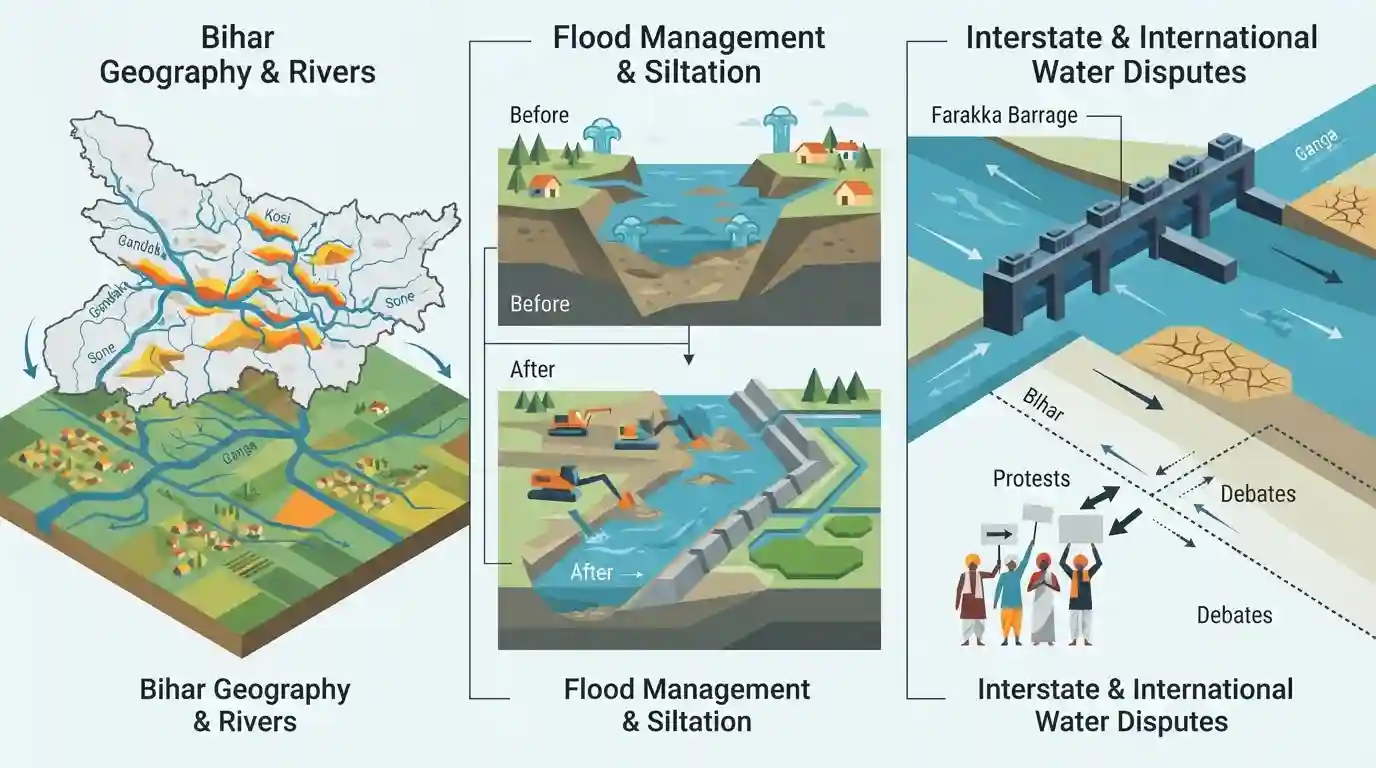
The Bihar government has formulated a comprehensive Silt Management Policy aimed at combating severe sedimentation and flood vulnerabilities across its river network. This move coincides with widespread protests and debates in the state concerning the environmental and hydrological fallout of the Farakka Barrage and bilateral Ganga water sharing mechanisms, which critics link to accelerated riverbed aggradation and increased flooding in Bihar.
Key Points
- Bihar government has introduced a new Silt Management Policy to address rising concerns over heavy sedimentation, riverbed rise, and recurring floods in the state's river systems.
- The policy comes amid growing political and public protests in Bihar regarding the adverse impacts of the Farakka Barrage and the Ganga Water Sharing Treaty with Bangladesh.
- Experts and local stakeholders argue that the Farakka Barrage has severely disrupted the natural flow of the Ganga, trapping silt upstream, raising riverbeds, and exacerbating flood risks across Bihar.
- The issue highlights longstanding friction between state-level flood management challenges and interstate/international water treaties involving upstream and downstream stakeholders.
Important Terms
Silt Management Policy

A state-level policy formulated by Bihar to address severe river sedimentation and flood vulnerabilities by regulating and utilizing accumulated silt across its river network.
UPSC context
Important for BPSC Paper II (Geography/Environment) under flood management, disaster mitigation, and state governance initiatives.
Ganga Water Sharing Treaty
A bilateral water-sharing agreement between India and Bangladesh signed in 1996 to govern dry-season water distribution at the Farakka Barrage, currently a focal point of debate regarding upstream siltation in Bihar.
UPSC context
Relevant for BPSC Paper II (International Relations & Polity) focusing on India-Bangladesh hydro-diplomacy and interstate/regional resource disputes.
Static Concepts Connected
What are the major geographical features and historical context of the Farakka Barrage?
- Commissioning & Purpose: Commissioned in 1975 in West Bengal to preserve and maintain the Kolkata Port by flushing silt using Bhagirathi-Hooghly flow.
- Location & Impact: Located on the Ganga river, close to the international border with Bangladesh, causing upstream siltation in Bihar.
- 1996 Treaty: Ganga Water Sharing Treaty signed in 1996 for a 30-year period, governing lean-season water sharing at Farakka.
Cross-Topic Patterns
Farakka Barrage: Domestic Floods vs. Hydro-Diplomacy
The Farakka Barrage dispute bridges Bihar's domestic flood management with India-Bangladesh bilateral hydro-diplomacy, frequently tested in BPSC questions on international water treaties.
Silt Management Policy & Infrastructure Synergy
Dredged river silt utilization in national highways and railways connects state-level water policies with national circular economy and infrastructure development frameworks.

Expect a linked question on Farakka Barrage's impact on Bihar's riverbed aggradation and the provisions of the Ganga Water Sharing Treaty.
Linked PYQs · 3
Linked PYQs · 3
- 2024-EBPSC_PRELIMSGS1
Which of the following drainage systems drains the lands of Bihar?
- 2019BPSC_PRELIMSGS1
The number of districts situated on the bank of Ganga river in Bihar State is
- 2022BPSC_PRELIMSGS1
Ganga Plain has been described as a
