Bihar Transfers Agriculture Input Subsidy to Calamity-Hit Farmers
Source:The Hindu ↗
Why It Matters
Understanding the relief mechanisms for crop damage and disaster subsidies is crucial for BPSC Prelims, as the state frequently suffers from unpredictable climatic events. Details such as the 33% damage threshold, participating districts, and DBT mechanisms are frequently examined.
Summary
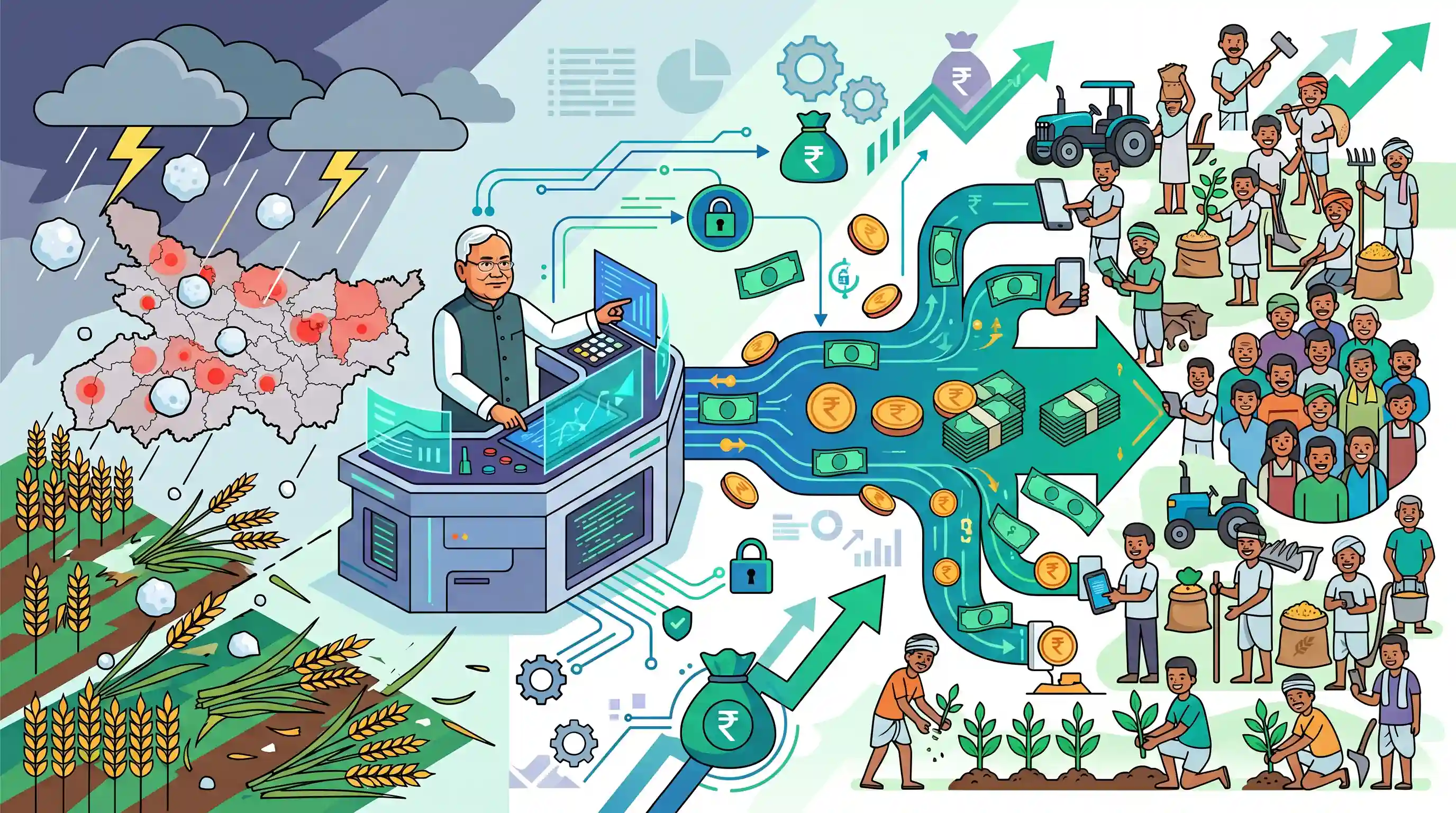
On June 22, 2026, Bihar Chief Minister Samrat Chaudhary transferred over ₹200 crore under the Agriculture Input Subsidy Scheme to 3.96 lakh farmers. The financial aid, dispatched via Direct Benefit Transfer (DBT), was intended to compensate for Rabi crop damage exceeding 33% caused by hailstorms, unseasonal rains, and lightning in March 2026 across 13 districts of Bihar.
Key Points
- Bihar Chief Minister Samrat Chaudhary transferred over ₹200 crore to more than 3.96 lakh farmers on June 22, 2026.
- The funds were disbursed under the Agriculture Input Subsidy Scheme (कृषि इनपुट सब्सिडी योजना) using Direct Benefit Transfer (DBT) to ensure transparency.
- The relief compensation addresses crop damage caused by natural calamities (unseasonal rain, lightning, and hailstorms) during the third and fourth weeks of March 2026 (Rabi season 2025-26).
- Compensation eligibility requires crop damage exceeding 33% in the disaster-hit areas.
- A total of 13 districts in Bihar were affected by these climatic events, including Saharsa, Samastipur, Muzaffarpur, Madhepura, Araria, Begusarai, Purnia, Darbhanga, Kishanganj, Khagaria, and Madhubani.
Important Terms
Krishi Input Subsidy Scheme

A state government initiative in Bihar providing financial compensation to registered farmers suffering over 33% crop damage due to natural calamities like hailstorms, droughts, or floods.
UPSC context
GS Paper III (Agriculture/Welfare Schemes); tests knowledge of state-level disaster mitigation, crop insurance, and financial support for distressed farmers.
Direct Benefit Transfer (DBT)
A governance reform mechanism in India that transfers welfare subsidies and payments directly into beneficiaries' Aadhaar-linked bank accounts, eliminating intermediaries and reducing system leakages.
UPSC context
GS Papers II & III (Governance/e-Gov/Economy); tests mechanisms of public delivery, financial inclusion, leakage elimination, and welfare governance.
Rabi Crop
Agricultural crops sown in winter (October to December) after the monsoon's retreat and harvested in spring (March to April). Key examples include wheat, mustard, and gram.
UPSC context
GS Papers I & III (Geography/Agriculture); tests familiarity with Indian cropping seasons, climate requirements, and food security patterns.
Agricultural Subsidies
Government financial interventions that lower farming input costs, stabilize rural incomes, and incentivize production to maintain nationwide food security and support agrarian livelihoods.
UPSC context
GS Paper III (Indian Economy/Agriculture); analyses the fiscal, environmental, distributive, and trade-related implications of domestic farm supports.
Prelims Trap
Lightning is classified as a notified natural disaster under the NDRF, enabling direct central funding for lightning-induced crop compensation.
The Centre does not categorize lightning as a notified natural disaster; states must fund lightning relief using their discretionary 10% SDRF allocation.
Static Concepts Connected
What are the operational guidelines and notified disasters under the SDRF/NDRF frameworks?
- Damage Threshold: Farmers qualify for agriculture input subsidy only if crop loss exceeds 33% (reduced from 50% in 2015).
- Notified List: Includes 12 disasters like floods, cyclones, and hailstorms, but excludes lightning, cold waves, and heatwaves at the national level.
- SDRF Cost Sharing: The Centre contributes 75% of SDRF allocation for general category states and 90% for special category states.
What meteorological factors cause severe pre-monsoon hailstorms and lightning in Eastern India?
- Western Disturbances: Extra-tropical cyclonic systems originating over the Mediterranean carry moisture eastward, destabilizing the upper atmosphere over northern India.
- Convective Confluence: These disturbances collide with warm, humid south-westerly winds from the Bay of Bengal, triggering violent localized thunderstorms.
Cross-Topic Patterns
Disaster federalism and lightning relief
Excluding lightning from the national NDRF list forces vulnerable states to exhaust discretionary SDRF caps, exposing gaps in fiscal disaster management.
Agro-climatic zoning vs. crop insurance
Integrating Bihar's distinct agro-climatic zones with PMFBY and DBT helps shift agriculture from reactive input subsidies to proactive risk-mitigation.

Multi-statement questions may test NDRF notified disasters (excluding lightning) alongside the 33% crop loss threshold for input subsidies.
Linked PYQs · 4
Linked PYQs · 4
- 2024-EBPSC_PRELIMSGS1
What is the contribution of agriculture in the Gross Domestic Product (GDP) of Bihar?
- 2020BPSC_PRELIMSGS1
Bihar Government launched a new scheme 'Satat Jivikoparjan Yojana' in August 2018. The objective of this scheme is
- 2020BPSC_PRELIMSGS1
The Government of India conferred the Krishi Karman Award to Bihar State on 2nd January, 2020. This award was given for
- 2025BPSC_PRELIMSGS1
Most of the Bihar comes under which of the following climate type?
