Bihar social security pension disbursement and monthly pension day
Source:The Hindu ↗
Why It Matters
This article contains crucial, highly specific facts regarding Bihar's social welfare administration, pension payout hikes (from ₹400 to ₹1,100), the declaration of 'Bihar Pension Day' (10th of every month), and digital governance via DBT, which are frequently asked in BPSC Prelims state-specific governance questions.
Summary
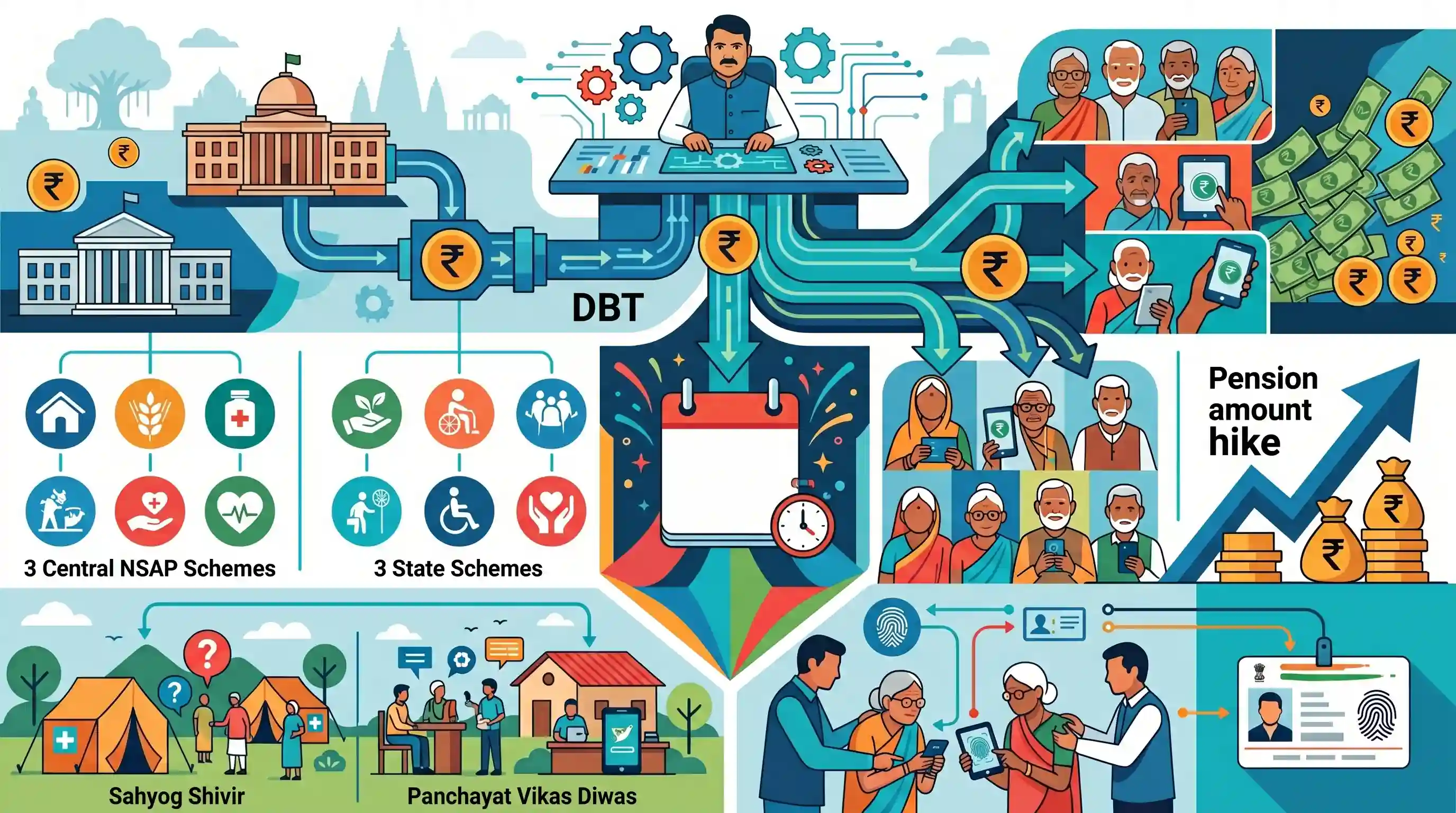
Bihar Chief Minister Samrat Choudhary transferred ₹1,423.94 crore via Direct Benefit Transfer (DBT) to 97.84 lakh social security pensioners and declared the 10th of every month as 'Bihar Pension Day' for timely disbursement. The funds cover three state pension schemes and three central National Social Assistance Programme (NSAP) schemes. Furthermore, the pension amount has been hiked from ₹400 to ₹1,100, and special welfare drives like 'Sahyog Shivir' and 'Panchayat Vikas Diwas' will be utilized to link remaining beneficiaries with Aadhaar.
Key Points
- Bihar Chief Minister Samrat Choudhary transferred ₹1,423.94 crore via Direct Benefit Transfer (DBT) to the bank accounts of 97.84 lakh social security pensioners.
- The Chief Minister announced that the 10th of every month will henceforth be observed as 'Bihar Pension Day' to ensure timely and monthly pension transfers via DBT.
- The transfers cover payments for June 2026 under the three state-specific pension schemes, and for May and June 2026 under the three National Social Assistance Programme (NSAP) pension schemes.
- The social security pension amount has been raised from ₹400 to ₹1,100 to enhance the livelihood and dignity of the elderly, disabled, and marginalized.
- To eliminate exclusion errors, special drives will be held during 'Sahyog Shivir' (assistance camps) and 'Panchayat Vikas Diwas' (Panchayat Development Day) to link missing eligible beneficiaries via Aadhaar.
Important Terms
National Social Assistance Programme (NSAP)

A centrally sponsored scheme launched in 1995 that provides social pensions and financial assistance to the elderly poor, widows, and persons with disabilities.
UPSC context
GS Paper II (Welfare Schemes) & GS Paper III (Social Security). Tests constitutional mandates for vulnerable sections under Article 41.
Bihar Pension Day
A designated state governance initiative in Bihar ensuring direct benefit transfers (DBT) of social security pensions to all eligible beneficiaries on the 10th of every month.
UPSC context
GS Paper II (Governance and E-Governance). Tests mechanisms designed to streamline public service delivery and direct benefit transfers.
Sahyog Shivir
A local facilitation and public grievance redressal campaign in Bihar aimed at solving civic issues, explaining policies, and registering remaining beneficiaries for government programs.
UPSC context
GS Paper II (Social Sector & Grievance Redressal). Tests administrative reforms, public grievance resolution, and inclusive outreach.
Panchayat Vikas Diwas
A state-wide monthly initiative held on the last Sunday of every month in Bihar to promote participative local governance, village project audits, and rural development.
UPSC context
GS Paper II (Decentralization and Local Governance). Tests grass-roots democracy, community participation, and decentralization policies.
Social Welfare Department (Bihar)
The provincial administrative department of Bihar responsible for the design, execution, and supervision of social security, pensions, and welfare schemes for marginalized groups.
UPSC context
GS Paper II (Welfare Schemes). Tests state-level administrative frameworks and institutional machinery for delivering social justice.
Prelims Trap
The National Social Assistance Programme is a Central Sector Scheme under the Ministry of Social Justice and Empowerment.
NSAP is a Centrally Sponsored Scheme (not Central Sector) and is administered by the Ministry of Rural Development, not Social Justice.
Static Concepts Connected
What is the National Social Assistance Programme (NSAP)?
- Origin and Ministry: Launched in 1995 as a Centrally Sponsored Scheme under the Ministry of Rural Development.
- Constitutional Mandate: Fulfills Article 41 of the DPSP, directing the State to provide public assistance to vulnerable citizens.
- Pension Components: Comprises IGNOAPS (elderly), IGNWPS (widow), and IGNDPS (disabled).
- Non-Pension Components: Includes National Family Benefit Scheme (NFBS) and Annapurna Scheme (food grain security).
Constitutional provisions governing social security in India
- Article 41 (DPSP): Directs the State to secure the right to public assistance in cases of old age, sickness, and disablement.
- Article 42: Secures just and humane conditions of work and maternity relief.
- Seventh Schedule: Places 'Social security and social insurance' under the Concurrent List (List III, Entry 23).
Cross-Topic Patterns
Demography vs State Fiscal Capacity
As states like Bihar approach their demographic peak, rising geriatric dependency ratios demand massive expansions of state-funded pension top-ups, stressing state finances.
DBT and Welfare Exclusion Errors
While DBT reduces financial leakages, biometric/Aadhaar failures create exclusion risks, making local decentralized camps critical for correcting digital-delivery errors.

Prelims 2026 may target the structural components of NSAP, specifically distinguishing pension and non-pension sub-schemes.
Linked PYQs · 2
Linked PYQs · 2
- 2020BPSC_PRELIMSGS1
Bihar Government launched a new scheme 'Satat Jivikoparjan Yojana' in August 2018. The objective of this scheme is
- 2025BPSC_PRELIMSGS1
Consider the following statements: 1) The proportion of the young population (0-19 years) in Bihar is projected to decline significantly by 2041. 2) Bihar’s demographic dividend is expected to peak around 2041. 3) The elderly population (60+ years) in Bihar is expected to rise more sharply than in India. Select the correct answer using the codes given below:
