Bihar Discusses Legal Framework for CBI Jurisdiction
Source:Indian Express ↗
Why It Matters
The article touches upon the operational framework of central investigative agencies like the CBI and their interaction with state consent under the DSPE Act, which is a key topic in Indian federalism and polity.
Summary
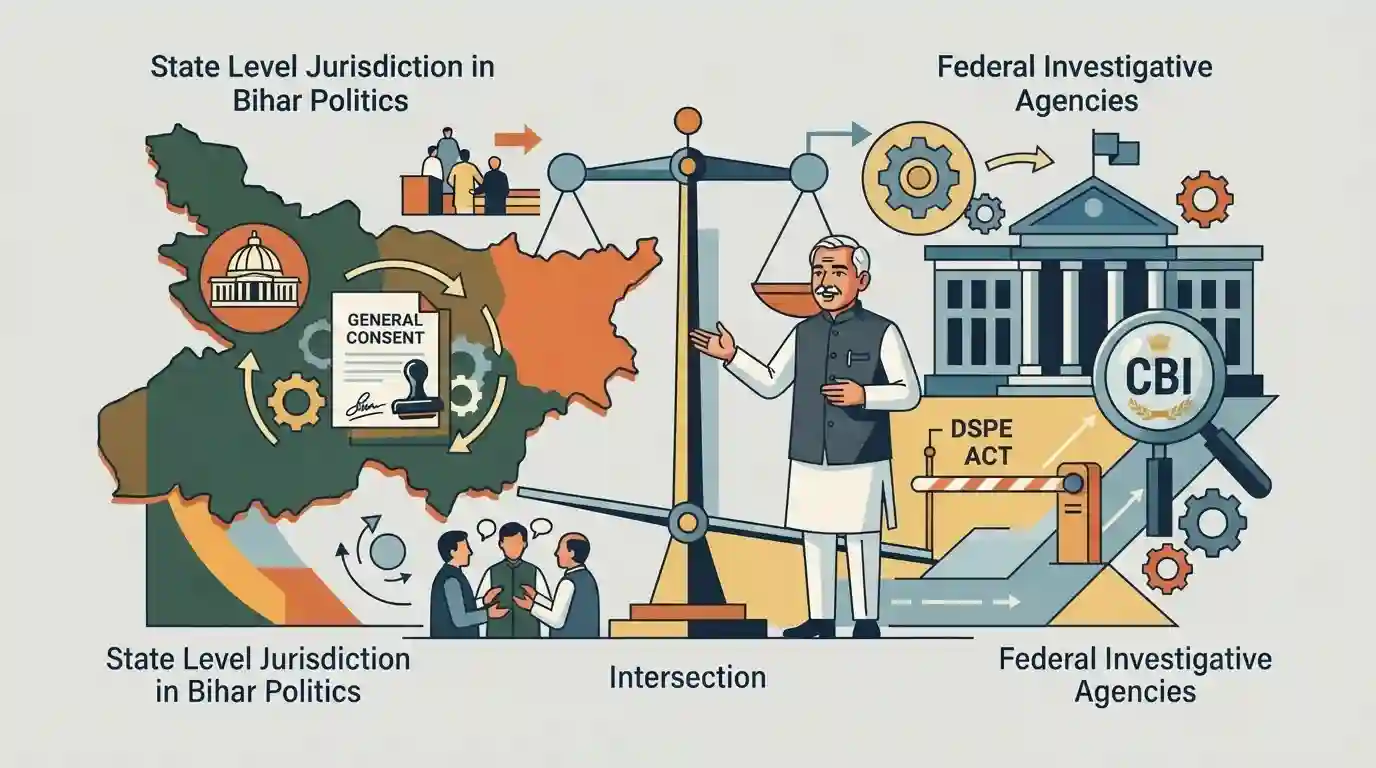
Bihar Deputy CM Samrat Choudhary commented on matters related to CBI consent under the DSPE Act, highlighting the intersection of federal investigative agencies and state-level jurisdiction in Bihar politics and administration.
Key Points
- Bihar Deputy Chief Minister Samrat Choudhary addressed discussions surrounding CBI's jurisdiction and general consent in the state.
- The legal framework governing the Central Bureau of Investigation (CBI) stems from the Delhi Special Police Establishment (DSPE) Act, 1946.
- States hold the power to grant or withdraw 'general consent' to the CBI for investigating cases within their territorial jurisdiction, impacting federal-state police cooperation.
Important Terms
Delhi Special Police Establishment (DSPE) Act

A legislation governing the Central Bureau of Investigation, where Section 6 requires state government consent before the agency can exercise investigative jurisdiction within a state.
UPSC context
Polity and Governance (GS Paper II); tests statutory frameworks governing federal investigative agencies and Centre-State relations.
Central Bureau of Investigation (CBI)
India's premier federal investigating agency that derives its legal powers from the DSPE Act, 1946, requiring state consent to probe non-union matters.
UPSC context
Statutory Bodies and Federal Polity (GS Paper II); tests the operational jurisdiction and autonomy of central investigative agencies.
Prelims Trap
Withdrawal of general consent completely bars the CBI from operating within a state's borders under any circumstance.
Aspirants often assume that once a state withdraws general consent, the CBI can no longer probe any case within that state. In reality, central agency probes can still proceed via specific court orders or for pre-existing registered cases.
Static Concepts Connected
What is the statutory basis and mechanism of General Consent for the CBI?
- Statutory Basis: The CBI derives its power from the Delhi Special Police Establishment (DSPE) Act, 1946.
- Section 6 DSPE: Under Section 6, the CBI needs state consent to investigate within a state's territorial jurisdiction.
- Judiciary Override: Supreme Court and High Courts can order CBI probes regardless of state consent withdrawal.
Cross-Topic Patterns
CBI General Consent vs. Federalism
The withdrawal of general consent by states creates a federal friction point between state policing powers (List II) and central investigative bodies (List I).

DSPE Act Section 6 and general consent will feature in Indian Polity questions testing Centre-State federal balance.
Linked PYQs · 3
Linked PYQs · 3
- 2024-IBPSC_PRELIMSGS1
The power of the Supreme Court of India to decide disputes between the Centre and the State falls under its
- 2024-IBPSC_PRELIMSGS1
The Parliament can make any law for the whole or any part of India for implementing International treaties
- 2023BPSC_PRELIMSGS1
Which of the following is concerned with the Supreme Court of India?
