Bihar Government Orders Judicial Probe into Bhojpur Police Encounter
Source:The Hindu ↗
Why It Matters
This article highlights critical elements of state administration, police accountability, human rights frameworks (Article 21), and the administrative powers of state governments to order judicial inquiries under the Commission of Inquiry Act 1952, which are frequent subjects in the BPSC Prelims polity section.
Summary
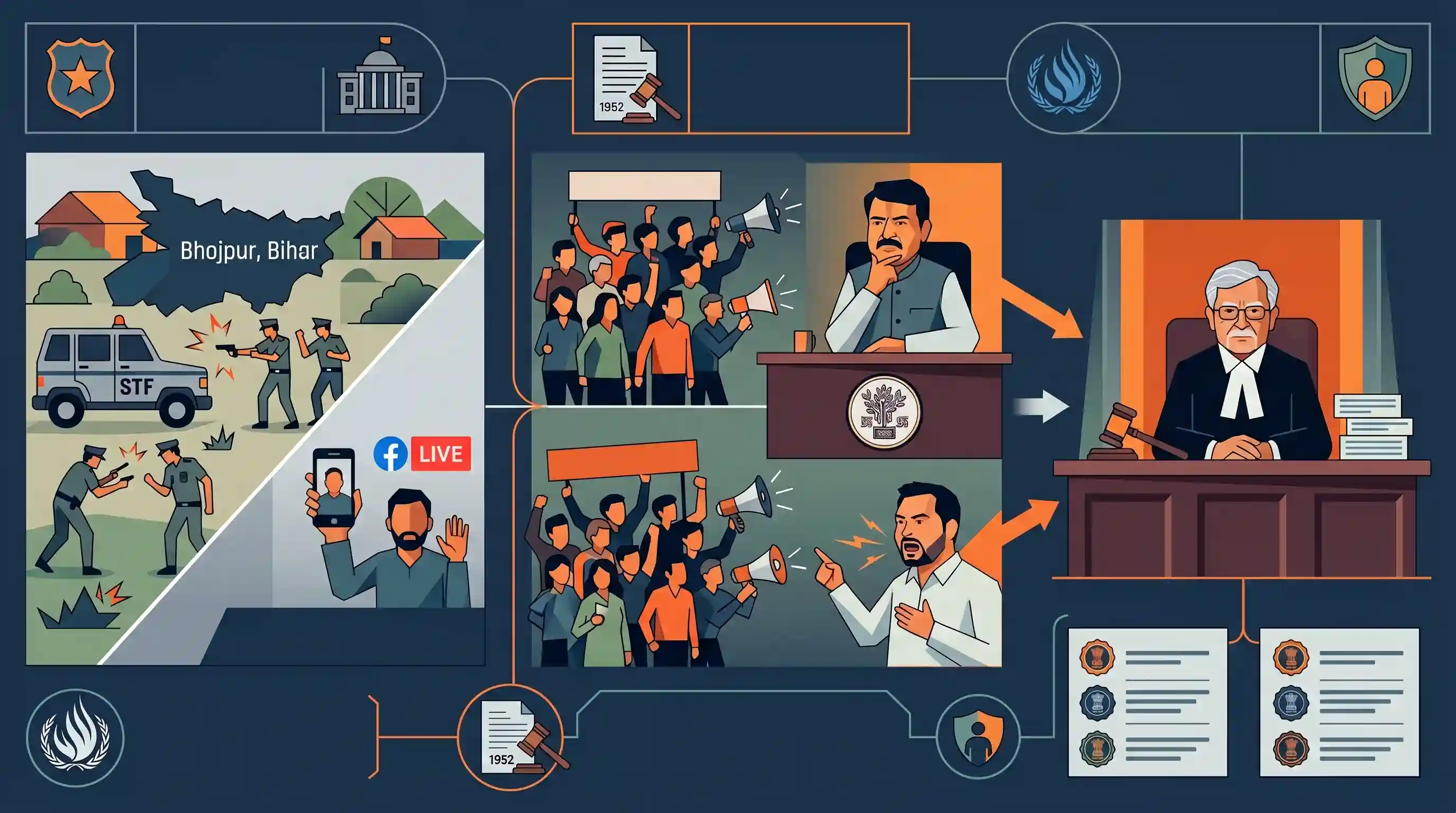
The Bihar state government, led by Chief Minister Samrat Choudhary, has ordered a retired High Court judge-led judicial inquiry into the alleged fake encounter of social activist Bharat Bhushan Tiwari on June 17, 2026, in Bhojpur district. Despite police and STF claims of a shootout, video evidence and a Facebook Live stream by the victim before his death showed him surrendering. Following widespread public and political outrage, including sharp criticism from opposition leader Tejashwi Yadav, the government ordered a formal inquiry to ensure administrative transparency.
Key Points
- Bihar Chief Minister Samrat Choudhary ordered a judicial inquiry by a retired High Court judge into the controversial death of 28-year-old social activist Bharat Bhushan Tiwari.
- The incident occurred on June 17, 2026, at Bilaoti village within the Shahpur police station limits of Bhojpur district, Bihar.
- Bhojpur Police and the Special Task Force (STF) initially claimed that Tiwari was killed in a retaliatory gunfight, but viral video footage from a local resident and Tiwari's own Facebook Live broadcast indicated he surrendered with hands raised.
- The victim, who worked for the rights of SC/ST/OBC and impoverished communities and had no prior criminal record, died while undergoing medical treatment at the Patna Medical College and Hospital (PMCH).
- The alleged fake encounter led to intense political controversy, with Leader of Opposition Tejashwi Yadav terming it administrative failure, leading to a prompt state-level intervention by the Chief Minister to ensure a transparent probe.
- Under the Indian constitutional framework, 'Police' and 'Public Order' are state subjects (Seventh Schedule), meaning state governments possess the legal authority to set up Commissions of Inquiry to investigate police actions under the Commission of Inquiry Act, 1952.
Important Terms
Commission of Inquiry Act, 1952

A central legislation empowering the Union and State governments to appoint commissions to investigate matters of public importance, vesting them with the powers of a civil court but without final judicial enforcement authority.
UPSC context
GS Paper II: Polity and Governance. Tests understanding of statutory bodies, federal administrative powers, and mechanisms for executive accountability.
Article 21 of the Constitution of India
A fundamental right guaranteeing that no person shall be deprived of their life or personal liberty except according to procedure established by law, protecting individuals from arbitrary state actions and extrajudicial executions.
UPSC context
GS Paper II: Constitutional Law and Fundamental Rights. Tests the conceptual evolution of the Right to Life, civil liberties, and human rights.
Seventh Schedule of the Constitution of India
A constitutional schedule under Article 246 that delineates the legislative powers and division of subjects between the Union and State governments across three lists: Union, State, and Concurrent.
UPSC context
GS Paper II: Federalism and Constitutional Structure. Tests knowledge of Centre-State relations, legislative jurisdiction, and the federal distribution of power.
Special Task Force (STF)
A specialized, elite unit within state police departments in India, created to neutralize organized crime networks, counter-insurgency operations, terrorism, and high-profile criminal activities.
UPSC context
GS Paper III: Internal Security. Tests awareness of state security architectures, policing agencies, and internal security challenges.
Prelims Trap
Commission of Inquiry recommendations are legally binding if the Commission is headed by a retired High Court or Supreme Court judge.
Under the 1952 Act, Commissions are purely fact-finding, advisory bodies. Regardless of whether a retired Supreme Court or High Court judge heads them, their findings are never legally binding on the government.
Static Concepts Connected
What are the federal limits of the Commissions of Inquiry Act, 1952?
- Subject restriction: State governments are restricted to appointing commissions only on subjects listed in List II (State List) or List III (Concurrent List).
- Parallel commissions: A state cannot establish a parallel commission if the Central Government has already set up one to investigate the same matter.
- Non-binding nature: Commission recommendations are strictly advisory and non-binding; they possess civil court powers but do not perform judicial functions.
What are the PUCL v. State of Maharashtra (2014) mandates?
- Mandatory FIR: An FIR must be registered immediately under Section 154 CrPC, followed by an independent probe by CID or another police station.
- Magisterial Inquiry: A mandatory magisterial inquiry under Section 176 CrPC must be conducted in all cases of encounter deaths.
- NHRC reporting: A detailed report on every encounter death must be sent to the NHRC or State Human Rights Commission without delay.
Cross-Topic Patterns
Police reforms and Article 21
Extrajudicial killings directly violate the 'procedure established by law' under Article 21, highlighting the slow execution of Prakash Singh directives on police accountability.
Federal friction in inquiry commissions
Section 3 of the 1952 Act allows central override of state-appointed commissions, occasionally sparking federal friction over sensitive state-list security issues.

PUCL guidelines (2014) combined with the federal limits of the Commission of Inquiry Act 1952 likely to feature in 2026 Prelims.
Linked PYQs · 3
Linked PYQs · 3
- 2025BPSC_PRELIMSGS1
The constitution of India provides for reasonable restrictions on Fundamental Rights but reasonableness must keep in mind that: 1. The restrictions must be necessary for the protection of the rights of others. 2. The restrictions must be proportionate to the end sought. 3. The restrictions must be reasonable in the light of the circumstances. 4. The restrictions must be in the public interest.
- 2020BPSC_PRELIMSGS1
Who was the first Chief Minister of Bihar?
- 2025BPSC_PRELIMSGS1
Consider the following subjects belonging to different lists of the constitution of India. Which of the following subjects belong to concurrent list? 1) Protection of wildlife 2) Income on Agriculture 3) Tax on Electricity consumption or sale 4) Price control Out of these:
