State Publications and Public Welfare Scheme Dissemination
Source:patna-press ↗
Why It Matters
Understanding the mechanisms of government communication and information dissemination is crucial for Governance. The publications emphasize the state's flagship welfare schemes (like Saat Nishchay), which are frequently tested in BPSC Prelims.
Summary
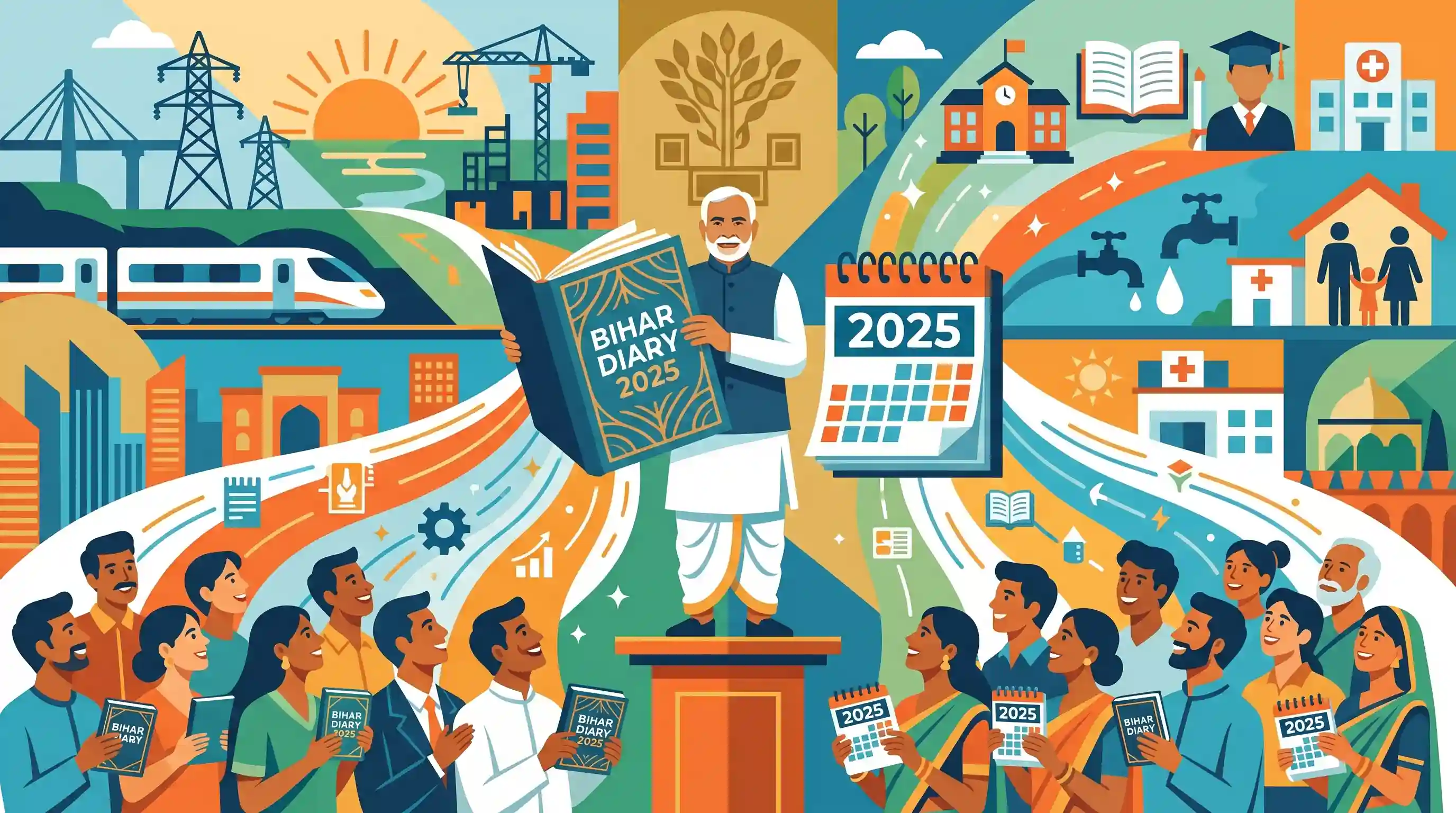
Bihar Chief Minister Nitish Kumar officially launched the 'Bihar Diary 2025' and 'Calendar 2025', published by the state's Information and Public Relations Department (IPRD). These official publications are aimed at showcasing the government's flagship schemes, developmental milestones, and welfare programs to enhance public awareness and effectively communicate administrative priorities.
Key Points
- Bihar Chief Minister Nitish Kumar launched the 'Bihar Diary 2025' and 'Calendar 2025'.
- The publications were compiled and released by the Information and Public Relations Department (IPRD) of Bihar.
- These materials serve as information dissemination tools, highlighting various welfare schemes, public policies, and development initiatives of the state government.
- They are intended to raise public awareness regarding the ongoing programs and the achievements of the Bihar administration.
Important Terms
Information and Public Relations Department (IPRD)

A state government agency responsible for disseminating information on policies, schemes, and achievements to the public while managing media relations and feedback.
UPSC context
GS Paper 2 (Governance); tests understanding of government-to-citizen (G2C) communication and administrative transparency.
Saat Nischay (Seven Resolves)
The flagship development roadmap of the Bihar government (currently Phase 2.0), targeting seven specific sectors including youth empowerment, women's entrepreneurship, and rural infrastructure.
UPSC context
GS Paper 2 (Welfare schemes); a core case study for state-led inclusive development models.
Development with Justice
The overarching administrative philosophy of the Bihar government, focusing on inclusive growth where development reaches the most marginalized sections of society.
UPSC context
GS Paper 2 (Inclusive Growth) and Essay; tests the ability to analyze regional development ideologies.
Jeevika
The Bihar State Rural Livelihoods Mission (BRLPS), which empowers rural women through Self-Help Groups (SHGs) to improve social and economic outcomes.
UPSC context
GS Paper 2 (SHGs) and GS Paper 3 (Rural Development); a model for poverty alleviation and women's empowerment.
Public Awareness Initiatives
Efforts by the state to educate citizens about welfare programs and rights using tools like official publications, digital platforms, and field outreach.
UPSC context
GS Paper 2 (Citizen-centric governance); focuses on the "last mile delivery" of government services.
Good Governance (Sushasan)
The exercise of authority in a manner that is transparent, accountable, and responsive to the needs of the citizens to ensure sustainable development.
UPSC context
GS Paper 2 (Governance) and GS Paper 4 (Ethics); fundamental to evaluating administrative efficiency and ethical conduct.
Prelims Trap
"Jeevika is a Central Sector Scheme entirely funded by the Union Ministry of Rural Development."
Jeevika is the Bihar Rural Livelihoods Project, supported by the World Bank. While it integrates with DAY-NRLM, it is not a fully centrally funded scheme.
Static Concepts Connected
How do State Rural Livelihood Missions (SRLMs) function in India?
- Implementation Nodes: SRLMs act as autonomous special purpose vehicles at the state level (e.g., Jeevika in Bihar) to implement poverty alleviation programs under DAY-NRLM.
- Multilateral Backing: Several state livelihood missions receive direct financial and technical support from the World Bank to enhance their poverty eradication strategies.
- Core Mandate: Their primary strategy involves mobilizing rural ultra-poor women into Self-Help Groups (SHGs) to facilitate financial inclusion, micro-credit access, and sustainable livelihood generation.
What is the constitutional and legal basis for proactive public disclosure?
- RTI Act Mandate: Section 4(1)(b) of the RTI Act mandates public authorities to publish information suo motu to minimize the need for citizens to file formal requests.
- Constitutional Basis: Proactive communication of schemes (via diaries, portals, or reports) fulfills the Right to Information derived from Article 19(1)(a) of the Constitution.
- Good Governance: Transparency, accountability, and participatory administration are core tenets of Good Governance, frequently measured by a state's proactive outreach mechanisms.
Cross-Topic Patterns
State SHG models scaling nationally
State-led livelihood missions like Bihar's Jeevika and Kerala's Kudumbashree frequently serve as successful micro-finance and empowerment templates that shape the broader national framework of DAY-NRLM.
Multilateral funding for state welfare
Multilateral institutions like the World Bank frequently provide direct financial and technical support to sub-national poverty programs, emphasizing state-level capacity building alongside capital infusion.

Questions on SHGs in GS-2 Mains increasingly demand specific state-level case studies like Bihar's Jeevika or Kerala's Kudumbashree.
Linked PYQs · 2
Linked PYQs · 2
- 2020BPSC_PRELIMSGS1
Bihar Government launched a new scheme 'Satat Jivikoparjan Yojana' in August 2018. The objective of this scheme is
- 2020BPSC_PRELIMSGS1
Which of the following is not included in Seven Resolves (Saat Nishchay) of Bihar Government?
