India Nepal Transboundary Water Management for North Bihar Floods
Source:uniindia ↗
Why It Matters
Flooding in North Bihar is a perennial disaster management challenge tied to the geography of Himalayan rivers flowing from Nepal. Questions on Bihar's drainage system (e.g., Kosi, Gandak, Bagmati) and inter-state/international water diplomacy frequently appear in BPSC Prelims and Mains.
Summary
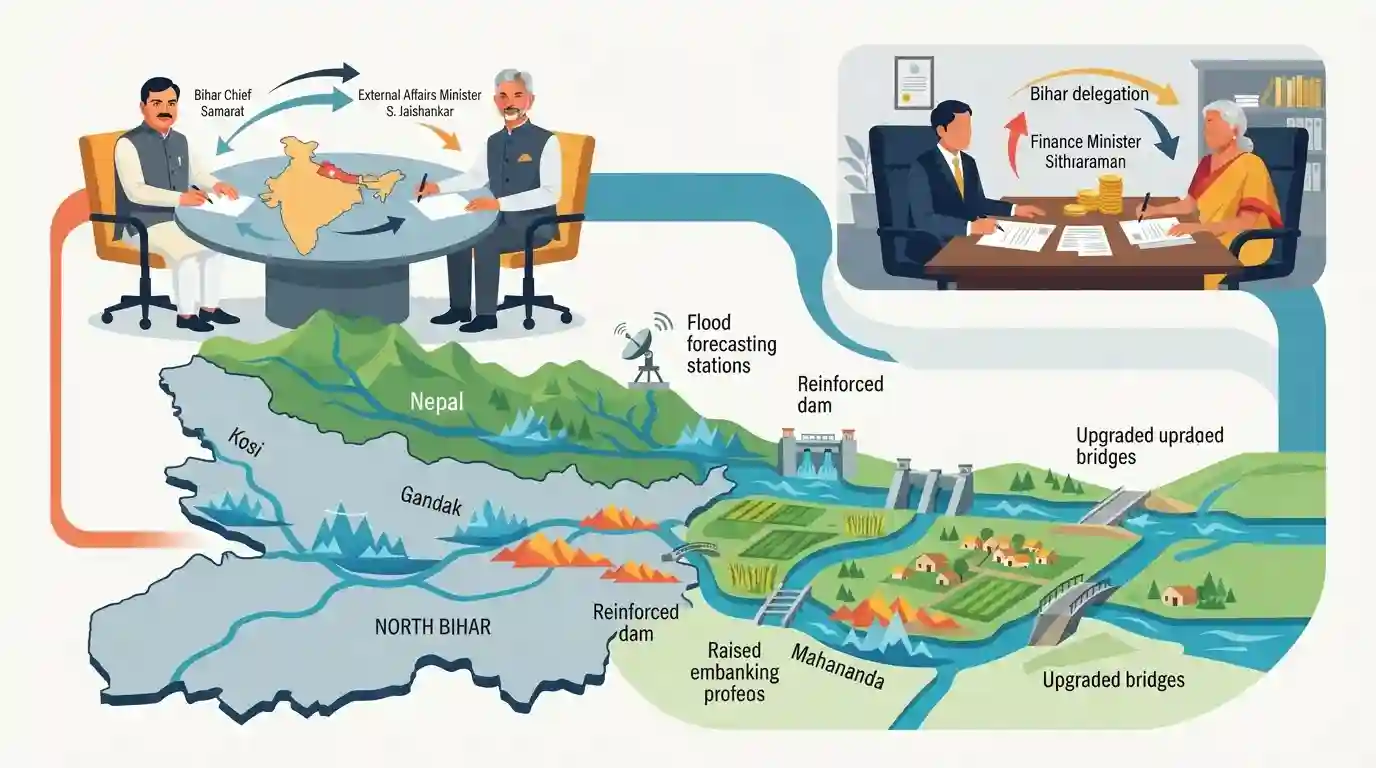
Bihar Chief Minister Samrat Choudhary held high-level discussions with External Affairs Minister S. Jaishankar regarding Indo-Nepal transboundary water management to address recurrent floods in North Bihar. The talks emphasized bilateral cooperation on flood forecasting, dam construction, and infrastructure projects along major rivers like the Kosi, Gandak, Bagmati, Kamla, and Mahananda. Furthermore, the state delegation met Finance Minister Nirmala Sitharaman to deliberate on Bihar's budgetary and developmental needs.
Key Points
- Bihar CM Samrat Choudhary met External Affairs Minister S. Jaishankar to discuss Indo-Nepal water issues and the management of transboundary rivers.
- The talks focused on finding long-term infrastructure solutions, such as dams, to mitigate the recurrent flooding in North Bihar caused by heavy rainfall in Nepal.
- Major transboundary river systems like Kosi, Gandak, Bagmati, Kamla, and Mahananda significantly influence the flood conditions in the region.
- Bihar emphasized the need for closer bilateral coordination with Nepal on flood forecasting, embankment protection, and river flow management.
- The delegation also met with Union Finance Minister Nirmala Sitharaman to discuss Bihar's state budget, tourism, and broader developmental issues.
Important Terms
Ministry of External Affairs

The Union government ministry responsible for managing India's foreign relations, including negotiating bilateral treaties, infrastructure projects, and transboundary water management agreements with countries like Nepal.
UPSC context
GS Paper 2 (International Relations): Tests knowledge of bilateral ties, diplomacy, and the Centre's role in resolving cross-border state issues.
Ministry of Finance
The Union ministry that oversees India's fiscal policy, national budget, and the allocation of funds and grants to states for developmental needs, infrastructure, and disaster mitigation.
UPSC context
GS Paper 2 & 3: Crucial for topics concerning Centre-State financial relations, fiscal federalism, and capital funding for regional development.
Government of Bihar
The state-level executive authority managing Bihar's administration. It coordinates with the Union government on state-specific challenges like disaster management, infrastructure projects, and financial assistance.
UPSC context
GS Paper 2 (Polity): Relevant for questions on cooperative federalism, state governance, and Centre-State policy coordination in disaster management.
Government of India
The central federal authority of India, responsible for national governance, foreign policy, defense, and providing financial and diplomatic support to states dealing with international border issues.
UPSC context
GS Paper 2 (Polity): Fundamental for understanding the Union's executive powers, federal structure, and constitutional duties towards the states.
Prelims Trap
"Mahananda is a transboundary river originating in Nepal."
While often grouped with North Bihar's flood-causing rivers, the Mahananda actually originates in the Darjeeling Hills of West Bengal (India), not in Nepal.
Static Concepts Connected
What are the key characteristics of North Bihar's Himalayan rivers?
- High Sediment Load: They bring massive silt from the young Himalayas, which raises river beds and causes frequent course shifting (meandering), notably in the Kosi.
- Perennial Nature: Fed by both glacial melt and monsoon rains, ensuring year-round water but catastrophic swelling during the monsoon season.
- Drainage Axis: They generally flow south or south-east to eventually join the River Ganga, the central drainage axis of the state.
Why does Bihar require the Union MEA for its state flood management?
- Sovereign Borders: The critical catchment areas and proposed high-dam sites (like the Kosi High Dam) are located in Nepal, requiring cross-border agreements.
- Union List Jurisdiction: Foreign affairs, international relations, and diplomatic treaties fall exclusively under the Union List (Schedule VII) of the Indian Constitution.
Cross-Topic Patterns
Disaster Management + Center-State Relations
Flood mitigation in Bihar requires Ministry of External Affairs intervention, highlighting how state-level geographic distress relies entirely on Union foreign policy and bilateral diplomacy.
Physical Geography + State Economy
The reality that 73% of Bihar is flood-prone is frequently used as the geographic justification in meetings with the Finance Ministry to demand special financial packages or status.

Expect multi-statement questions mapping North Bihar rivers (Kosi, Gandak, Kamla) to their exact origins and associated barrage projects.
Linked PYQs · 3
Linked PYQs · 3
- 2020BPSC_PRELIMSGS1
Which of the following rivers flowing in Bihar is a north flowing river?
- 2024-EBPSC_PRELIMSGS1
Which of the following drainage systems drains the lands of Bihar?
- 2024-IBPSC_PRELIMSGS1
Which river is known as the ‘Sorrow of Bihar’?
