Bihar Gati Initiative Reviewed for Time Bound Completion of Projects
Source:uni-india ↗
Why It Matters
These infrastructure and irrigation schemes, such as the Kosi-Mechi and North Koel projects, represent pivotal developmental landmarks in Bihar that are frequently featured in BPSC Prelims examinations.
Summary
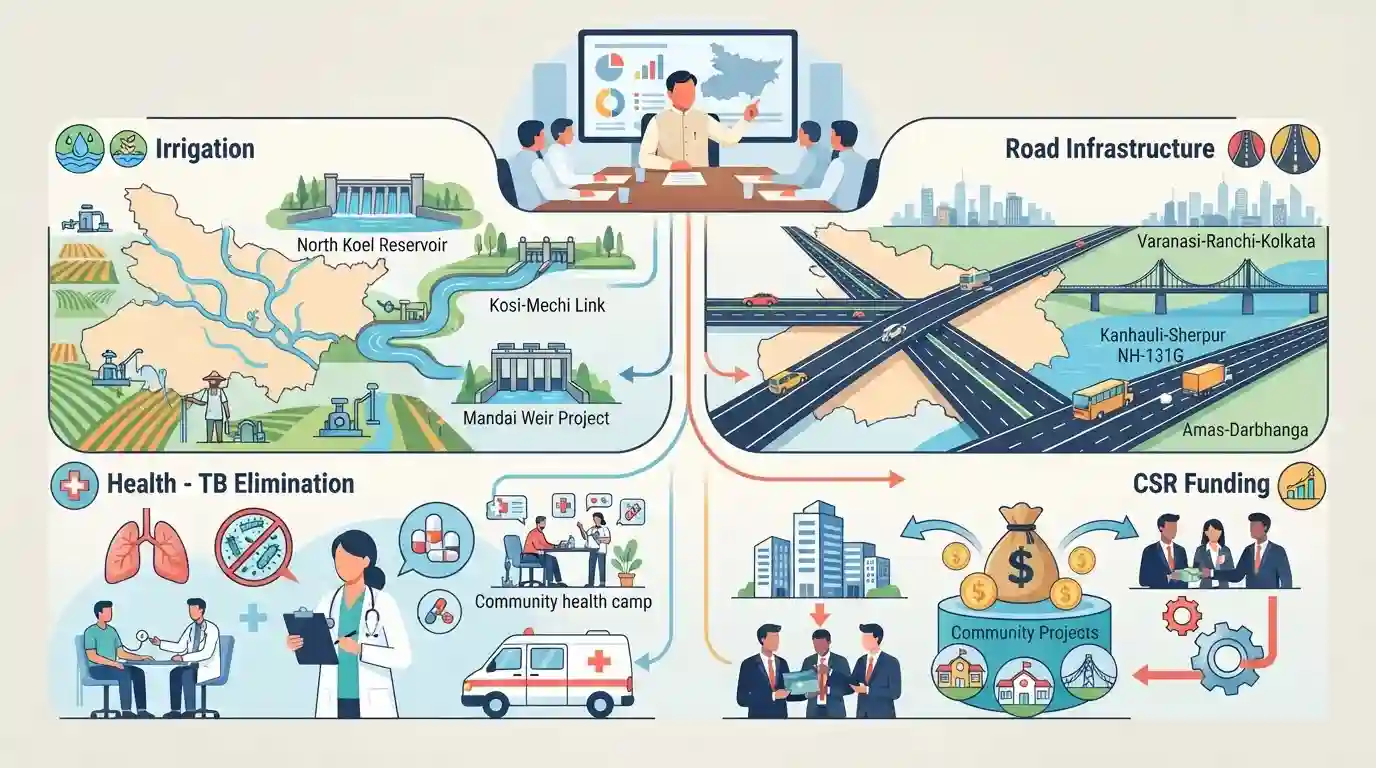
Bihar Chief Minister Samrat Choudhary reviewed the 'Bihar Gati' initiative to ensure the timely and bottleneck-free completion of state projects worth over Rs 100 crore. The review covered major irrigation schemes (Kosi-Mechi Link, North Koel Reservoir, and Mandai Weir projects), high-impact road infrastructure (Varanasi-Ranchi-Kolkata, Amas-Darbhanga, and Kanhauli-Sherpur NH-131G projects), tuberculosis elimination drives, and an action plan to mobilize Rs 2,000 crore via Corporate Social Responsibility (CSR).
Key Points
- The 'Bihar Gati' initiative focuses on streamlining and monitoring state projects valued at over Rs 100 crore and centrally-sponsored schemes.
- Key water resources projects highlighted include the Kosi-Mechi Inter-State Link Project, North Koel Reservoir Project, and Mandai Weir Project to boost Bihar's irrigation capacity.
- Major road corridors targeted for fast-track execution include the Varanasi-Ranchi-Kolkata six-lane corridor, the Amas-Darbhanga four-lane project, and the Kanhauli-Sherpur (NH-131G) six-lane project.
- In the health sector, the CM directed intensified drives for the 'TB-Free India' and 'TB-Free Bihar' campaigns with expanded screening, functional centers, and nutritional support.
- The administration plans to mobilize Rs 2,000 crore through Corporate Social Responsibility (CSR) initiatives to fund education, healthcare, and skill development.
Important Terms
Bihar Gati

A state infrastructure initiative designed to fast-track, monitor, and ensure the time-bound completion of major development projects worth over ₹100 crore in Bihar.
UPSC context
GS Paper III: Infrastructure. Tests knowledge of regional planning models and administrative coordination for capital expenditure.
Kosi-Mechi Intra-State Link Project
India's second major river-interlinking project, transferring surplus water from the Kosi River to the Mechi River (Mahananda basin) to irrigate four north-eastern districts of Bihar.
UPSC context
GS Paper I & III: Geography, Irrigation. Tests concepts of river interlinking, transboundary water flow, and flood mitigation.
North Koel Reservoir Project
An inter-state irrigation scheme on the North Koel River between Bihar and Jharkhand, featuring the Mandal Dam, designed to irrigate drought-prone districts.
UPSC context
GS Paper I & III: Geography, Environmental Impact. Tests issues surrounding irrigation projects, cooperative federalism, and wildlife conservation conflicts.
Mandai Weir Project
An irrigation infrastructure initiative on Bihar’s Falgu River, designed to supply critical surface water to drought-susceptible blocks across Jehanabad, Nalanda, and Patna districts.
UPSC context
GS Paper I & III: Geography, Water Resources. Tests local water conservation schemes, land acquisition challenges, and regional agricultural sustainability.
TB-Free India Campaign
A national public health campaign (Pradhan Mantri-TB Mukt Bharat Abhiyaan) launched in 2022 to eliminate tuberculosis by 2025 through community engagement and social support.
UPSC context
GS Paper II: Social Justice and Health. Tests national healthcare objectives, community-led initiatives, and public epidemiological challenges.
Prelims Trap
"The Kosi-Mechi link is an inter-state river interlinking project shared between Bihar and Nepal."
Though Kosi is a trans-boundary river, the Kosi-Mechi project is India's second major intra-state river link, transferring surplus water entirely within Bihar.
Static Concepts Connected
What is the geographical significance of the North Koel River?
- Origin & Confluence: Rises in the Ranchi plateau (Jharkhand) and flows northward to join the Sone River as a major right-bank tributary.
- Ecological Overlap: Flows through the Palamu Tiger Reserve and forms the northern boundary of Betla National Park.
- Mandal Dam: Associated with the North Koel Reservoir (Mandal Dam) project, historically stalled due to forest submergence concerns.
What is the statutory mandate for CSR in India?
- Eligibility Thresholds: Applies to companies with a net worth of ₹500cr+, turnover of ₹1000cr+, or net profit of ₹5cr+.
- Spending Mandate: Companies must spend at least 2% of their average net profits from the preceding three financial years.
- Schedule VII: Funds can be directed to TB elimination, healthcare, and education as permitted by Schedule VII of the Companies Act.
Cross-Topic Patterns
State-level Gati Shakti variants
'Bihar Gati' mirrors PM Gati Shakti’s whole-of-government approach, reflecting how competitive federalism is institutionalizing digital, inter-departmental monitoring for capex execution.
River projects vs Tiger habitats
Just as the Ken-Betwa link threatens Panna, the North Koel Reservoir impacts Palamu Tiger Reserve. UPSC frequently tests these exact infrastructure-conservation trade-offs.

Mapping of Sone River tributaries (North Koel) and their intersection with tiger reserves (Palamu/Betla) is a high-probability 2026 Prelims MCQ.
Linked PYQs · 2
Linked PYQs · 2
- 2019BPSC_PRELIMSGS1
Prime Minister Narendra Modi recently laid the foundation of Mandal Dam Project to be built on which river?
- 2025BPSC_PRELIMSGS1
Which districts in Bihar will benefit from the Kosi Mechi Link Project?
