Valmiki Tiger Reserve Wildlife Relocation Program to West Bengal
Source:times-of-india ↗
Why It Matters
This development is highly relevant for questions on Environment & Ecology, specifically regarding Project Tiger, wildlife relocation strategies, genetic diversity management, and protected areas in India (like Valmiki TR and Buxa TR).
Summary
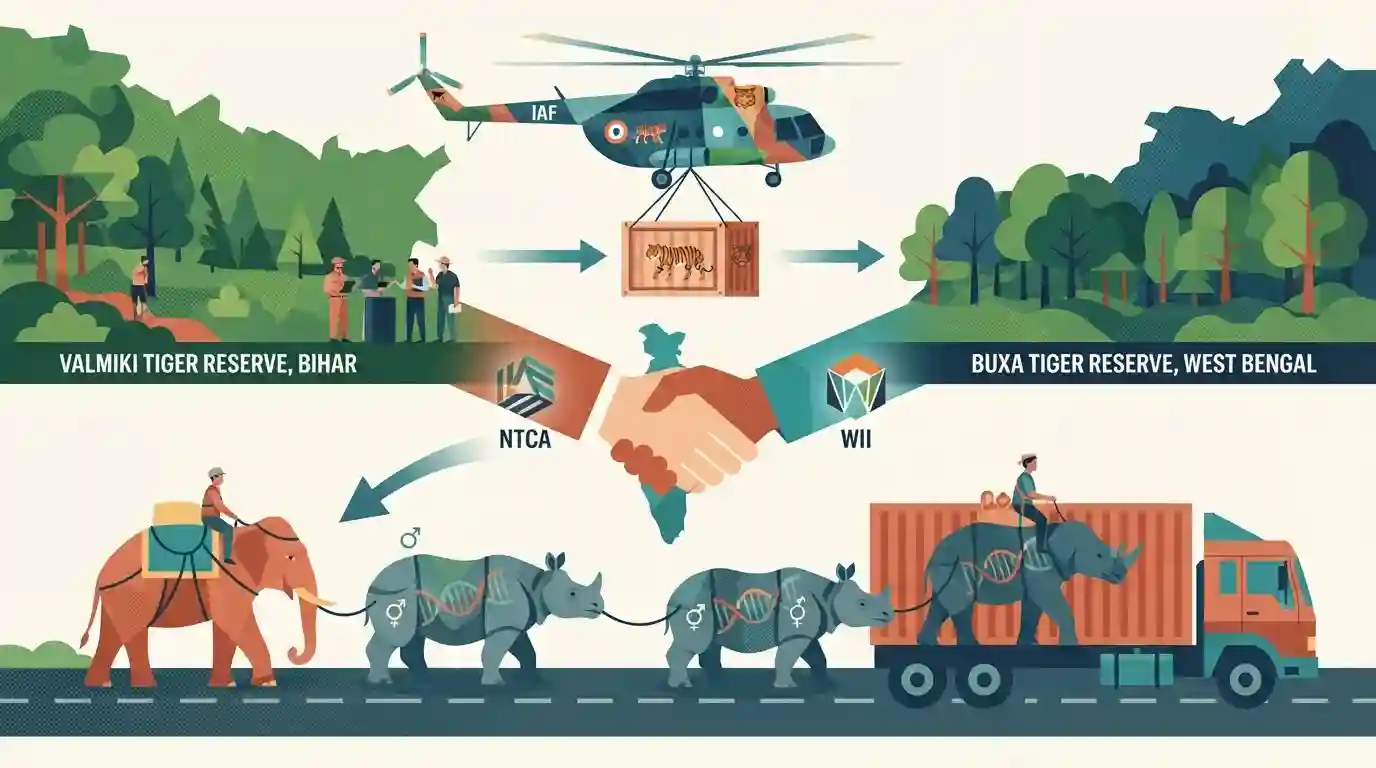
Bihar Chief Minister Samrat Choudhary has approved a proposal to relocate several tigers from Bihar's Valmiki Tiger Reserve to West Bengal's Buxa Tiger Reserve for a reintroduction program. The transfer, facilitated by the NTCA and WII, will likely begin with an IAF airlift of a tigress to minimize transit stress. In exchange, Bihar is seeking two 'kunki' elephants and two female rhinos from Bengal to boost the genetic diversity of the rhino population in Valmiki TR, highlighting a collaborative interstate approach to wildlife conservation.
Key Points
- Bihar has approved the transfer of a number of tigers from Valmiki Tiger Reserve to West Bengal's Buxa Tiger Reserve to aid in a tiger reintroduction program.
- To minimize transit stress, the first transfer—a tigress—is proposed to be airlifted using an Indian Air Force helicopter.
- In a reciprocal move, Bihar requested at least two trained (kunki) elephants and two female rhinos from West Bengal to enhance the genetic diversity of its rhino population.
- The relocation process is being facilitated by the Wildlife Institute of India (WII) and the National Tiger Conservation Authority (NTCA).
Important Terms
Project Tiger

A centrally sponsored wildlife conservation program launched in 1973 to ensure a viable population of Bengal tigers in their natural habitats. It establishes dedicated Tiger Reserves, including Bihar's Valmiki Tiger Reserve.
UPSC context
Essential for Prelims and GS Paper 2. BPSC frequently tests major environmental initiatives and their localized impacts within Bihar.
National Tiger Conservation Authority (NTCA)
A statutory body established in 2005 under the Ministry of Environment, Forest and Climate Change. It serves as the apex body administering Project Tiger and overseeing the protection of tiger reserves across India.
UPSC context
Crucial for GS Paper 2 (Environment & Ecology) and Prelims. Tests knowledge of statutory bodies governing wildlife conservation frameworks.
Wildlife Institute of India (WII)
An autonomous institution based in Dehradun, operating under the MoEFCC. It conducts specialized wildlife research, advisory services, and academic training on biodiversity, habitat ecology, and conservation issues.
UPSC context
Important for Prelims (Institutions) and Mains GS 2. Questions often target the mandates, functions, and locations of key environmental bodies.
Ministry of Environment, Forest and Climate Change (MoEFCC)
The apex administrative body in India's Central Government responsible for planning, promoting, and overseeing environmental, forestry, and wildlife conservation programs, including the administrative oversight of NTCA and WII.
UPSC context
Relevant for GS Paper 2. Candidates must understand the nodal ministries driving national environmental policies, climate action, and biodiversity protection.
Prelims Trap
"Tigers are being relocated from Buxa Tiger Reserve to Bihar's Valmiki Tiger Reserve to boost population."
Aspirants often confuse the direction of interstate wildlife transfers. The tigers are going FROM Bihar to Bengal, while Bihar is requesting rhinos and elephants in return.
Static Concepts Connected
What are the key geographical and administrative features of Valmiki Tiger Reserve (VTR)?
- Location: Situated in the West Champaran district of Bihar, sharing an international border with Nepal's Chitwan National Park.
- River System: The Gandak River forms the western boundary of the reserve, acting as a crucial water source and natural border.
- Unique Status: It currently holds the distinction of being the only National Park and established Tiger Reserve in Bihar.
What is the structure and mandate of the National Tiger Conservation Authority (NTCA)?
- Legal Status: It is a statutory body under the Ministry of Environment, Forest and Climate Change (MoEFCC).
- Establishment: Established in 2005 under the amending provisions of the Wildlife (Protection) Act, 1972 to reorganize tiger conservation.
- Leadership: The Authority is chaired by the Union Minister of Environment, Forest and Climate Change.
Cross-Topic Patterns
Transboundary Conservation Complexes
Valmiki TR is contiguous with Nepal's Chitwan National Park. BPSC often tests border-sharing protected areas when probing international wildlife corridors and transboundary conservation efforts.
Genetic Diversity & Interstate Translocations
The exchange of tigers for rhinos highlights the ecological management of 'genetic bottlenecks.' Expect linkages between interstate species translocation and the scientific need to prevent inbreeding in isolated populations.

Multi-statement questions highly likely on Valmiki TR's geography (bordering Chitwan/Gandak river) paired with NTCA's statutory powers.
Linked PYQs · 3
Linked PYQs · 3
- 2025BPSC_PRELIMSGS1
Which of the following parks/sanctuaries come under the project tiger in Bihar?
- 2023BPSC_PRELIMSGS1
Which of the following National Parks/Wildlife Sanctuaries are in Bihar? 1. Valmiki National Park 2. Dudhwa National Park 3. Gajner Wildlife Sanctuary 4. Bhimbandh Wildlife Sanctuary Select the correct answer using the codes given below.
- 2025BPSC_PRELIMSGS1
Consider the following subjects belonging to different lists of the constitution of India. Which of the following subjects belong to concurrent list? 1) Protection of wildlife 2) Income on Agriculture 3) Tax on Electricity consumption or sale 4) Price control Out of these:
