Bihar child welfare budget education allocation and public expenditure
Source:indianmasterminds ↗
Why It Matters
It details Bihar's unique public finance history, highlighting its pioneering role in child budgeting (2013-14) and providing crucial, examiner-favorite statistical indicators like child population share (48%) and education's share of the child budget (81.56%).
Summary
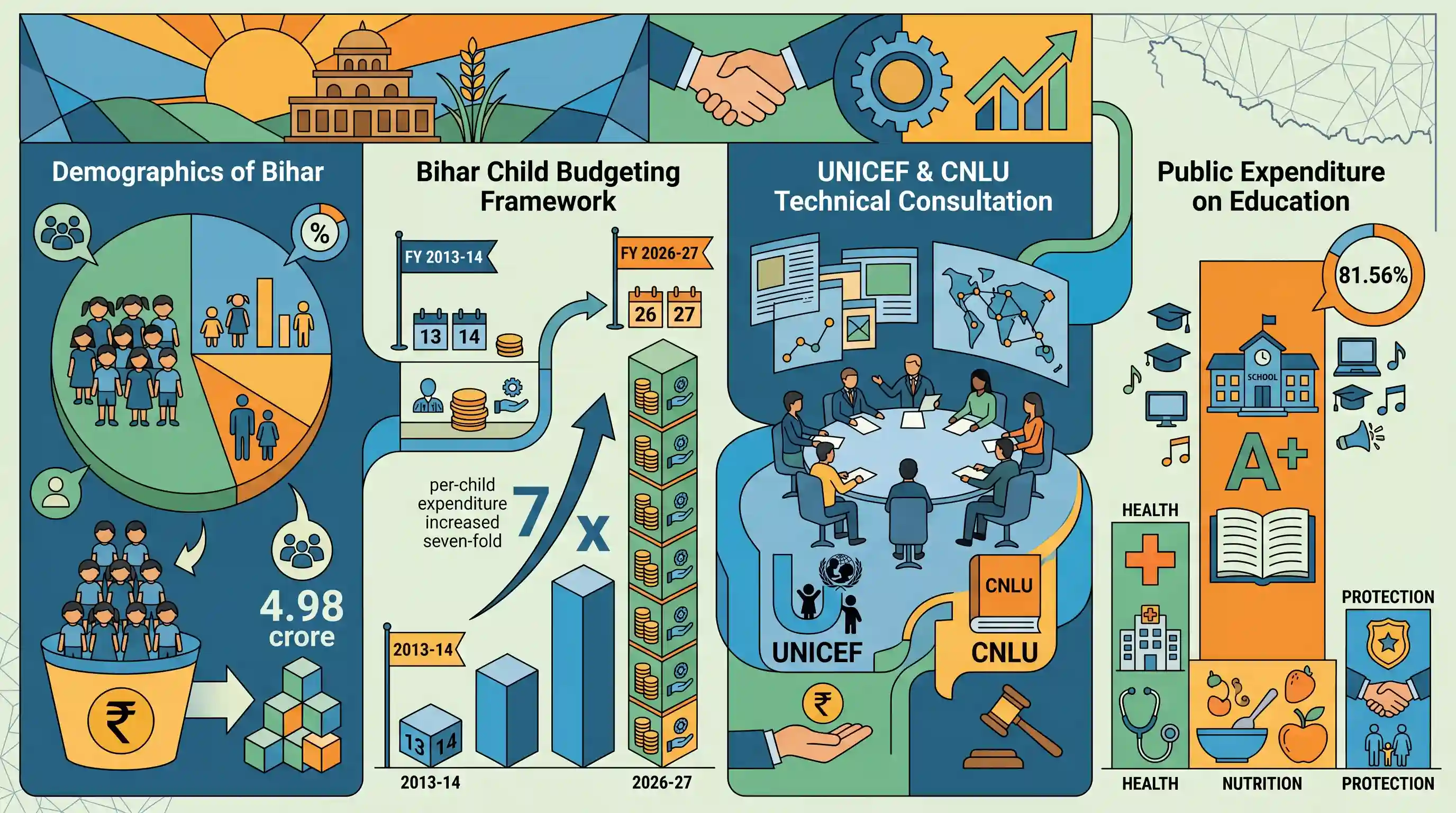
The Bihar Finance Department, alongside UNICEF and CNLU, held a technical consultation on the Bihar Child Welfare Budget 2026-27. Highlighting Bihar's status as a pioneer in child budgeting since FY 2013-14, the state announced that per-child expenditure has increased seven-fold over 13 years. In the 2026-27 child budget, the education sector leads with an 81.56% allocation. Children make up approximately 48% (4.98 crore) of Bihar's overall population.
Key Points
- The Bihar Finance Department, in collaboration with UNICEF and the Centre for Child Rights at CNLU, Patna, organized a technical consultation workshop on the Bihar Child Welfare Budget 2026-27.
- Bihar has been one of India's pioneering states in institutionalizing child budgeting, having introduced it in the Financial Year 2013-14. Over the past 13 years, the share of child-centric expenditure in the overall state budget has risen by nearly 11 percentage points.
- The per-child public expenditure in Bihar has increased more than seven-fold in FY 2024-25 compared to the baseline of FY 2013-14.
- Under the upcoming Child Welfare Budget 2026-27, the education sector has been accorded the highest priority, capturing 81.56% of the total allocation (representing a 13.9% increase compared to the previous year).
- According to Dr. Monica O. Nielsen, Chief of UNICEF Bihar Field Office, children (0-18 age group) comprise nearly 48% of Bihar's total population, amounting to approximately 4.98 crore children.
Important Terms
Child Budgeting

A public finance tool that tracks, categorizes, and evaluates government allocations and expenditures specifically directed towards children's welfare, education, health, and development.
UPSC context
GS Paper II (Social Justice) & GS Paper III (Budgeting); tests understanding of vulnerable sections and public finance management.
Bihar Child Welfare Budget 2026-27
The state-specific fiscal framework of Bihar prioritizing child development, allocating 81.56% of child-centric outlays to education, aiming for outcome-oriented tracking and evidence-based structural reforms.
UPSC context
GS Paper II & III; tests knowledge of state-level social sector budgeting, fiscal decentralization, and human development indicators.
Child Rights Centre (CRC), CNLU
A specialized research center at Chanakya National Law University, Patna, collaborating with UNICEF to provide technical and legal support, research, and policy recommendations for child protection in Bihar.
UPSC context
GS Paper II (Social Justice & statutory/non-statutory bodies); tests role of academic-legal institutions in policy and child rights.
UNICEF Bihar
The state-level field office of the United Nations Children's Fund, partnering with the Bihar government to support social policies, child-centric budgeting, and child protection programs.
UPSC context
GS Paper II (Welfare Schemes & International Relations); tests knowledge of international development agencies collaborating with subnational governments.
Bihar Finance Department
The state executive organ responsible for Bihar's public financial management, budgeting, and pioneering social sector allocations, including gender and child-focused budgeting frameworks.
UPSC context
GS Paper III (Government Budgeting & State Finances); tests understanding of state public financial administration and fiscal planning for development.
Prelims Trap
Child Budgeting is presented as a separate, legally binding Appropriation Bill under Article 202 of the Constitution.
Child Budgeting is a reporting tool and policy statement, not a legally distinct Appropriation Bill or separate legislative constitutional mandate.
Static Concepts Connected
What is Child Budgeting and how is it structured in India?
- Definition and Scope: It is not a separate budget, but a policy tool to track and analyze budget allocations specifically benefiting children (0-18 years).
- Union Level Initiative: Introduced a dedicated Child Budget Statement (Statement 22) in FY 2008-09 to track child-centric spending across ministries.
- Key Pillars: Typically categorizes child expenditure into four thematic sectors: Development, Health, Education, and Protection.
What are the key Constitutional provisions protecting child rights in India?
- Article 21A: Mandates free and compulsory education for all children in the age group of six to fourteen years.
- Article 39(f): Directs the State to secure opportunities for children to develop in a healthy manner and in conditions of freedom and dignity.
- Article 45: Endeavors to provide early childhood care and education for all children until they complete the age of six years.
Cross-Topic Patterns
Fiscal devolution & social sector budgeting
Linking fiscal devolution under the Finance Commission with state-level child budgeting highlights how sub-national fiscal autonomy directly translates into targeted human capital development investments.
Demographic divergence and migration flows
High-fertility states like Bihar investing in youth education contrasts with ageing southern states, reshaping India's future internal migration patterns and interstate labor dynamics.

Expect comparative questions on fiscal tools like Child and Green budgeting, testing their administrative vs constitutional status in 2026.
Linked PYQs · 3
Linked PYQs · 3
- 2024-EBPSC_PRELIMSGS1
Which sector received the highest allocation in the Bihar Budget 2024-25?
- 2025BPSC_PRELIMSGS1
Consider the following statements: 1) The proportion of the young population (0-19 years) in Bihar is projected to decline significantly by 2041. 2) Bihar’s demographic dividend is expected to peak around 2041. 3) The elderly population (60+ years) in Bihar is expected to rise more sharply than in India. Select the correct answer using the codes given below:
- 2024-EBPSC_PRELIMSGS1
When did Bihar State introduce the Green Budget for the first time?
