Mahamaya Prasad Sinha and the rise of non-Congress politics
Source:Indian Express ↗
Why It Matters
The 1967 elections and the formation of SVD governments are critical milestones in India's post-independence history. Understanding this transition is essential for UPSC aspirants studying the evolution of the Indian party system, the advent of coalition politics, federalism, and the political dynamics of state governments.
Summary
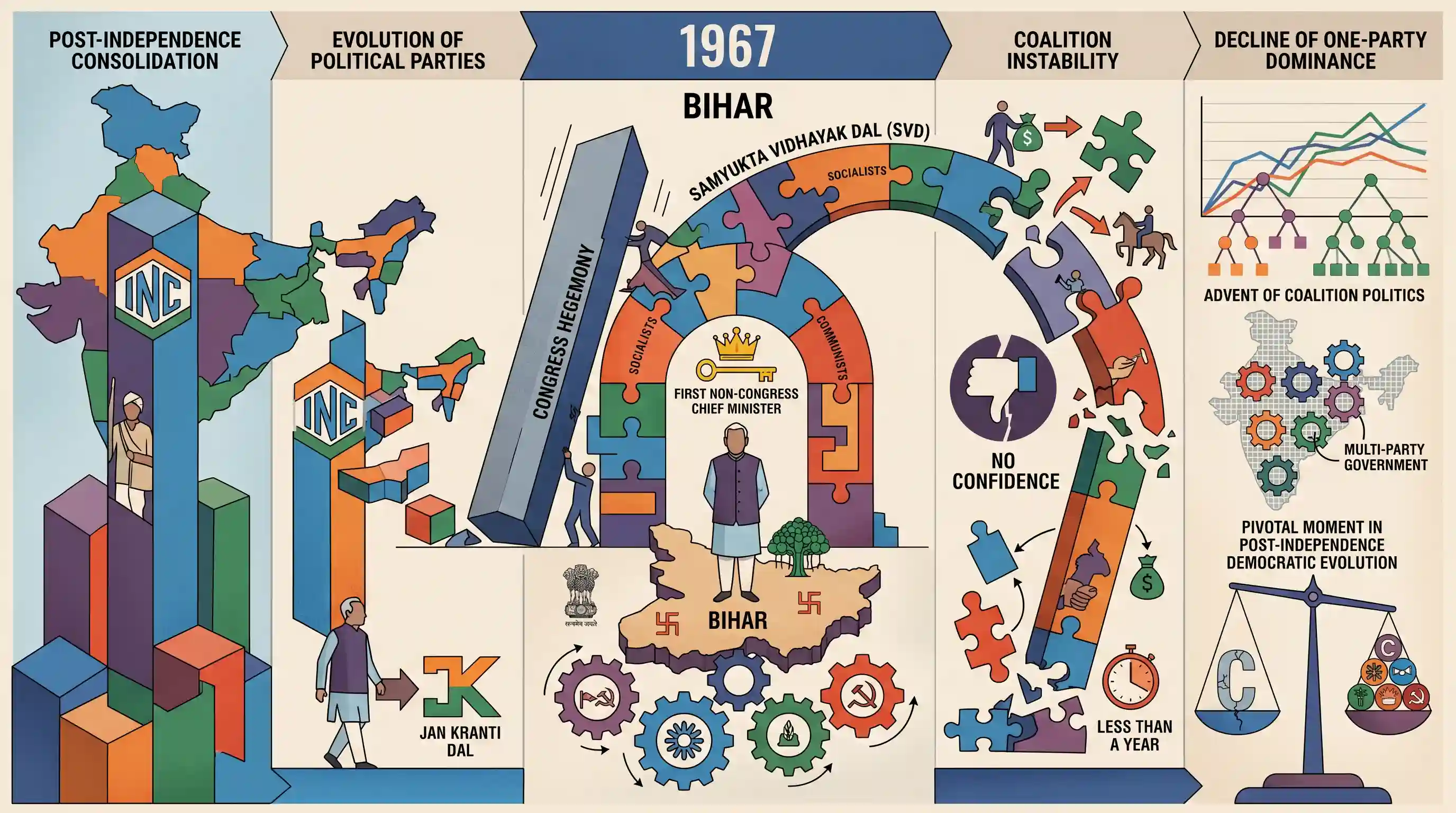
The article details the political journey of Mahamaya Prasad Sinha, who made history by becoming the first non-Congress Chief Minister of Bihar in 1967. Originally a stalwart of the Indian National Congress and a freedom fighter, Sinha grew disillusioned with the party and established the Jan Kranti Dal. In the landmark 1967 elections—often viewed as the beginning of the end of undisputed Congress hegemony in India—he successfully led a disparate coalition known as the Samyukta Vidhayak Dal (SVD) to power. Although his government was short-lived, lasting less than a year due to inherent coalition instability and defections, his tenure was a pivotal moment in India's post-independence democratic evolution, marking the advent of multi-party coalition politics at the state level.
Key Points
- Mahamaya Prasad Sinha was sworn in as the first non-Congress Chief Minister of Bihar in 1967, leading the Samyukta Vidhayak Dal (SVD) coalition government.
- A former prominent leader of the Congress party and a veteran of the freedom struggle (including the Quit India Movement), Sinha left the party over internal disputes prior to the 1967 elections.
- He founded the Jan Kranti Dal and successfully contested against the Congress, capitalizing on anti-incumbency and political realignments.
- The 1967 elections marked a watershed moment in Indian post-independence history, representing the first major decline of the one-party dominance (the 'Congress system') as non-Congress coalitions captured power in multiple states.
- Sinha's tenure lasted only 330 days, underscoring the instability, ideological contradictions, and frequent defections that characterized the early era of coalition politics in India.
Important Terms
Samyukta Vidhayak Dal (SVD)

A coalition of diverse non-Congress parties (e.g., SSP, BJS) formed in North Indian states after 1967 to challenge Congress dominance.
UPSC context
GS Paper II (Polity) & I (Post-Independence): Tests understanding of the first shift from one-party rule to coalition governance.
Jan Kranti Dal (JKD)
A Bihar-based political party founded in 1967 by Mahamaya Prasad Sinha after splitting from Congress; it led the state's first non-Congress government.
UPSC context
GS Paper I (Post-Independence Consolidation): Illustrates the emergence of regional parties and internal fragmentation within the early Congress.
One-Party Dominance
A political phase (1947–1967) where the Indian National Congress held undisputed power centrally and across states, often called the 'Congress System'.
UPSC context
GS Paper II (Polity): Essential concept for analyzing the evolution of India's multi-party system and democratic competition.
1967 General Elections
A landmark 'watershed' election where Congress lost majorities in eight states, marking the beginning of multi-party competition and coalition politics in India.
UPSC context
GS Paper I (Post-Independence History): Frequently tested as the turning point for Indian federalism and political stability.
Coalition Politics
A governance model where multiple political parties cooperate to form a majority; became a staple of Indian state politics after the 1967 SVD experiments.
UPSC context
GS Paper II (Polity/Governance): Tests the dynamics of power-sharing, federalism, and the stability of cabinet government.
Common Minimum Programme (CMP)
A document outlining shared goals and policies agreed upon by coalition partners with different ideologies to provide a stable governing framework.
UPSC context
GS Paper II (Governance): Relevant for questions on how ideologically disparate coalitions manage administration and policy-making.
Defection (Aaya Ram Gaya Ram)
The act of a legislator changing party loyalty after election; its rampant rise in 1967 eventually necessitated the 10th Schedule (Anti-Defection Law).
UPSC context
GS Paper II (Polity): Crucial for understanding electoral reforms and the legal safeguards for parliamentary stability.
Prelims Trap
"The 1967 elections marked the formation of the first non-Congress state government in independent India."
1967 marked the widespread rise of non-Congress coalitions (SVDs), but the very first non-Congress state government in India was formed by the CPI in Kerala in 1957.
Static Concepts Connected
What are the core provisions of the Anti-Defection Law?
- Origin: Inserted via the 52nd Amendment Act (1985) into the 10th Schedule to combat the "Aya Ram Gaya Ram" culture of political party-hopping.
- Disqualification grounds: An MP/MLA is disqualified if they voluntarily give up membership of their party or vote contrary to the party whip without prior permission.
- Merger Exception: Splits are no longer protected (post-91st Amendment), but mergers are exempt if 2/3rds of the legislative party's members agree to merge with another party.
What characterizes the 'Congress System' in Post-Independence India?
- Definition: A term coined by political scientist Rajni Kothari to describe the first two decades of independence, characterized by undisputed single-party dominance by the INC.
- Factional consensus: The Congress acted as a massive umbrella organization, absorbing diverse ideological factions, regional interests, and social groups, effectively functioning as both government and internal opposition.
- Decline: Began to structurally decline during the 1967 elections due to the rise of regional political assertion and agrarian middle-class mobilization.
Cross-Topic Patterns
1967 Coalitions and One Nation One Election
The frequent collapse of SVD coalition governments post-1967 permanently disrupted simultaneous elections in India. This historical breakdown forms the primary context for the current 'One Nation One Election' (ONOE) proposal.
Coalition Instability and the Governor's Discretion
The era of fractured state mandates starting in 1967 vastly expanded the discretionary powers of Governors in government formation, shifting the institution into a persistent friction point in Center-State relations.

The 1967 electoral rupture directly ties into modern debates on ONOE and anti-defection, making it a high-probability GS2 Mains theme.
Linked PYQs · 3
Linked PYQs · 3
- 2016MainsGS2
The Indian party system is passing through a phase of transition which looks to be full of contradictions and paradoxes." Discuss.
- 2025MainsGS1
Trace India's consolidation process during early phase of independence in terms of polity, economy, education and international relations.
- 2022MainsGS2
“While the national political parties in India favour centralisation, the regional parties are in favour of State autonomy.” Comment.
