Patna to Host Permanent NSTI Women Campus and SIIC
Source:india-education-diary ↗
Why It Matters
Understanding these skill development initiatives is crucial for BPSC Prelims, as the state frequently questions new governance models, women's empowerment programs, and institutional setups in Bihar's budget and policy frameworks.
Summary
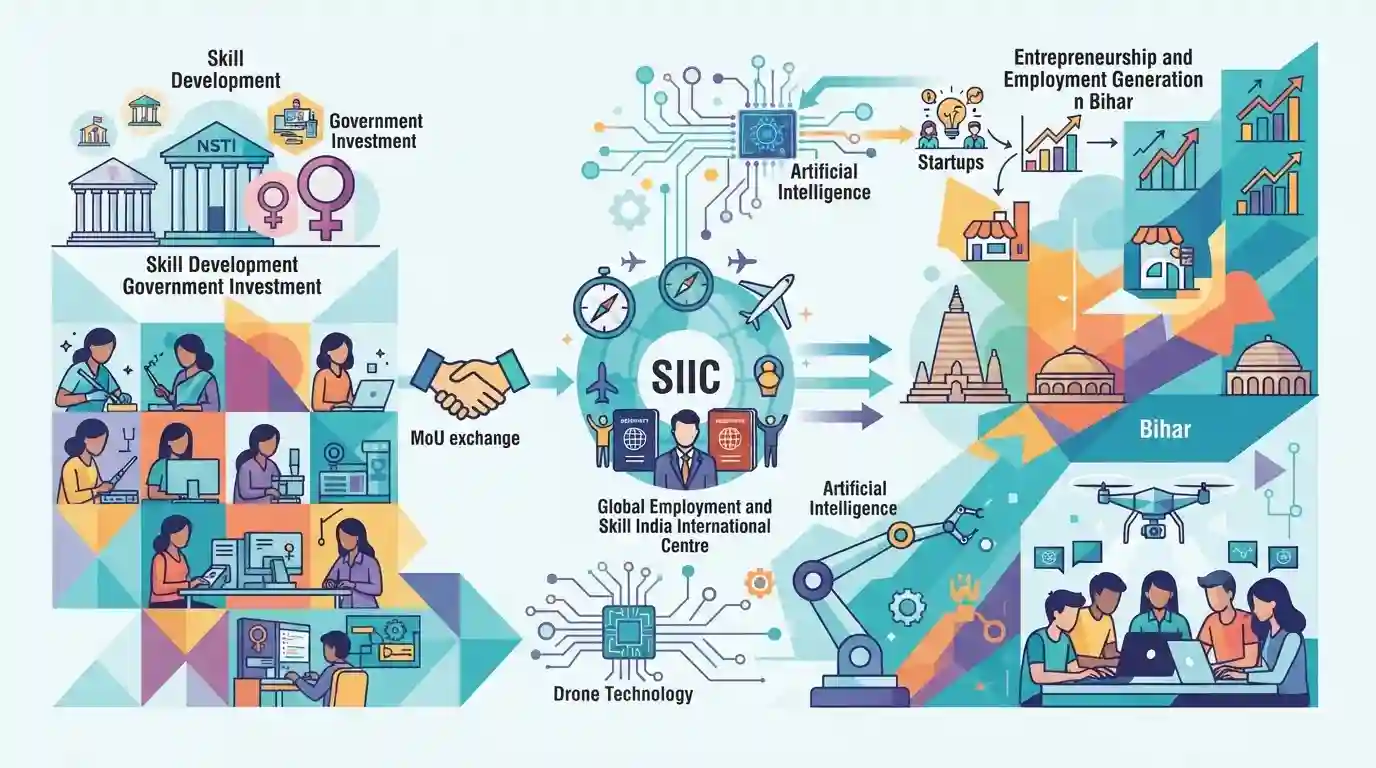
A permanent campus for the National Skill Training Institute (NSTI) for Women was announced in Bihta, Patna, alongside the exchange of an MoU to establish a Skill India International Centre (SIIC). Supported by substantial investments from the Ministry of Skill Development and Entrepreneurship, these initiatives aim to provide cutting-edge vocational training in AI and drone technology, equip youth for global employment, and foster entrepreneurship in Bihar.
Key Points
- The foundation stone was laid for the permanent campus of the National Skill Training Institute (NSTI) for Women in Bihta, Patna, aimed at enhancing women's vocational training.
- The NSTI campus is supported by an investment of ₹99.97 crore and will offer training in emerging sectors like Artificial Intelligence (AI), drone technology, and solar tech.
- An MoU was signed between MSDE and the Bihar Government to establish the Skill India International Centre (SIIC) in Patna with a ₹7 crore capital investment.
- SIIC will train youth for the global job market by providing foreign language courses (e.g., German, Japanese) and placement counseling, aiming to curb out-migration.
- The initiatives are designed to foster entrepreneurship and align with national flagship schemes like PM Surya Ghar Muft Bijli Yojana.
Important Terms
Skill India International Centre (SIIC)

A dedicated skill development centre offering foreign language training, pre-departure orientation, and international certification to prepare Indian youth for overseas employment opportunities.
UPSC context
GS Paper 2 (HRD) - Tests knowledge of government efforts in global workforce mobility and international employment generation.
National Skill Training Institute (NSTI)
Central government institutes under MSDE providing advanced vocational and industrial training. They focus on preparing instructors and offering specialized courses, including exclusive campuses for women (NSTI-W).
UPSC context
GS Paper 2 & 3 (Education/Employment) - Relevant to evaluating India's skilling infrastructure and women's empowerment initiatives.
Craft Instructor Training Scheme (CITS)
A flagship MSDE program that trains instructors for Industrial Training Institutes (ITIs). It blends technical expertise with pedagogy to ensure the effective transfer of practical skills.
UPSC context
GS Paper 2 (Human Resources) - Highlights capacity building by ensuring a supply of quality vocational trainers.
Craftsmen Training Scheme (CTS)
A central scheme providing vocational training in various engineering and non-engineering trades through ITIs, aiming to supply a steady flow of skilled workers to industries.
UPSC context
GS Paper 3 (Employment) - A core component of India's vocational education framework addressing unemployment and industrial skill deficits.
Skills Strengthening for Industrial Value Enhancement (STRIVE)
A World Bank-assisted scheme aimed at improving the quality, relevance, and efficiency of vocational training provided through Industrial Training Institutes (ITIs) and apprenticeship programs.
UPSC context
GS Paper 2 & 3 - Significant for questions on international collaborations in skill development and institutional reforms.
Prelims Trap
Skill India International Centres (SIIC) are established by the Ministry of External Affairs for diaspora welfare.
SIICs are an initiative of the Ministry of Skill Development and Entrepreneurship (MSDE) and NSDC, focused on training Indians for overseas jobs, not MEA.
Static Concepts Connected
How is the vocational training ecosystem regulated and implemented in India?
- NCVET (Regulator): National Council for Vocational Education and Training acts as the overarching regulatory body, having absorbed the erstwhile NCVT and NSDA.
- DGT (Implementation): Directorate General of Training is the implementing agency that oversees Industrial Training Institutes (ITIs) and operates National Skill Training Institutes (NSTIs).
- NSDC (Catalyst): A Public-Private Partnership non-profit entity that catalyzes the creation of vocational institutions and funds private skilling initiatives.
What are the core features of the STRIVE scheme in skill development?
- Primary Objective: Skills Strengthening for Industrial Value Enhancement (STRIVE) aims to improve the relevance and efficiency of ITIs and apprenticeship programs.
- Funding Model: It is a Central Sector Scheme supported by World Bank loan assistance, utilizing a Result Based Financing (RBF) mechanism.
Cross-Topic Patterns
Demographic Dividend meets Migration Diplomacy
SIICs act as the domestic training engines for India’s Migration and Mobility Partnership Agreements (MMPAs) with aging economies like Japan and Germany, transitioning migration from informal to structured pathways.
Green-Tech Vocational Pivot
Integrating solar tech and drones into NSTI curricula reflects a shift toward green skilling, linking core employment frameworks directly to schemes like PM Surya Ghar and Namo Drone Didi.

Expect a multi-statement question linking Skill India International Centres (SIICs) with India's bilateral Migration & Mobility pacts.
Linked PYQs · 4
Linked PYQs · 4
- 2022BPSC_PRELIMSGS1
The new ministry proposed in the Bihar Budget for the year 2021-22 focuses on
- 2025BPSC_PRELIMSGS1
According to PLFS 2023-24, which of the following statements best describe the nature of employment among women in Bihar?
- 2020BPSC_PRELIMSGS1
Bihar Government launched a new scheme 'Satat Jivikoparjan Yojana' in August 2018. The objective of this scheme is
- 2023BPSC_PRELIMSGS1
Consider the following statements regarding the SVAMITVA scheme: 1. It is a Central Sector Scheme under the Ministry of Mines. 2. This scheme seeks to create geopositioning infrastructure like CORS network to benchmark the location and provides five centimetre level accuracy. 3. CORS means Cross-Origin Resource Sharing. 4. The scheme is a reformative step towards establishment of clear ownership of property in rural inhabited (Abadi) areas, by mapping of land parcels using drone technology.
