CET BEd Exam: High-tech security arrangements deployed in Bihar
Source:patnapress ↗
Why It Matters
The article is highly relevant for BPSC as it highlights important administrative governance (role of Governor's secretariat in state exams), technical interventions in fair governance (signal jammers), and key social trends (growing female participation in professional education in Bihar).
Summary
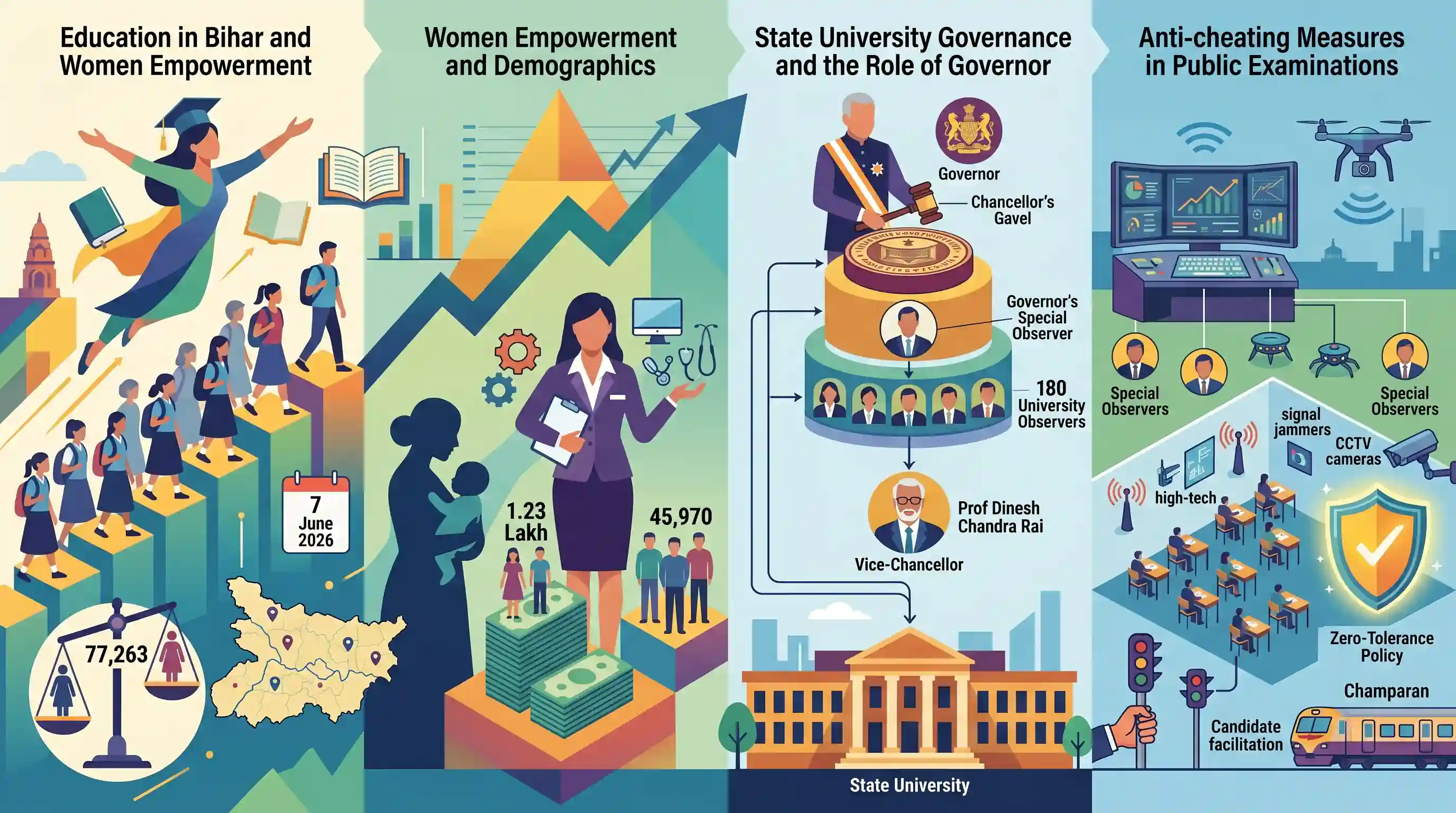
The article highlights the extensive administrative and technical preparations for the Bihar Combined Entrance Test for BEd admissions (CET-BEd 2026) scheduled for June 7, 2026. Highlighting a progressive gender trend, female applicants (77,263) comprise the majority of the 1.23 lakh registered candidates. To prevent exam malpractices, authorities have implemented a multi-layered surveillance structure including special observers appointed by the Governor's Secretariat, 180 university observers, and high-tech signal jammers across 180 centres. Prof Dinesh Chandra Rai, Vice-Chancellor of the nodal university, emphasized a zero-tolerance policy, while local administrations are coordinating with railways to facilitate transport for candidates from the Champaran region.
Key Points
- Gender Demographics in Higher Education: Out of 1,23,237 registered candidates for the CET-BEd 2026 exam, women (77,263) significantly outnumber men (45,970), indicating strong female participation in Bihar's professional/teacher education sector.
- Three-Tier Monitoring System: The Bihar Governor's Secretariat has appointed 11 special observers to oversee the exam across 11 cities. The system also includes 180 university observers, 120 flying squad teams, and 60 magistrate-cum-coordinating observers.
- Anti-Malpractice Technology: High-tech signal jammers have been deployed at 164 examination centres to block mobile, internet, and Bluetooth networks to ensure free and fair examinations.
- Nodal University Administration: Prof Dinesh Chandra Rai, Vice-Chancellor of the nodal university, is leading the coordination and has enforced a strict 'zero tolerance' approach to irregularities.
- Infrastructure Support: Steps are being taken to coordinate with railway authorities to run special trains for candidates travelling from distant locations in the Champaran region (Bettiah and Motihari).
Important Terms
Governor's Secretariat

The administrative office assisting the Governor, who acts as the ex-officio Chancellor of state universities in India, overseeing Vice-Chancellor appointments, university statutes, and governance.
UPSC context
GS Paper II (Polity) — Examines the Governor's discretionary powers and the debate over state university autonomy vs. federal control.
Bihar CET-BEd 2026
A state-level common entrance test conducted in Bihar for admissions into two-year Bachelor of Education (B.Ed.) and Shiksha Shastri programs across state universities.
UPSC context
GS Paper II (Social Justice/Education) — Tests analysis of educational governance, centralized testing systems, and demographic/gender trends in professional education.
Babasaheb Bhimrao Ambedkar Bihar University (BRABU)
A state university in Muzaffarpur designated by Bihar's Governor-Chancellor as the State Nodal University to conduct and coordinate the Bihar CET-BEd 2026 examination.
UPSC context
GS Paper II (Education & Governance) — Illustrates state university administration and the role of designated nodal agencies in conducting large-scale exams.
Public Examinations (Prevention of Unfair Means) Act, 2024
A central legislation aimed at preventing organized cheating, paper leaks, and malpractices in public exams, prescribing stringent criminal and financial penalties for offenders.
UPSC context
GS Paper II (Government Policies) — Analyzes legislative and technological frameworks implemented to ensure academic credibility and transparent recruitment systems.
Prelims Trap
The Public Examinations (Prevention of Unfair Means) Act, 2024, automatically covers state-level university entrance examinations.
The central Act only applies to central recruitment and entrance bodies like NTA, UPSC, and SSC. State-level exams require state-specific legislation.
Static Concepts Connected
What are the key provisions of the Public Examinations (Prevention of Unfair Means) Act, 2024?
- Applicability: Applies to designated central authorities including UPSC, SSC, RRB, NTA, and IBPS.
- Penalties: Prescribes 3-10 years imprisonment and fines up to ₹1 crore for organized paper leaks.
- Legal Nature: Declares all offences under the Act to be cognizable, non-bailable, and non-compoundable.
What is the Governor’s role as the Chancellor of State Universities?
- Statutory capacity: The Governor acts as Chancellor of state universities under specific state university legislations.
- Executive powers: Appoints Vice-Chancellors and oversees university administration, including directing special audits or inquiries.
- Discretionary authority: Acts independently of the council of ministers' aid and advice in university statutory matters.
Cross-Topic Patterns
Gendered employment and education paradox
High female registration in B.Ed exams highlights a drive for formal jobs, contrasting with PLFS data showing predominant female employment in unpaid household work.
Federalism and exam security laws
Central laws governing exams do not automatically cover state exams, forcing states to draft separate legislative frameworks to curb local recruitment malpractices.

Multi-statement questions on the 2024 Public Examinations Act's jurisdiction limits vs state-level anti-cheating laws likely in 2026.
Linked PYQs · 3
Linked PYQs · 3
- 2004BPSC_PRELIMSGS1
What is the female literacy rate in Bihar as per 2001 census?
- 2025BPSC_PRELIMSGS1
According to PLFS 2023-24, which of the following statements best describe the nature of employment among women in Bihar?
- 2018BPSC_PRELIMSGS1
The Governor of a State is appointed by
