Bihar e-Cabinet and Senior Citizen Property Registration Reforms
Source:patnapress ↗
Why It Matters
The initiatives reflect significant steps in administrative reforms (e-governance) and inclusive policies (senior citizens' home registry, SC/ST courts), which are critical themes in BPSC Polity and Governance syllabi. The revival of sugar mills addresses the economic geography and industrialization efforts of Bihar.
Summary
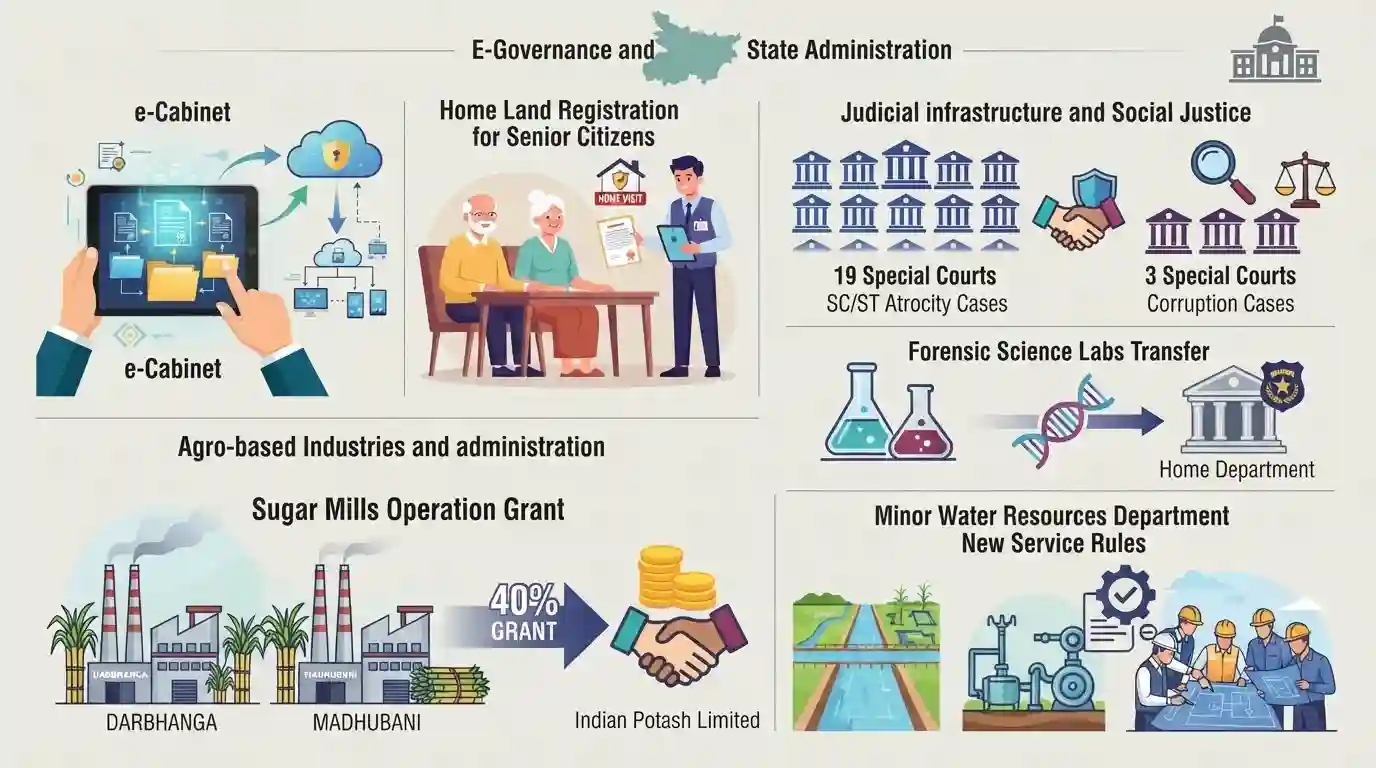
The Bihar Cabinet has approved 24 major proposals spanning governance, justice, and agriculture. Key highlights include the rollout of a paperless e-Cabinet system and a pioneering home land registration service for senior citizens over 75 years old. In industrial efforts, the state will provide a 40% financial grant to Indian Potash Limited (IPL) to operate cooperative sugar mills in Darbhanga and Madhubani. Judicial infrastructure receives a boost with 19 new special courts for SC/ST Atrocity cases and 3 for corruption cases. Additionally, structural changes include transferring Forensic Science Labs to the Home Department and implementing new service rules for Minor Water Resources Department cadres.
Key Points
- Implementation of a paperless e-Cabinet system developed by NIC to enhance administrative efficiency and reduce environmental impact.
- Introduction of a home land registration service utilizing mobile units for senior citizens aged 75 and above.
- Financial assistance of 40% approved by the state for Indian Potash Limited (IPL) to revive cooperative sugar mills in Raiyam (Darbhanga) and Sakri (Madhubani).
- Establishment of 19 special courts for SC/ST Prevention of Atrocities Act cases and 3 special courts for Prevention of Corruption Act cases (Patna and Muzaffarpur).
- Forensic Science Labs transferred to the Home Department to bolster operational control and ensure impartiality in investigations.
- Creation of new direct recruitment service rules for Hydrologist, Hydrogeologist, and Geophysicist cadres under the Minor Water Resources Department.
Important Terms
Scheduled Castes and Scheduled Tribes (Prevention of Atrocities) Act, 1989

A landmark legislative act enacted to prevent caste-based discrimination, violence, and atrocities against members of Scheduled Castes (SCs) and Scheduled Tribes (STs), mandating special courts and victim rehabilitation.
UPSC context
GS Paper II (Polity & Governance) and GS Paper I (Indian Society); tests social justice mechanisms and constitutional safeguards.
Prevention of Corruption Act, 1988
India's primary legislative framework enacted to combat corruption in public office, defining offenses such as bribery and criminal misconduct, and establishing special courts for the trial of public servants.
UPSC context
GS Paper II (Polity & Governance) and GS Paper IV (Ethics); tests governance accountability and anti-corruption architecture.
National Investigation Agency (NIA)
India's premier federal counter-terrorism law enforcement agency, established under the NIA Act, 2008, with pan-India concurrent jurisdiction to investigate offenses affecting national sovereignty, security, and integrity.
UPSC context
GS Paper III (Internal Security) and GS Paper II (Governance); tests federal anti-terror frameworks and security challenges.
National Informatics Centre (NIC)
The premier science and technology institution and official technology partner of the Government of India under MeitY, responsible for providing e-governance infrastructure, software applications, and IT consultancy.
UPSC context
GS Paper II (Governance & E-governance); tests the role of digital infrastructure in public service delivery.
Pradhan Mantri Krishi Sinchayee Yojana (PMKSY)
A centrally sponsored scheme launched in 2015 to expand agricultural irrigation coverage ("Har Khet Ko Pani"), improve on-farm water use efficiency ("More Crop Per Drop"), and implement sustainable water conservation.
UPSC context
GS Paper III (Agriculture & Economy); tests government schemes for rural prosperity, water resource management, and technology adoption.
Prelims Trap
The Central Government is mandated to establish Special Courts under the SC/ST (Prevention of Atrocities) Act across all districts.
Section 14 mandates State Governments, not the Centre, to establish these Exclusive Special Courts, requiring the explicit concurrence of the respective High Court's Chief Justice.
Static Concepts Connected
How are Special Courts established under the SC/ST (Prevention of Atrocities) Act?
- State Mandate: State governments are legally mandated to establish these courts to ensure speedy trials for atrocity cases under Section 14 of the Act.
- Judicial Concurrence: The establishment of these Exclusive Special Courts requires the explicit concurrence of the Chief Justice of the respective High Court.
- Trial Timeline: The Act sets a target that trials in these Special Courts should ideally be completed within two months from the filing of the charge sheet.
How do cooperative sugar mills support India's broader economic and energy goals?
- Ethanol Blending: Reviving dormant sugar mills directly boosts molasses and sugarcane juice availability, feeding into the national Ethanol Blended Petrol (EBP) program.
- Rural Economy: Agro-based cooperatives provide critical local employment and fair remuneration to farmers, revitalizing the rural agrarian economy and curbing distress migration.
Cross-Topic Patterns
E-Governance + Vulnerable Sections
Doorstep land registration for citizens aged 75+ is a perfect GS-2 Mains example of using technology to overcome physical accessibility barriers in public service delivery.
Agro-industries + Energy Security
State grants to revive dormant sugar cooperatives (like Bihar's aid to IPL) connect localized rural job creation with national ethanol blending targets.

Expect a Prelims statement testing the exact authority (State Govt + HC Chief Justice) mandated to create Special Courts under SC/ST Act.
Linked PYQs · 4
Linked PYQs · 4
- 2022BPSC_PRELIMSGS1
The 'Digital India Award, 2020' was given to the Bihar Government for
- 2023BPSC_PRELIMSGS1
Which of the following statements is true about sugar industry in India?
- 2023BPSC_PRELIMSGS1
The Fifth Schedule deals with the governance and protection of the interests of which specific group of people?
- 2020BPSC_PRELIMSGS1
The objective of PM-KUSUM Scheme is
