Bihar Medical Colleges PPP Model Operation Approval
Source:The Hindu ↗
Why It Matters
It represents a major policy shift in Bihar's healthcare sector, utilizing private sector investment to expand medical education and healthcare delivery across districts.
Summary
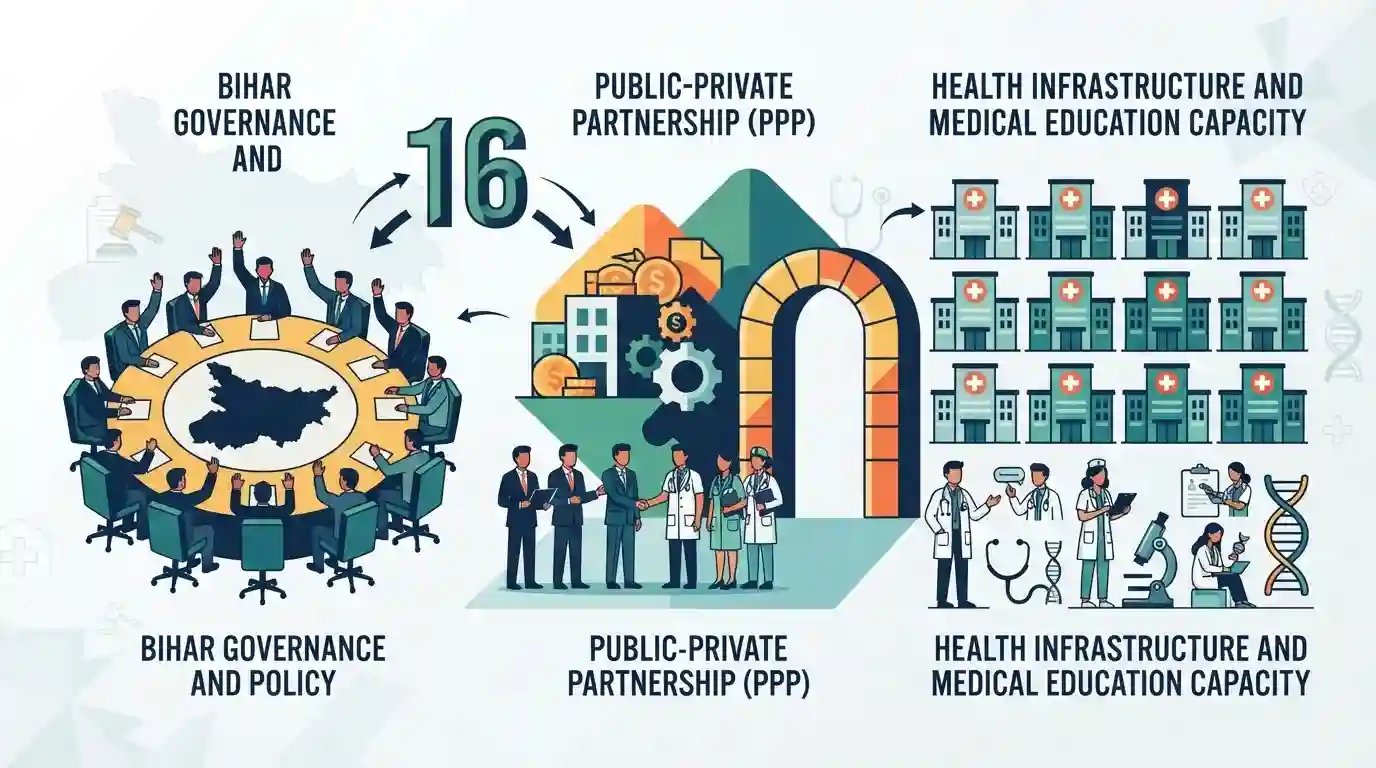
The Bihar Cabinet gave its nod to operate 16 medical colleges and hospitals under the Public-Private Partnership (PPP) model to expand healthcare access and medical education capacity within the State.
Key Points
- The Bihar Cabinet approved a proposal to operate 16 medical colleges and hospitals under the Public-Private Partnership (PPP) model.
- This initiative aims to upgrade healthcare infrastructure, bridge gaps in medical education, and enhance specialized treatment facilities across districts in Bihar.
- The policy leverages private capital and management expertise to improve the public healthcare delivery ecosystem in the state.
Important Terms
Public Private Partnership (PPP) model

A collaborative arrangement between government bodies and private sector companies to finance, build, and operate infrastructure projects such as medical colleges and hospitals.
UPSC context
Important for BPSC General Studies Paper II (Economic Policy and Infrastructure Development), testing models of public service delivery.
Bihar Cabinet
The apex executive body of the state government comprising ministers headed by the Chief Minister, responsible for policy formulation and administrative decisions in Bihar.
UPSC context
Relevant for BPSC Polity and Governance, testing executive decision-making processes and state administration.
Prelims Trap
Operate 16 medical colleges and hospitals under the PPP model amounts to total privatization of state medical infrastructure.
Aspirants often assume PPP models imply complete privatization of healthcare assets, whereas ownership typically remains with the state while operations and management are shared or leased.
Static Concepts Connected
What are the major structural models of Public-Private Partnerships (PPPs) in India's infrastructure development?
- BOT Model: Private partner designs, builds, finances, and operates the asset, transferring it back to the government after a concession period.
- BOO Model: Private entity designs, builds, finances, operates, and maintains the facility, retaining ownership and operating rights indefinitely or for a very long term.
- OMT / Management Contract: Government owns the asset, but contracts a private operator to manage and operate it for a fixed fee or performance-based incentive.
Cross-Topic Patterns
PPP Models and State Fiscal Health
Bihar's growing reliance on PPP models for infrastructure intersects with fiscal deficit management and state-level capital expenditure strategies under the 15th Finance Commission recommendations.
Healthcare Access and Doctor-Patient Ratios
Expanding medical colleges via private capital addresses the severe doctor-patient ratio shortfall highlighted in National Health Accounts estimates for Bihar.

Expect a multi-statement question on Bihar's health policy shifts, specifically combining PPP models with medical education expansion targets.
Linked PYQs · 2
Linked PYQs · 2
- 2022BPSC_PRELIMSGS1
The new ministry proposed in the Bihar Budget for the year 2021-22 focuses on
- 2024-EBPSC_PRELIMSGS1
Which sector received the highest allocation in the Bihar Budget 2024-25?
