Bihar Cabinet Approves Medical Colleges PPP Model and Special Courts
Source:The Hindu ↗
Why It Matters
BPSC Prelims frequently asks questions regarding specific state government schemes, policy decisions, and structural developments in Bihar (such as healthcare models, urban development under AMRUT, and new courts). Knowing state-level PPP ventures and administrative approvals is crucial for the Bihar Specific section of GS.
Summary
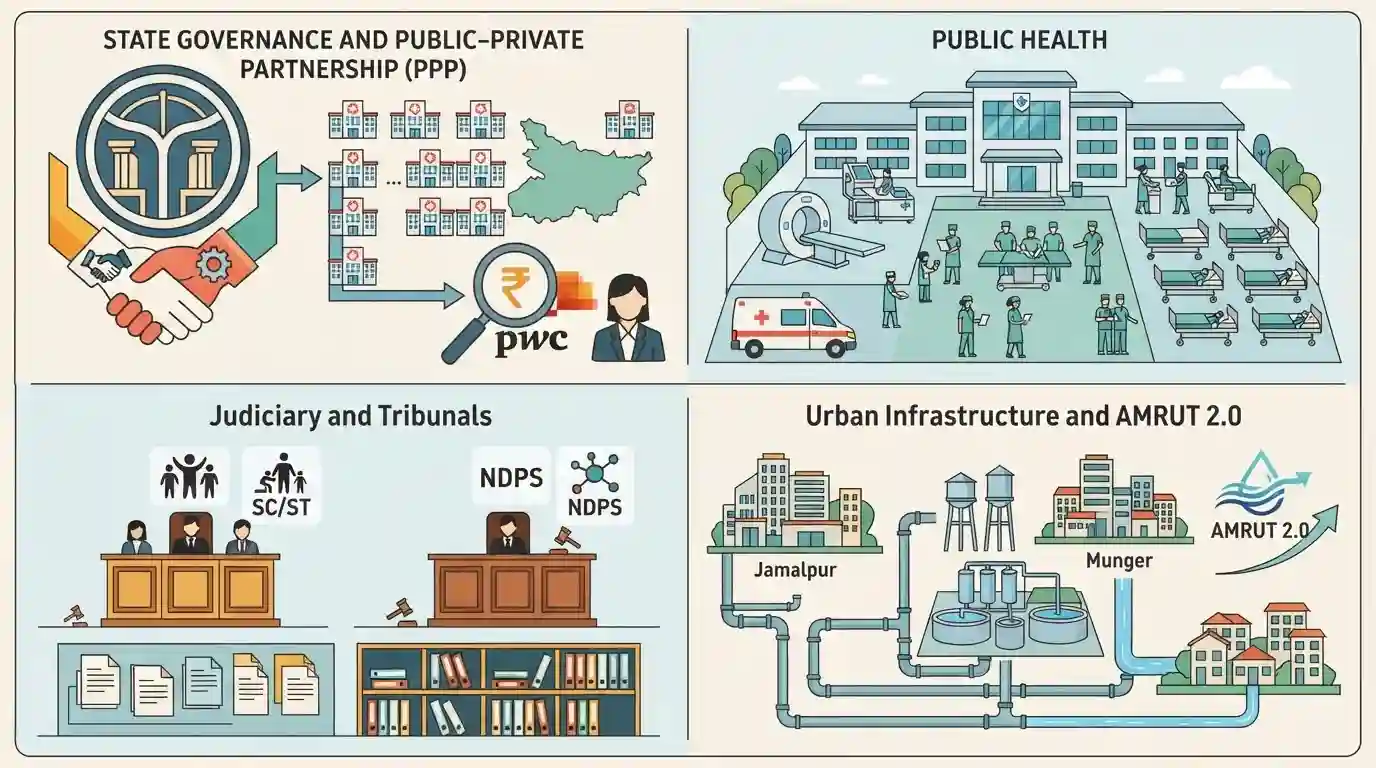
The Bihar Cabinet has sanctioned the operation of 16 medical colleges and hospitals under the Public-Private Partnership (PPP) model, aiming to bolster the state's healthcare infrastructure with PwC serving as the transaction advisor. Additionally, the Cabinet approved land allocations for educational and security establishments, established new specialized courts to handle SC/ST and NDPS Act cases, and gave the nod to significant urban water supply projects in Jamalpur and Munger under the AMRUT 2.0 scheme.
Key Points
- The Bihar Cabinet approved the operation of 16 medical colleges and hospitals under a Public-Private Partnership (PPP) model, appointing PwC as the transaction advisor.
- Land transfers were sanctioned: 5 acres in East Champaran for a Kendriya Vidyalaya and 43.98 acres in Nawada for a Bihar Industrial Security Force (BISF) unit.
- The Cabinet approved the creation of 19 special courts for SC/ST Act cases and 3 special courts for NDPS Act cases across various districts.
- Administrative approval was granted for the Jamalpur and Munger Water Supply Projects under the Central government's AMRUT 2.0 scheme.
- A new Sports Science Centre is set to be established at the Rajgir Campus.
Important Terms
Public-Private Partnership (PPP) model

A collaborative arrangement where the government partners with private entities to design, build, finance, or operate public infrastructure and services. It helps share risks, attract private investment, and improve project efficiency.
UPSC context
Crucial for GS-3 (Investment Models). Tests knowledge of how India funds large public assets and infrastructure without straining fiscal resources.
AMRUT 2.0 scheme
Launched in 2021, this housing and urban affairs ministry mission aims to provide universal water supply coverage, improve sewerage systems, and promote a circular economy of water in Indian statutory towns by 2026.
UPSC context
Highly relevant for GS-2 (Government Policies) and GS-3 (Urbanization). Tests understanding of urban infrastructure, water security, and sustainable development goals.
SC/ST (Prevention of Atrocities) Act
A stringent law enacted to prevent atrocities, hate crimes, and discrimination against Scheduled Castes and Scheduled Tribes. It establishes Special Courts for rapid trials and prescribes strict penalties, generally denying anticipatory bail to accused persons.
UPSC context
Essential for GS-2 (Social Justice/Vulnerable Sections). Questions often focus on its protective provisions, misuse debates, and Supreme Court interpretations.
NDPS Act
The Narcotic Drugs and Psychotropic Substances Act, 1985, is India's primary law combating drug trafficking. It prohibits the production, sale, and consumption of illicit drugs, prescribing severe punishments, including property forfeiture and long imprisonment.
UPSC context
Key for GS-3 (Internal Security). Frequently tested regarding organized crime, cross-border drug smuggling, and the mandate of the Narcotics Control Bureau.
Har Ghar Tiranga campaign
An initiative under Azadi Ka Amrit Mahotsav launched by the Ministry of Culture. It encourages citizens to hoist the national flag at their homes during Independence Day celebrations to instill patriotism and national pride.
UPSC context
Relevant for GS-1 (Culture) and GS-2 (Governance). Tests awareness of mass participatory government campaigns and their broader socio-cultural impacts.
Prelims Trap
Special Courts under the SC/ST Act are constituted by the Central Government on the recommendation of the Supreme Court.
Under Section 14 of the SC/ST Act, it is the State Government, with the concurrence of the Chief Justice of the respective High Court, that establishes these courts.
Static Concepts Connected
How does Viability Gap Funding (VGF) support PPP infrastructure projects?
- Core Mechanism: Provides a one-time capital grant to infrastructure projects that are economically justified but financially unviable.
- Nodal Administration: Administered by the Department of Economic Affairs (Ministry of Finance), enabling states to boost private investment.
- Social Sector Push: The VGF scheme was revamped to significantly increase outlay for social sectors like health and education (up to 30% of project cost).
What distinguishes AMRUT 2.0 from the Jal Jeevan Mission (JJM)?
- Target Area: AMRUT 2.0 targets statutory towns and urban areas, whereas JJM primarily focuses on rural households.
- Core Scope: AMRUT includes sewerage, septage management, and a circular economy of water, while JJM focuses on functional tap connections.
- Nodal Ministry: AMRUT 2.0 is under the Ministry of Housing and Urban Affairs (MoHUA); JJM is under the Ministry of Jal Shakti.
Cross-Topic Patterns
NITI Aayog's District Hospital PPPs
Privatization of secondary and tertiary care links VGF mechanics with the Right to Health debate, a likely GS2 mains theme on tackling India's health infrastructure deficits.
Statutory Backing of Specialized Courts
The NDPS, SC/ST, and POCSO Acts all mandate specialized courts. UPSC frequently tests the notifying authority behind such tribunals (typically State Govt + High Court CJ).

Expect a prelims statement testing the exact notifying authority for Special Courts under SC/ST and NDPS Acts (State Govt + High Court CJ).
Linked PYQs · 3
Linked PYQs · 3
- 2024-EBPSC_PRELIMSGS1
Which sector received the highest allocation in the Bihar Budget 2024-25?
- 2016BPSC_PRELIMSGS1
'SUPUR' project in Bihar relates to :
- 2020BPSC_PRELIMSGS1
Bihar Government launched a new scheme 'Satat Jivikoparjan Yojana' in August 2018. The objective of this scheme is
