Bihar Cabinet Decisions: Anganwadi Vacancies and e-Cabinet System
Source:The Hindu ↗
Why It Matters
BPSC Prelims frequently tests candidates on new state government initiatives, e-governance milestones (like paperless systems), and regional geographic features (such as rivers like Kiul). Understanding the structural changes in state administration and welfare guidelines is crucial for the exam.
Summary
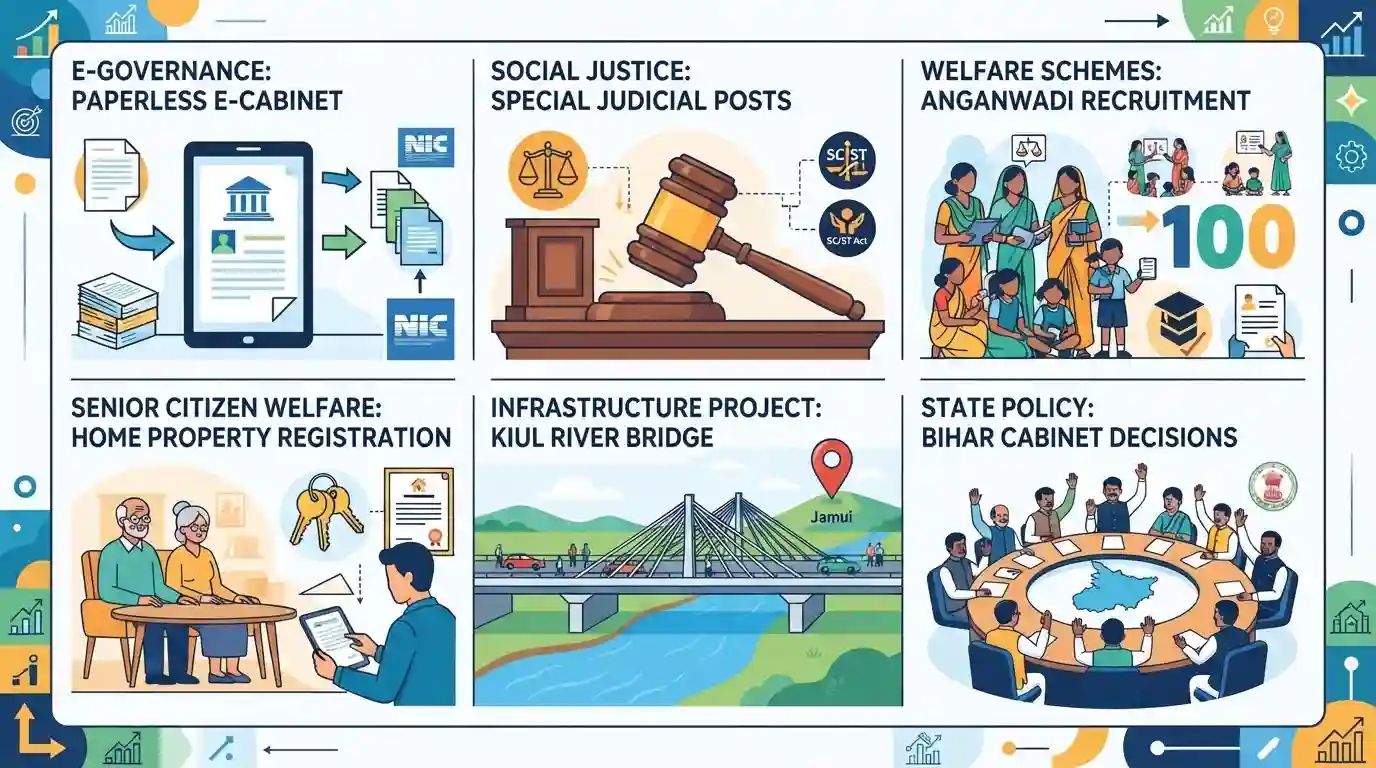
The Bihar Cabinet has taken several significant decisions encompassing e-governance, social justice, and child welfare. Key measures include the approval of the Anganwadi Worker/Helper Selection Guidelines- 2026 to fill nearly 23,000 vacancies under the ICDS scheme, and the creation of judicial posts for Special Courts dealing with cases under the SC/ST (Prevention of Atrocities) Act. Additionally, the government has mandated the shift to a paperless e-Cabinet system managed by the NIC, permitted home property registration for senior citizens over 75, and approved major infrastructural projects like a bridge over the Kiul River in Jamui.
Key Points
- The Bihar Cabinet approved guidelines to fill 22,981 vacant Anganwadi posts (workers and helpers) under the Integrated Child Development Services (ICDS) scheme.
- Approval was granted to transition to an e-Cabinet system to promote a paperless environment, with the National Informatics Centre (NIC) designated as the implementing agency.
- The cabinet cleared the creation of 19 posts of District & Additional Sessions Judge for Exclusive Special Courts under the SC and ST (Prevention of Atrocities) Act.
- Under the Bihar Registration (Amendment) Rules, 2026, senior citizens aged 75 or above can now avail home registration for properties.
- Administrative approval was given for the construction of a high-level RCC bridge over the Kiul and Suknar Rivers in Jamui district.
Important Terms
Integrated Child Development Services (ICDS)

A centrally sponsored scheme launched in 1975 to provide supplementary nutrition, preschool education, and primary healthcare to children under six, pregnant women, and lactating mothers through Anganwadi centres.
UPSC context
Essential for GS Paper II (Social Justice). Tests knowledge on child development, maternal health, and malnutrition interventions.
SC and ST (Prevention of Atrocities) Act, 1989
An Indian legislation designed to prevent caste-based discrimination, abuse, and hate crimes against marginalized communities, featuring stringent penalties and provisions for establishing specialized trial courts.
UPSC context
Crucial for GS Paper II (Social Justice). Addresses statutory safeguards and human rights protections for vulnerable populations.
Anganwadi Worker/Helper Selection Guidelines- 2026
Recently approved regulations by the Bihar Cabinet aimed at efficiently recruiting local women to fill nearly 23,000 vacant Anganwadi positions, bolstering grassroots child welfare and nutrition delivery.
UPSC context
Relevant for BPSC and GS Paper II (Governance). Highlights decentralization, rural women's employment, and ICDS implementation.
Bihar Registration (Amendment) Rules, 2026
An amendment by the Bihar government enabling paperless, at-home property registration via Mobile Registration Units specifically designed for senior citizens aged 75 years and older.
UPSC context
Notable for GS Paper II (Governance) and BPSC. Demonstrates citizen-centric administration and targeted welfare for the elderly.
National Informatics Centre (NIC)
The premier technology partner of the Indian Government under MeitY. It designs and implements essential IT infrastructure, enabling e-governance systems like Bihar's newly approved paperless e-Cabinet.
UPSC context
Important for GS Paper II and III (E-Governance). Relates to digital transformation and transparency in public administration.
Prelims Trap
The SC/ST (Prevention of Atrocities) Act places an absolute bar on granting anticipatory bail to the accused.
The Supreme Court has clarified that this bar is not absolute; anticipatory bail is maintainable if the FIR fails to establish a prima facie caste-based offense.
Static Concepts Connected
What are the core components and target demographics of ICDS?
- Scheme Nature: It is a Centrally Sponsored Scheme under the Ministry of Women and Child Development, requiring shared funding and state-level implementation.
- Six Core Services: Includes Supplementary Nutrition, Pre-school Non-formal Education, Nutrition & Health Education, Immunisation, Health Check-up, and Referral Services.
- Target Beneficiaries: The scheme targets children aged 0-6 years, pregnant women, and lactating mothers exclusively through Anganwadi Centres.
How are Special Courts established under the SC/ST (Prevention of Atrocities) Act?
- Statutory Mandate: Section 14 mandates the establishment of Special Courts or Exclusive Special Courts to ensure speedy trials (target of two months from charge sheet).
- Creation Process: The State Government establishes them with the concurrence of the Chief Justice of the respective High Court, specifying a Court of Session for this purpose.
Cross-Topic Patterns
ICDS + POSHAN 2.0 integration
Anganwadi workers serve as the critical frontline node linking foundational ICDS objectives with overlapping national nutrition targets like POSHAN Abhiyaan 2.0 and Anemia Mukt Bharat.
Peninsular tributaries of the Ganga
The Kiul River highlights the frequently tested drainage pattern of south-bank Ganga tributaries that originate in the Chhotanagpur Plateau and flow northwards.

Judicial exceptions to anticipatory bail bars under the SC/ST Act are highly likely to appear as a tricky statement in a 2026 Polity MCQ.
Linked PYQs · 2
Linked PYQs · 2
- 2020BPSC_PRELIMSGS1
Bihar Government has introduced the Comprehensive Financial Management System (CFMS) on 1st April, 2019. This system
- 2020BPSC_PRELIMSGS1
Which of the following rivers flowing in Bihar is a north flowing river?
