Bihar Cabinet approves upgrading B.Ed colleges under NEP 2020
Source:The Hindu ↗
Why It Matters
This article comprehensively covers multiple recent policy approvals by the Bihar Government. These include significant educational reforms aligned with the national NEP 2020 framework, continuations of flagship youth empowerment schemes (Saat Nischay), and commitments to renewable energy through biogas and solar initiatives. Such policy updates are highly relevant for the Bihar-specific segment of the BPSC Prelims examination.
Summary
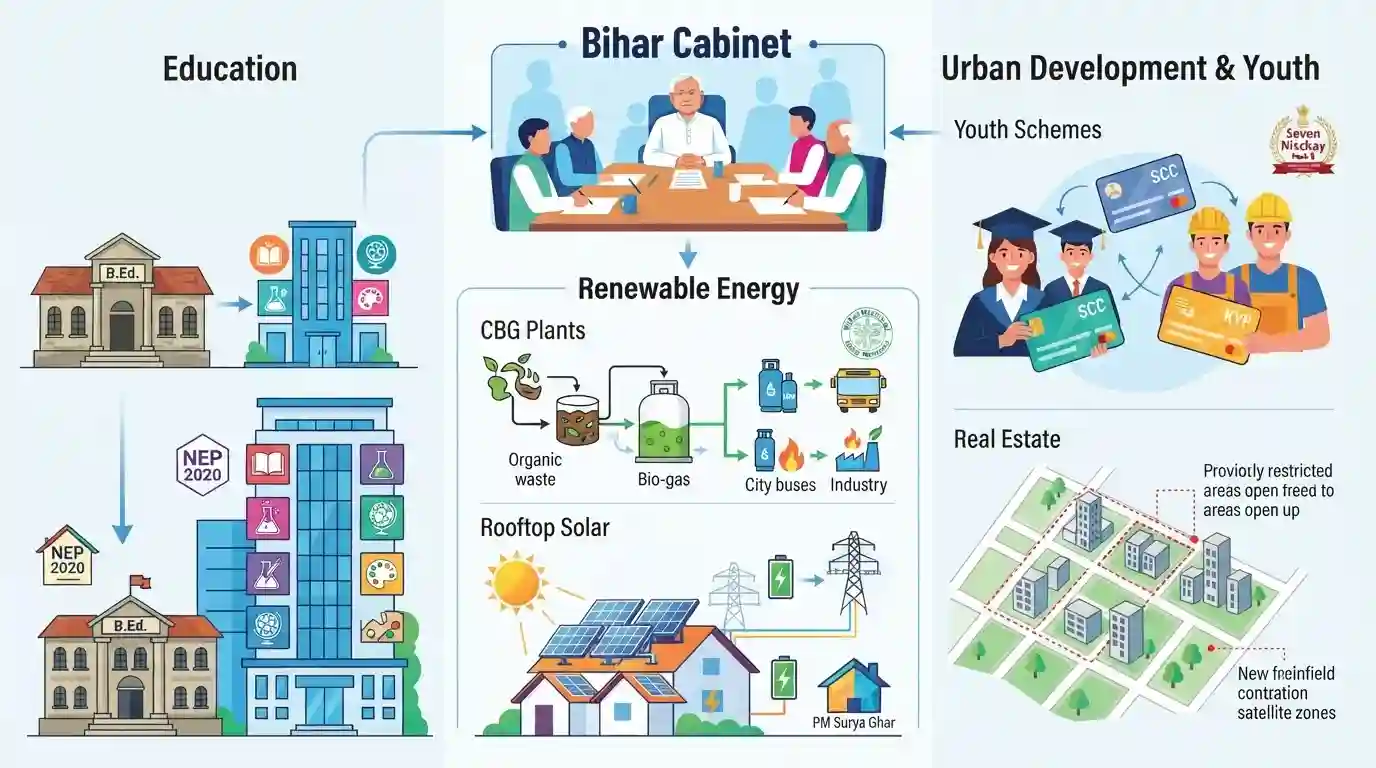
The Bihar Cabinet, chaired by Chief Minister Nitish Kumar, has approved several pivotal initiatives spanning education, green energy, and infrastructure. Over 300 private B.Ed. colleges will be upgraded to multidisciplinary degree colleges in compliance with the NEP 2020. Additionally, key youth empowerment schemes—the Student Credit Card (SCC) and Kushal Yuva Programme—were extended for five years under 'Seven Nischay Part-3'. Promoting renewable energy, the cabinet approved the setup of Compressed Biogas (CBG) plants in four municipal corporations and state financial assistance for rooftop solar panels under the PM Surya Ghar: Muft Bijli Yojana. Real estate restrictions in Greenfield Satellite Cities were also removed.
Key Points
- The Bihar Cabinet approved the transformation of 300 private B.Ed. colleges into multidisciplinary degree colleges to align with the NEP 2020.
- The Student Credit Card scheme and Kushal Yuva Programme have been extended for five years (2026-27 to 2030-31) under the 'Seven Nischay Part-3'.
- Compressed Biogas (CBG) plants will be established under a PPP model in four municipal corporations: Gaya, Muzaffarpur, Bhagalpur, and Biharsharif.
- Financial assistance was sanctioned for consumers to install rooftop solar systems under the Pradhan Mantri Surya Ghar: Muft Bijli Yojana.
- Restrictions on the purchase, sale, and transfer of land in notified Greenfield Satellite Cities have been lifted.
Important Terms
National Education Policy (NEP) 2020

A comprehensive framework guiding education in India, advocating a shift from stand-alone institutions to multidisciplinary higher education models to improve access, equity, and the Gross Enrolment Ratio (GER).
UPSC context
GS Paper 2 (Education). Frequently tested regarding educational reforms, human resource development, and restructuring of higher education.
Pradhan Mantri Surya Ghar: Muft Bijli Yojana
A central government scheme providing up to 300 units of free electricity per month and capital subsidies to one crore households for installing residential rooftop solar panels.
UPSC context
GS Paper 3 (Energy). Important for evaluating India's renewable energy targets, climate commitments, and sustainable infrastructure initiatives.
Seven Nischay Part-3
The third phase of Bihar's flagship state development agenda, encompassing strategic policy commitments focused on youth empowerment, skill development, industrial growth, and healthcare expansion.
UPSC context
GS Paper 2 (Governance). Essential for BPSC and serves as an excellent governance case study for targeted, multi-sectoral state development.
Student Credit Card (SCC) scheme
A Bihar state welfare program providing education loans up to ₹4 lakh at nominal interest rates to financially assist students pursuing higher and technical education.
UPSC context
GS Paper 2 (Social Justice). Useful as an example of state interventions to increase the higher education Gross Enrolment Ratio (GER).
Kushal Yuva Programme (KYP)
A Bihar government skill-development initiative offering free training in basic computer literacy, life skills, and communication to youth aged 15-28, enhancing local employability.
UPSC context
GS Paper 2 (Welfare Schemes). Highly relevant as a state-level case study on harnessing the demographic dividend and youth skill empowerment.
Prelims Trap
"Compressed Biogas (CBG) primarily consists of butane and propane, making it a sustainable alternative to LPG."
CBG is chemically similar to CNG and primarily contains methane (over 90%). LPG, on the other hand, is composed mainly of butane and propane.
Static Concepts Connected
What is Compressed Biogas (CBG) and its chemical composition?
- Production source: Produced naturally through the anaerobic digestion of biomass sources like municipal solid waste, agricultural residue, and sugarcane press mud.
- High methane content: It contains over 90% methane, making it chemically identical to Compressed Natural Gas (CNG), allowing it to directly replace CNG in vehicles.
- Valuable byproducts: The CBG production process yields fermented organic manure (FOM) as a byproduct, which supports sustainable agriculture.
What is the NEP 2020 mandate regarding standalone educational institutions?
- Phasing out single-stream: NEP 2020 aims to phase out single-stream educational institutions (like standalone B.Ed. or engineering colleges) over time.
- Multidisciplinary transformation: It mandates the transformation of all higher education institutions into multidisciplinary entities or clusters by 2040.
- Holistic learning: This approach is designed to promote holistic, cross-disciplinary learning, integrating humanities, sciences, and vocational training.
Cross-Topic Patterns
Urban Governance + Waste-to-Energy (SATAT)
Municipal solid waste management is increasingly linked with renewable energy policies like the SATAT scheme, treating urban waste as a valuable feedstock for Compressed Biogas (CBG) production.
Decentralized Solar + Cooperative Federalism
State-level financial top-ups for PM Surya Ghar reflect a federal push toward decentralized, prosumer-driven solar grids, reducing dependence on large-scale centralized solar parks.

Expect a 2026 prelims question linking CBG composition (>90% methane), the SATAT scheme, and municipal solid waste management rules.
Linked PYQs · 4
Linked PYQs · 4
- 2023BPSC_PRELIMSGS1
The National Education Policy, 2020 emphasizes the integration of vocational education into mainstream education from which grade onwards?
- 2020BPSC_PRELIMSGS1
Bihar Government launched a new scheme 'Satat Jivikoparjan Yojana' in August 2018. The objective of this scheme is
- 2024-IBPSC_PRELIMSGS1
In April, 2020 the Bihar Education Department started the following program through DD Bihar
- 2024-EBPSC_PRELIMSGS1
Which of the following centres in Bihar is proposed to develop under Vishnupad Yojana for promotion of tourism in Union Budget 2024?
