Bihar Cabinet Authorises Gram Panchayats to Levy Local Taxes and Fees
Source:The Hindu ↗
Why It Matters
Questions on Panchayati Raj structure, functions, and finances are perennial favorites in the BPSC Prelims. Specific state-level developments like the Tharuhat Development Agency (West Champaran) and the new state ropeways company are highly relevant for Bihar-specific polity, geography, and current affairs.
Summary
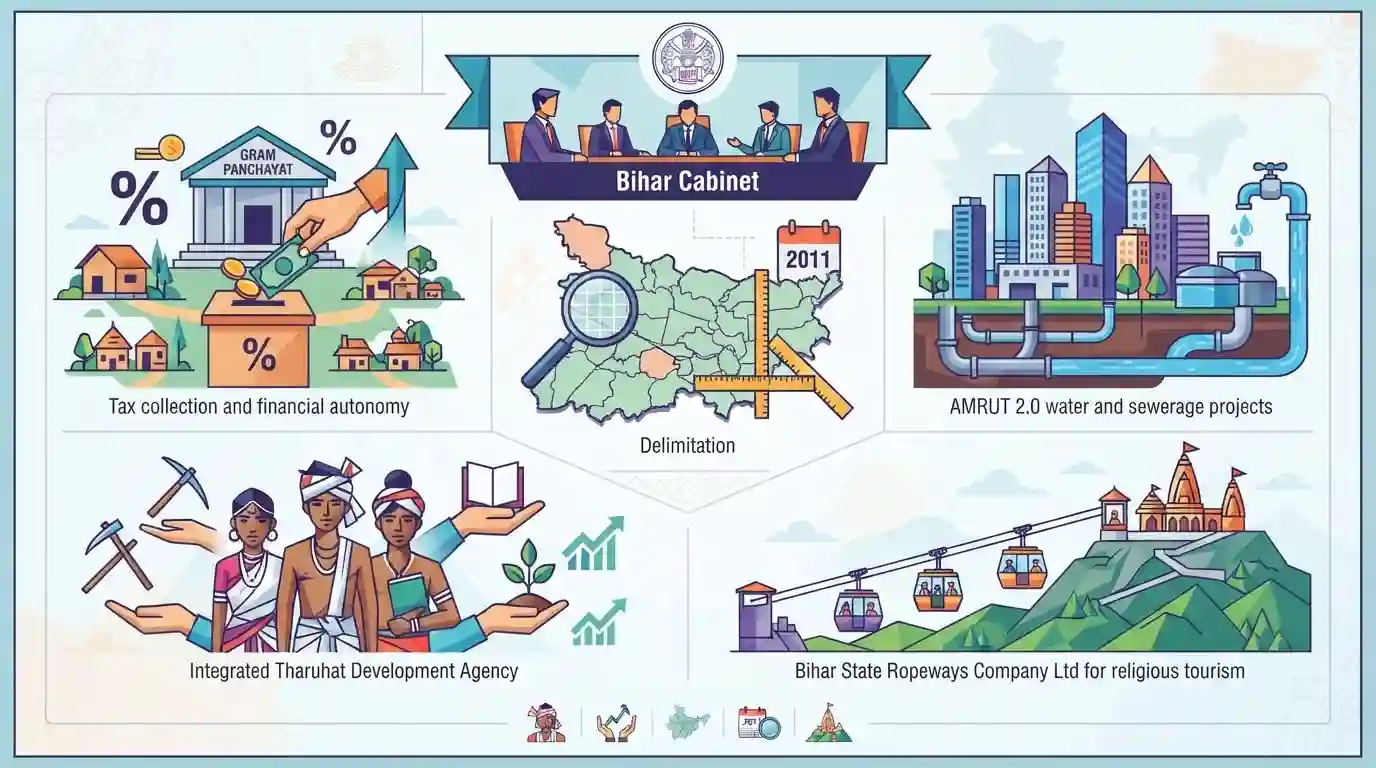
The Bihar Cabinet, chaired by Chief Minister Samrat Choudhary, made key decisions across local governance, urban development, tourism, and tribal welfare. It approved rules allowing Gram Panchayats to levy and collect their own taxes, enhancing their financial autonomy under the Bihar Panchayat Raj Act, 2006. The delimitation of rural local bodies will be based on the 2011 Census. In other major steps, water and sewerage projects were approved under AMRUT 2.0, the Integrated Tharuhat Development Agency in West Champaran was extended to aid the Tharu tribe, and a new Bihar State Ropeways Company Ltd was formed to bolster religious tourism.
Key Points
- The Bihar Cabinet approved the Draft Gram Panchayat Taxes, Rates and Fees Rules, 2026, authorizing Gram Panchayats to levy and collect taxes to boost their financial independence.
- Delimitation of local body constituencies (Gram Panchayat, Panchayat Samiti, and Zila Parishad) will be conducted based on the 2011 Census population figures.
- AMRUT 2.0 projects were sanctioned for water supply in Khagaria, Sitamarhi, and Samastipur, and for a sewerage treatment plant in Hajipur.
- The tenure of the Integrated Tharuhat Development Agency in West Champaran was extended to continue developmental works for the Tharu Scheduled Tribe.
- The Bihar State Ropeways Company Ltd was established to operate, manage, and construct ropeways, particularly aimed at boosting religious tourism.
Important Terms
Gram Panchayat Taxes, Rates and Fees Rules, 2026

New Bihar government rules empowering Gram Panchayats to levy holding taxes, professional fees, and user charges. This operationalizes taxation provisions to boost local bodies' Own Source Revenue (OSR).
UPSC context
Crucial for GS Paper 2 (Panchayati Raj), highlighting financial empowerment and devolution of fiscal powers to local self-governments.
AMRUT 2.0
A centrally sponsored MoHUA mission (2021-2026) targeting universal water supply coverage across all statutory towns, sewerage management, and water body rejuvenation to build water-secure cities.
UPSC context
Important for GS 2 (Government Policies) and GS 3 (Urban Infrastructure), testing knowledge of urban transformation and cooperative federalism.
Integrated Tharuhat Development Agency
A nodal state agency headquartered in West Champaran, Bihar, dedicated to the socio-economic and infrastructural development of the indigenous Tharu tribal community. Its mandate was recently extended to 2031.
UPSC context
Highly relevant for GS 1 (Tribes/Society) and GS 2 (Vulnerable Sections), illustrating targeted regional development and tribal welfare.
Bihar Panchayat Raj Act, 2006
The primary legislation governing rural local governance in Bihar. Recent cabinet decisions authorized the delimitation of Panchayats under this Act based on the 2011 Census population data.
UPSC context
Tests GS 2 (Local Self-Government), specifically state-level adaptations of the 73rd Constitutional Amendment and rural decentralization.
Bihar State Ropeways Company Ltd
A newly constituted public enterprise by the Bihar government focused on building and operating safe, modern ropeway transportation to boost connectivity at religious tourist destinations across the state.
UPSC context
Relevant for GS 3 (Infrastructure/Tourism), reflecting state initiatives in alternative transport mechanisms and heritage tourism promotion.
Prelims Trap
The Constitution directly grants Gram Panchayats the mandatory power to levy and collect local taxes.
Article 243H is enabling, not mandatory. The Constitution empowers the State Legislature to authorize Panchayats to levy taxes; it is not an automatic right.
Static Concepts Connected
What are the sources of finance for Panchayati Raj Institutions under the Constitution?
- Taxation powers: State legislatures may authorize Panchayats to levy, collect, and appropriate taxes, duties, tolls, and fees (Article 243H).
- Assigned taxes: The State government can assign revenues from specific state-level taxes to Panchayats.
- Grants-in-aid: Provided from the Consolidated Fund of the State based on the recommendations of the State Finance Commission.
Who are the Tharu people and what is their geographical distribution?
- Geographical habitat: They inhabit the Terai lowlands along the Shivalik foothills (India-Nepal border), primarily in Uttar Pradesh, Bihar, and Uttarakhand.
- Bihar presence: They form the highest percentage of the Scheduled Tribe population in Bihar, predominantly concentrated in the West Champaran district.
- Socio-economic profile: Traditionally agrarian, they are known for cultivating rice and practicing distinct animist-Hindu syncretic religious traditions.
Cross-Topic Patterns
Fiscal Devolution vs. Central Urban Missions
While Panchayats gain taxation autonomy via State Acts, urban infrastructure still relies heavily on Centrally Sponsored Schemes like AMRUT 2.0, highlighting contrasting models of fiscal decentralization in rural vs. urban local bodies.
Terai Tribal Geography & Ecotourism
The Tharuhat Agency operates in West Champaran, overlapping with the Valmiki Tiger Reserve. Tribal development initiatives are increasingly tested alongside ecotourism and protected area management in the Terai landscape.

Expect a multi-statement Prelims question testing whether Panchayat taxation powers are directly constitutional or delegated by States.
Linked PYQs · 5
Linked PYQs · 5
- 2024-IBPSC_PRELIMSGS1
What is the system of governance in the Panchayat Raj set-up?
- 2025BPSC_PRELIMSGS1
What is the main purpose of Panchayati Raj?
- 2023BPSC_PRELIMSGS1
At what level does a Panchayat Samiti operate a Panchayati Raj structure?
- 2023BPSC_PRELIMSGS1
The specifications required for a community to be declared as a Scheduled Tribe are 1. indications of primitive traits 2. distinctive culture 3. shyness of contact with the community at large 4. backwardness and geographical isolation
- 2023BPSC_PRELIMSGS1
Bihar’s geographical structure consists of rock systems. Match the rock systems with their descriptions: a. Dharwar rock system 1. Created by the rapid deposition of alluvium by Himalayan and Peninsular rivers b. Vindhyan rock system 2. Can be found in the West Champaran district c. Quaternary rock system 3. Part of the oldest Archaean rock system d. Tertiary rock system 4. Sandstone, limestone, dolomite, quartzite and shale are the main constituents of this rock system Select the correct answer using the codes given below.
