Bihar Cabinet Approval for PMFBY and Rural Employment Schemes
Source:drishtiias ↗
Why It Matters
This decision represents a major policy reversal as Bihar transitions back to the central PMFBY framework for agricultural risk mitigation, while launching VB-GRAM-G to enhance rural employment guarantees beyond the standard 100 days of MGNREGA. It also underscores ongoing infrastructure investments in Bihar's irrigation and municipal sectors.
Summary
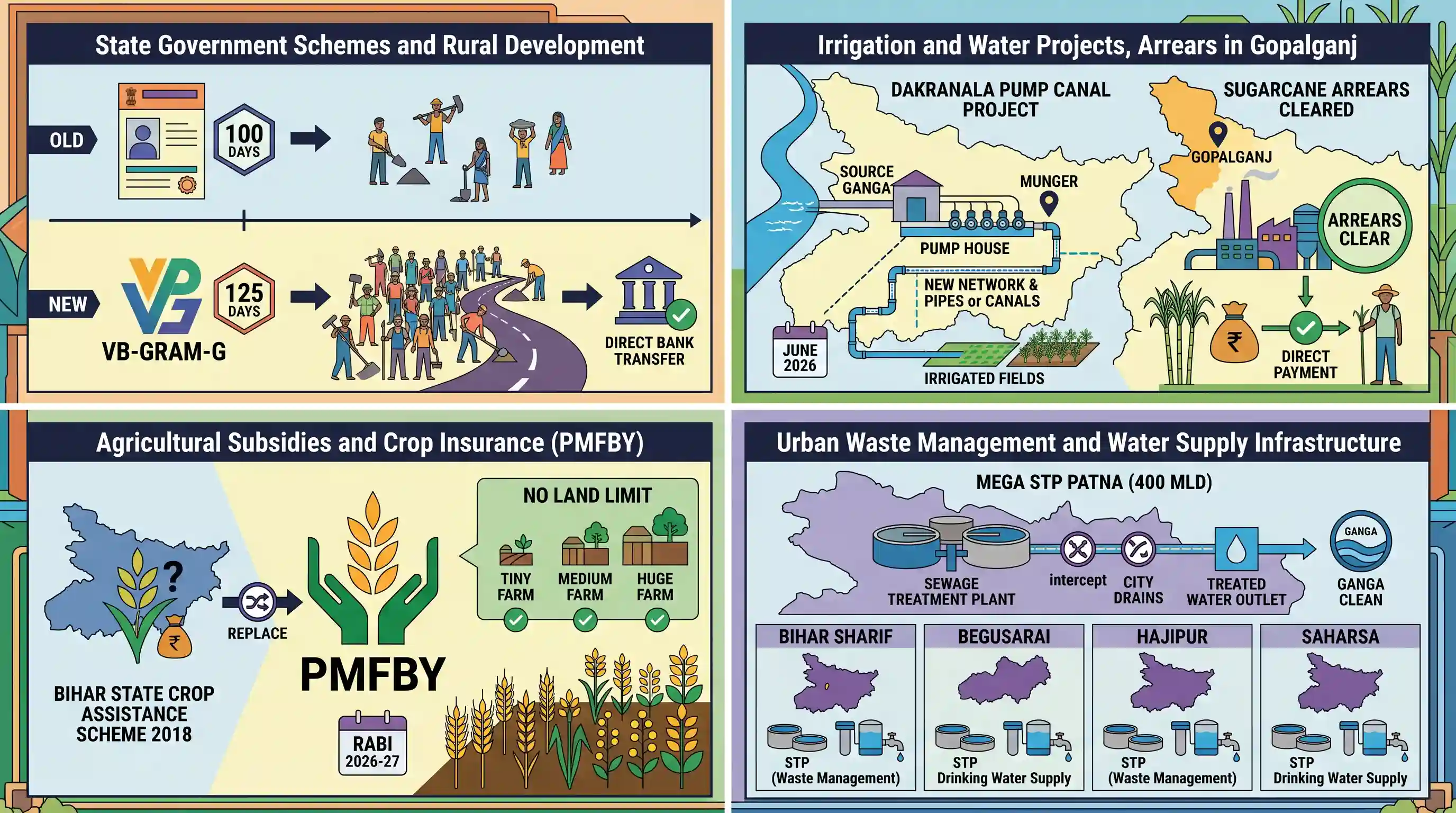
The Bihar Cabinet has approved several landmark initiatives including the introduction of the VB-GRAM-G rural employment scheme and re-implementing the Central Government's Pradhan Mantri Fasal Bima Yojana (PMFBY) from the Rabi 2026-27 crop season. PMFBY will replace the 2018 Bihar State Crop Assistance Scheme. Additionally, the Cabinet cleared critical sugarcane arrears in Gopalganj, sanctioned major water resource projects (including the Dakranala Pump Canal), and approved municipal sewage and drinking water projects across various districts.
Key Points
- The Bihar Cabinet approved the implementation of VB-GRAM-G (Viksit Bharat - Green Rural Agricultural Mission - Gramin), which guarantees 125 days of wage employment per financial year to rural households for unskilled manual work.
- The state has approved the re-introduction of the central Pradhan Mantri Fasal Bima Yojana (PMFBY) starting from the Rabi 2026–27 season, replacing the local Bihar State Crop Assistance Scheme (Bihar Rajya Fasal Sahayata Yojana) that was active since 2018.
- The cabinet cleared ₹43 crore in outstanding sugarcane dues for farmers under Sasamusa Sugar Works Private Limited in Gopalganj district.
- An allocation of ₹1,113 crore was approved for three major Water Resources Department projects, including the Dakranala Pump Canal project at the confluence of Ganga and Dakranala.
- Approved ₹798 crore for urban projects, which include setting up Sewage Treatment Plants (STPs) in Bihar Sharif (Nalanda) and Begusarai, as well as drinking water schemes in Hajipur (Vaishali) and Saharsa.
Important Terms
Pradhan Mantri Fasal Bima Yojana (PMFBY)

A centrally sponsored crop insurance scheme launched in 2016 to provide comprehensive financial protection to farmers against non-preventable crop damage caused by natural hazards, pests, or diseases.
UPSC context
GS Paper III (Agriculture & Government Schemes), testing knowledge of agricultural safety nets and crop insurance.
Viksit Bharat - Guarantee for Rozgar and Aajeevika Mission - Gramin (VB-GRAM-G)
A national rural employment scheme enacted in 2025 as a revamped version of MGNREGA, guaranteeing 125 days of wage-based employment per financial year to eligible rural households.
UPSC context
GS Paper II & III (Rural Development), testing concepts of right to work, rural livelihoods, and poverty alleviation.
Bihar State Crop Assistance Scheme (Bihar Rajya Fasal Sahayata Yojana)
A Bihar-specific, premium-free assistance scheme launched in 2018 that provides direct financial compensation to farmers based on crop yield thresholds rather than insurance premium payouts.
UPSC context
GS Paper III (Agriculture), testing understanding of alternative state-level crop compensation frameworks.
Prelims Trap
The Central Government continues to fund 100% of unskilled manual wages under the new VB-GRAM-G framework, similar to MGNREGA.
Unlike MGNREGA's 100% central funding for unskilled labor, the new VB-GRAM-G Act, 2025 shifts this to a 60:40 Centrally Sponsored sharing model.
Static Concepts Connected
What are the core premium features of the Pradhan Mantri Fasal Bima Yojana (PMFBY)?
- Farmer premiums: Farmers pay fixed premiums of 2% for Kharif, 1.5% for Rabi, and 5% for commercial/horticultural crops.
- Subsidy sharing: Remaining premium cost is shared 50:50 between Centre and States, except 90:10 for Himalayan and Northeastern states.
- Voluntary nature: The scheme is completely voluntary for all categories of farmers, including loanee farmers, since 2020.
What are the key differences between Central Sector and Centrally Sponsored Schemes?
- Funding source: Central Sector Schemes are 100% funded by the Centre, while Centrally Sponsored Schemes feature cost-sharing ratios.
- Implementation agency: Central Sector Schemes are implemented by Union ministries; Centrally Sponsored Schemes are executed by State administrations.
Cross-Topic Patterns
Cooperative Federalism & Fiscal Decentralization
Shifting the unskilled wage burden under the new VB-GRAM-G to a 60:40 ratio heavily impacts financially stressed state budgets, reshaping Union-State fiscal dynamics.
Agricultural Risk Management
Bihar's return to PMFBY demonstrates the limitations of yield-based state-funded assistance programs compared to structured, premium-based multi-peril crop insurance systems.

The transition of MGNREGA to the VB-GRAM-G Act (2025) and state returns to PMFBY will likely be framed as comparative GS-3 questions in 2026.
Linked PYQs · 2
Linked PYQs · 2
- 2016BPSC_PRELIMSGS1
Which of the following canal systems irrigate areas of Bihar?
- 2024-EBPSC_PRELIMSGS1
What is the contribution of agriculture in the Gross Domestic Product (GDP) of Bihar?
