Bihar Cabinet: Approval for VB-G RAM G and PMFBY implementation
Source:etv-bharat ↗
Why It Matters
This article covers critical policy transitions in Bihar, such as the major structural shift from MGNREGA to VB-G RAM G and the return to PMFBY. It also highlights key regional geographic details, local economic revival in the sugar industry, and major irrigation and urban projects essential for state-level civil service exams.
Summary
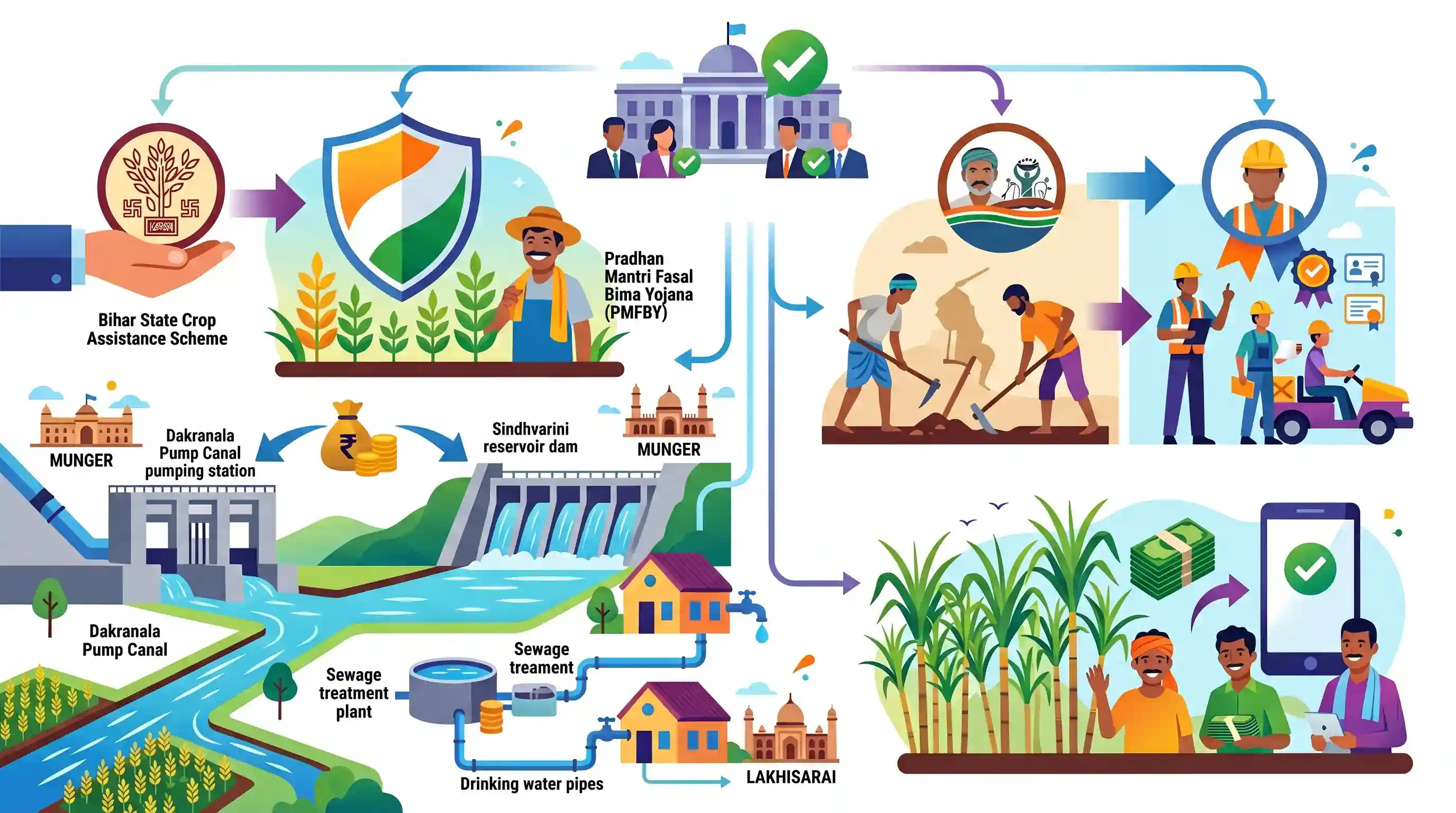
The Bihar Cabinet approved several major developmental and agricultural policy decisions, including replacing MGNREGA with the new national rural employment legislation, VB-G RAM G, and replacing the Bihar State Crop Assistance Scheme with the Pradhan Mantri Fasal Bima Yojana (PMFBY). Additionally, the state approved Rs 1,113 crore for water resources projects—such as the Dakranala Pump Canal and Sindhvarini reservoir in Munger and Lakhisarai—as well as sewage and drinking water projects across various districts, and cleared long-pending arrears for sugarcane farmers in Gopalganj.
Key Points
- The Bihar Cabinet, chaired by Chief Minister Samrat Choudhary, approved the implementation of Viksit Bharat - Guarantee for Rozgar and Aajeevika Mission (Gramin) (VB-G RAM G) starting July 1, 2026.
- VB-G RAM G replaces MGNREGA (2005) as the country's rural employment legislation, guaranteeing 125 days of wage-based employment per financial year for unskilled adult members of rural families.
- The cabinet approved the re-implementation of the Pradhan Mantri Fasal Bima Yojana (PMFBY) starting Rabi 2026-27, replacing the 2018 Bihar State Crop Assistance Scheme (Bihar Rajya Fasal Sahayata Yojana) and removing upper limits on landholdings.
- An allocation of Rs 43 crore was approved for clearing sugarcane farmers' arrears at the Sasamusa Sugar Works Private Limited in Gopalganj, which is being revived by the Karnataka-based MRN Group after its closure in 2018-19.
- Three major Water Resources Department projects totaling Rs 1,113 crore were approved: the Dakranala Pump Canal project (Ganga-Dakranala confluence irrigating 3,284 hectares in Munger and Lakhisarai), the Sindhvarini reservoir project in Kharagpur (Munger, Rs 197 crore at the Mani-Sindhvarini confluence), and border area flood management (Rs 771 crore).
- Urban infrastructure proposals worth Rs 798 crore were approved, including Sewage Treatment Plants (STPs) in Bihar Sharif (Nalanda) and Begusarai, along with drinking water schemes in Hajipur (Vaishali) and Saharsa.
Important Terms
Viksit Bharat – Guarantee for Rozgar and Aajeevika Mission (Gramin) (VB-G RAM G)

A national legislation enacted in 2025 (implemented July 1, 2026) that replaces MGNREGA. It guarantees 125 days of unskilled wage employment annually per rural household under a 60:40 Centre-State cost-sharing model.
UPSC context
GS Paper II (Welfare Schemes) and GS III (Employment). Tests structural reforms in rural safety nets and fiscal federalism.
Pradhan Mantri Fasal Bima Yojana (PMFBY)
A centrally sponsored crop insurance scheme launched in 2016. It offers comprehensive financial protection to farmers against crop damages from non-preventable natural disasters at uniform, highly subsidized premium rates.
UPSC context
GS Paper III (Agriculture & Farmer Welfare). Tests crop risk-mitigation models, agricultural subsidies, and center-state financial coordination.
Mahatma Gandhi National Rural Employment Guarantee Act (MGNREGA) 2005
A landmark social security legislation enacted in 2005 that provided a legal guarantee of 100 days of manual wage employment per year to rural households. It was replaced by the VB-G RAM G Act.
UPSC context
GS Paper II & III (Welfare Schemes/Employment). Tests evolution of rights-based wage security, demand-driven schemes, and decentralized rural planning.
Bihar State Crop Assistance Scheme (Bihar Rajya Fasal Sahayata Yojana)
A state-funded agricultural scheme launched by Bihar in 2018 to compensate farmers for crop damage due to natural disasters. It required no premium and was replaced by the national PMFBY in 2026.
UPSC context
GS Paper III (Agriculture). Tests knowledge of crop compensation mechanisms, state vs. central insurance models, and direct assistance.
Sasamusa Sugar Works Private Limited
A historic, private sugar mill located in Gopalganj, Bihar, established in 1932. After closing in 2018-19, it is being revived through state funding and private partnership to settle pending farmer dues.
UPSC context
GS Paper III (Industrial Revival/Sugarcane Pricing). Tests sugar sector challenges, fair pricing arrears, and public-private models for agro-industrial revival.
MRN Group
A Karnataka-based diversified industrial conglomerate tasked by the Bihar government with reviving and operating the closed 96-year-old Sasamusa Sugar Mill as part of the state's industrial expansion plans.
UPSC context
GS Paper III (Agro-industries/Investment). Tests public-private partnerships (PPP), industrial revival strategies, and diversification into bio-products.
Prelims Trap
Like MGNREGA, the VB-G RAM G scheme is an open-ended, demand-driven program with 100% Central funding for wages.
Aspirants may assume VB-G RAM G retains MGNREGA's landmark 'demand-driven' open-ended funding mechanism and 100% Central wage financing. In reality, it transitions to a fixed-budget normative allocation with a 60:40 Centre-State split.
Static Concepts Connected
What are the core features and premium structures of the Pradhan Mantri Fasal Bima Yojana?
- Premium caps: Uniform premium rates of 2% for Kharif, 1.5% for Rabi, and 5% for commercial/horticultural crops paid by farmers.
- Voluntary choice: Participation is voluntary for all farmers, including those with outstanding crop loans, since the 2020 reforms.
- Subsidy sharing: The remaining premium cost is split 50:50 between Center and States (90:10 for North-Eastern states).
How do demand-driven welfare schemes differ from fixed-budget normative allocations?
- Demand-driven: Funding is legally open-ended; expenditures scale up dynamically to match actual citizen demand (e.g., original MGNREGA design).
- Normative allocation: Funds are capped and distributed based on pre-set structural parameters or formulaic criteria, limiting overall fiscal liability.
Cross-Topic Patterns
Rural employment vs Farm labor shortages
The 60-day work pause in VB-G RAM G addresses a persistent farm-owner complaint, balancing welfare guarantees with the labor needs of private intensive farming.
State assistance vs National insurance
Bihar's return to PMFBY underscores the fiscal limits of state-funded, premium-free disaster assistance versus the risk-pooling advantages of structured national crop insurance.

The structural shift from MGNREGA to VB-G RAM G (funding ratio, fixed budget, 125 days) will likely feature in comparative 2026 Prelims.
Linked PYQs · 2
Linked PYQs · 2
- 2018BPSC_PRELIMSGS1
Which one of the following is the objective of MGNREGA?
- 2022BPSC_PRELIMSGS1
Which is the first Ramsar Site in Bihar?
