Bihar Cabinet Rooftop Solar Additional Subsidy Approval
Source:bioenergy-times ↗
Why It Matters
State-specific top-up subsidies for flagship central schemes are critical for BPSC Prelims, highlighting Bihar's active policy interventions in the renewable energy sector and infrastructure development.
Summary
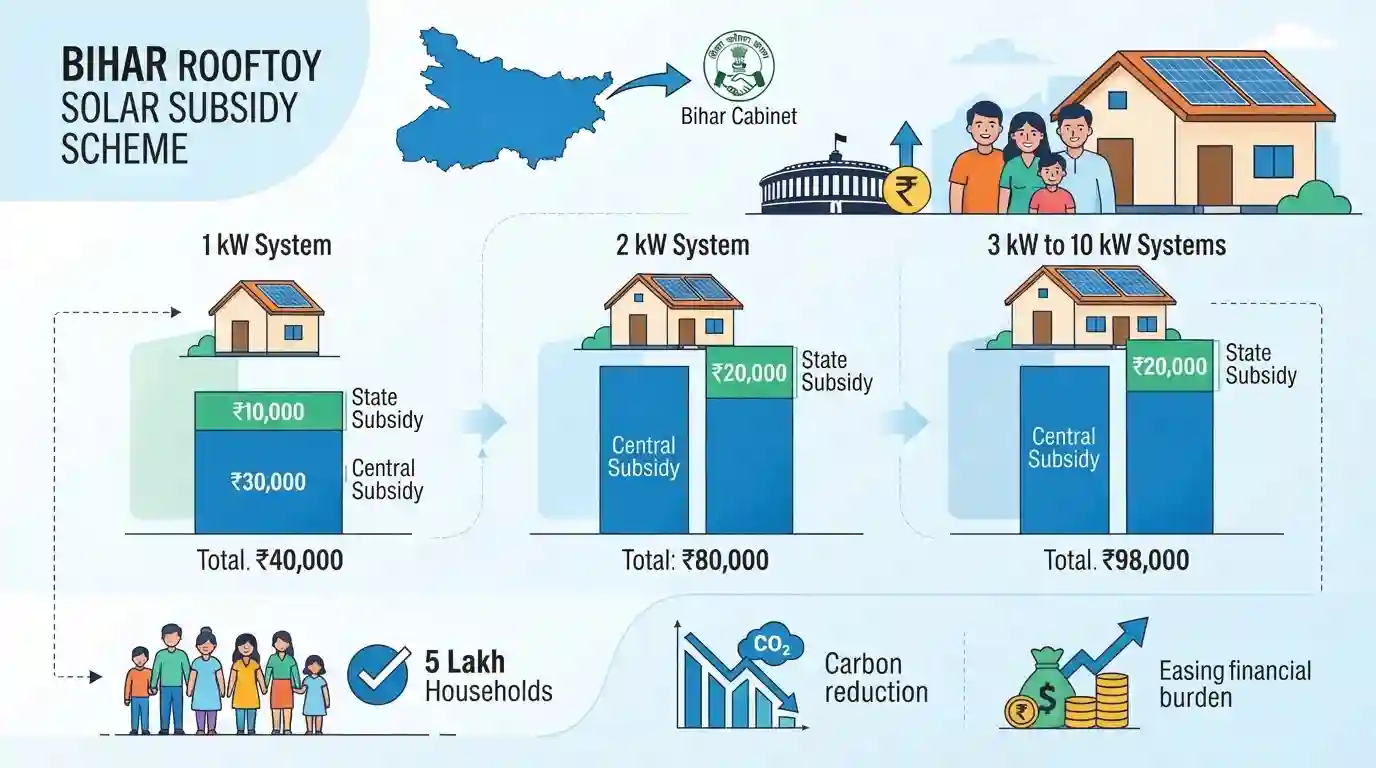
The Bihar Cabinet has greenlit a supplementary state subsidy of up to Rs 20,000 to encourage rooftop solar installations under the central government's PM Surya Ghar Muft Bijli Yojana. With the state offering Rs 10,000 per kW on top of central assistance, the total subsidy jumps to Rs 40,000 for a 1 kW system, Rs 80,000 for a 2 kW system, and caps at Rs 98,000 for setups of 3 kW to 10 kW. The initiative aims to benefit 5 lakh households in Bihar, easing the financial burden of adopting clean energy and contributing to broader environmental and carbon-reduction goals.
Key Points
- The Bihar Cabinet has approved an additional state subsidy for rooftop solar installations under the PM Surya Ghar Muft Bijli Yojana.
- The state will provide an additional Rs 10,000 per kW, up to a maximum of Rs 20,000, over and above the central subsidy.
- For a 1 kW plant, total financial support is Rs 40,000 (Rs 30k central + Rs 10k state); for 2 kW, it is Rs 80,000 (Rs 60k central + Rs 20k state).
- For solar plants ranging from 3 kW to 10 kW, the maximum combined subsidy is capped at Rs 98,000.
- The scheme targets 5 lakh households in Bihar, promoting clean energy adoption and reducing the state's carbon footprint.
Important Terms
PM Surya Ghar Muft Bijli Yojana

A central government scheme launched in 2024 providing financial assistance to households for installing rooftop solar panels. It targets 1 crore households, aiming to provide up to 300 units of free electricity monthly and reduce carbon emissions.
UPSC context
Crucial for GS2 (Policies) and GS3 (Renewable Energy), testing knowledge of India's decentralized solar capacity and zero-emission goals.
Rooftop Solar (RTS) Scheme
A clean energy initiative where solar photovoltaic panels are installed on building roofs. It provides decentralized power generation, supported by subsidies to decrease dependence on the traditional power grid and lower overall electricity costs.
UPSC context
Relevant for GS3 (Infrastructure & Energy), highlighting decentralized green energy generation, grid integration, and sustainable development.
Bihar Renewable Energy Development Agency (BREDA)
The nodal state agency in Bihar tasked with developing and implementing non-conventional energy schemes, such as rooftop solar subsidies and village electrification. It facilitates the state-level execution of central green energy missions.
UPSC context
Important for GS3 (Energy) and state exams, illustrating state-level institutional mechanisms required to implement India's broader renewable energy targets.
Prelims Trap
PM Surya Ghar is a Centrally Sponsored Scheme because state governments share the subsidy burden.
PM Surya Ghar is a 100% centrally funded Central Sector Scheme. State governments offering independent top-up subsidies does not alter its core classification.
Static Concepts Connected
What distinguishes a Central Sector Scheme from a Centrally Sponsored Scheme?
- Funding Pattern: Central Sector is 100% Union-funded, whereas Centrally Sponsored is cost-shared between the Centre and States (e.g., 60:40 or 90:10).
- Implementation Agency: Central Sector schemes are directly implemented by Union ministries or agencies, while Centrally Sponsored schemes are typically implemented by State governments.
How does 'Net Metering' function in rooftop solar installations?
- Grid Integration: It allows consumers who generate their own electricity to feed surplus solar power back into the local distribution grid.
- Billing Mechanism: Consumers are billed only for the 'net' energy used—total electricity drawn from the grid minus the solar electricity exported to it.
Cross-Topic Patterns
Urban vs Rural Solar Frameworks
PM Surya Ghar targets residential urban/semi-urban rooftops, whereas PM-KUSUM targets rural agricultural pumps. UPSC frequently tests comparative targeting and mechanisms of such allied renewable energy schemes.
Sub-national Climate Action & NDCs
State-specific top-ups to central schemes reflect 'competitive federalism' in achieving India's overarching NDC goal of 50% cumulative non-fossil fuel installed electricity capacity.

Expect a 2026 prelims statement mixing PM Surya Ghar's central funding pattern with net-metering mechanics and state-level top-up allowances.
Linked PYQs · 3
Linked PYQs · 3
- 2023BPSC_PRELIMSGS1
Bihar Government has planned to make Bihar State ‘pollution-free’ by reducing carbon emissions by which year?
- 2023BPSC_PRELIMSGS1
The first ‘floating solar power plant’ has been built at which place in Bihar?
- 2020BPSC_PRELIMSGS1
The objective of PM-KUSUM Scheme is
