Bihar Cabinet approves PPP model for sixteen medical colleges
Source:indianmasterminds ↗
Why It Matters
These cabinet decisions highlight Bihar's strategic shift toward utilizing PPP models for healthcare infrastructure, expanding high-end tourism options, and improving urban amenities, which are highly relevant for BPSC questions on state policies and socio-economic development.
Summary
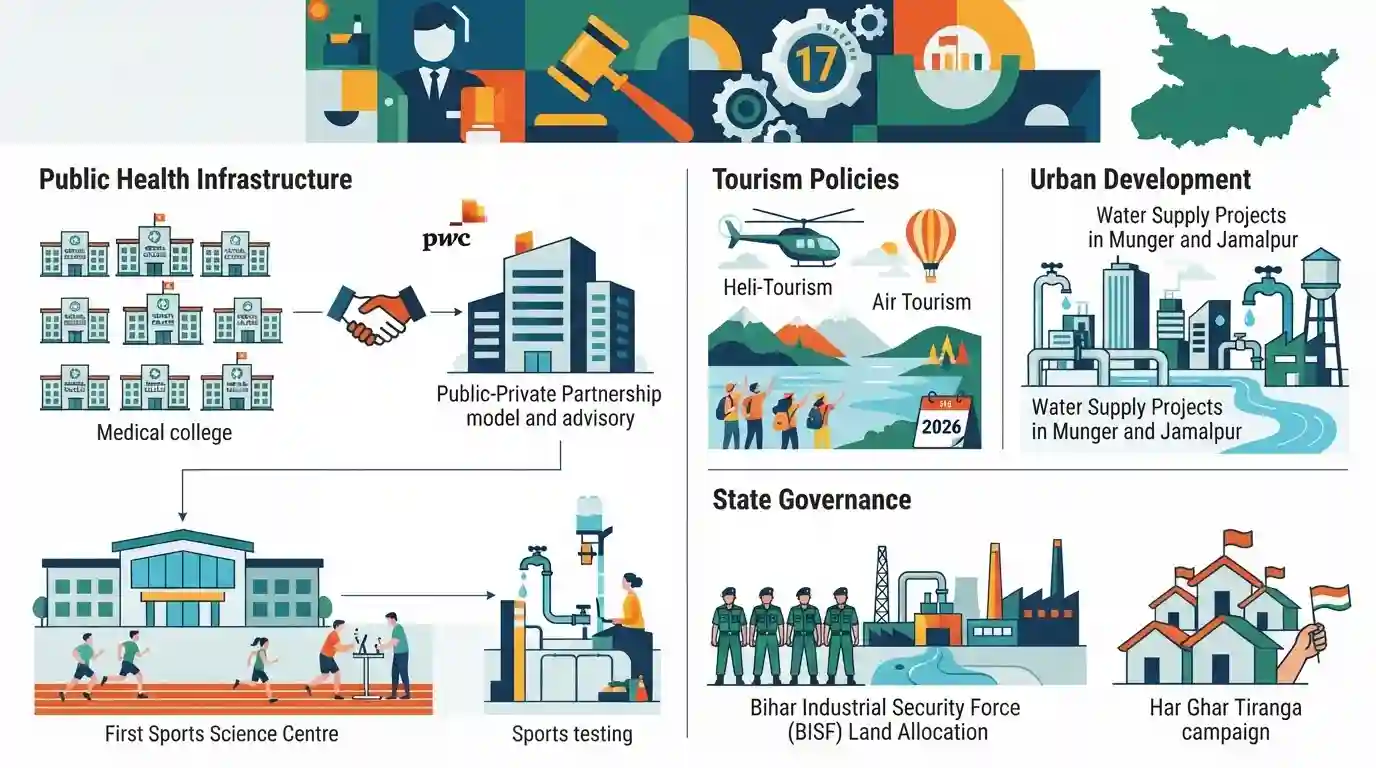
The Bihar Cabinet has cleared 17 key proposals, significantly focusing on healthcare and infrastructure. A major decision includes operating 16 medical colleges and hospitals via the Public-Private Partnership (PPP) model, appointing PwC as the advisory agency. The cabinet also approved the establishment of Bihar's first Sports Science Centre and introduced the Heli-Tourism and Air Tourism Service Scheme 2026 to boost tourism. Additional approvals cover land allocation for the Bihar Industrial Security Force (BISF), funding for the Har Ghar Tiranga campaign, and water supply projects in Munger and Jamalpur under AMRUT 2.0.
Key Points
- The Bihar Cabinet approved the operation of 16 medical colleges and hospitals under the Public-Private Partnership (PPP) model, with PwC as the advisory agency.
- The state sanctioned its first Sports Science Centre for high-performance sports training and injury rehabilitation.
- The Heli-Tourism and Air Tourism Service Scheme 2026 was approved to enhance the tourism sector in Bihar.
- Approvals were also granted for AMRUT 2.0 water supply projects in Jamalpur and Munger, and ₹6.12 crore was allocated for the Har Ghar Tiranga Campaign.
- Land was allocated for the Bihar Industrial Security Force (BISF) in Nawada and a Kendriya Vidyalaya in East Champaran.
Important Terms
PPP Model

A cooperative arrangement between public sector authorities and private sector entities to fund, design, construct, and operate public infrastructure or services, sharing risks and rewards.
UPSC context
GS Paper III: Investment Models. Tests understanding of resource mobilization and private sector participation in infrastructure.
AMRUT 2.0
A centrally sponsored scheme aiming to make Indian cities water-secure through universal piped water supply, rejuvenation of water bodies, and sustainable wastewater recycling.
UPSC context
GS Paper II: Government Schemes; GS Paper III: Urbanization. Tests policies for sustainable urban development and sanitation.
Har Ghar Tiranga Campaign
A mass campaign launched under Azadi Ka Amrit Mahotsav by the Ministry of Culture encouraging citizens to hoist the national flag at homes to foster patriotism.
UPSC context
GS Paper I: Post-Independence India; GS Paper II: Governance. Tests knowledge of national symbols, integration, and civic participation.
Bihar Industrial Security Force (BISF)
A specialized security force in Bihar, modeled on the CISF, designed to provide a secure environment for investors and protect key industrial clusters.
UPSC context
GS Paper III: Internal Security. Tests state-level security architectures and their connection to economic investment and business environments.
Heli-Tourism and Air Tourism Service Scheme 2026
A subsidized air travel scheme launched by Bihar to provide affordable helicopter services to tourist sites, boosting regional tourism and local employment.
UPSC context
GS Paper III: Infrastructure and Tourism. Tests transport connectivity policies, state tourism infrastructure, and regional economic growth.
Prelims Trap
The Bihar Industrial Security Force (BISF), being modeled on the CISF, operates under the Union Ministry of Home Affairs.
The BISF is a state police wing under the Bihar Government (State List - Entry 2), whereas the CISF is a Union CAPF (Union List - Entry 2).
Static Concepts Connected
What are NITI Aayog's guiding principles for PPP in district hospitals?
- Co-location Model: Linking existing public district hospitals with private medical colleges to optimize resources and tertiary care.
- Viability Gap Funding: Using government-backed financial support to ensure project feasibility in underserved tier-2 and tier-3 districts.
How do State Industrial Security Forces (SISF) differ from the CISF?
- Administrative Control: SISFs are raised, funded, and managed by state home departments; the CISF is a Union CAPF under the Ministry of Home Affairs.
- Operational Mandate: SISFs secure state-specific assets, public utilities, and private industries, reducing the security load on the central government.
Cross-Topic Patterns
Healthcare PPP + Article 21
Leveraging private players for state-run medical colleges tests the constitutional mandate of providing affordable tertiary healthcare as part of the Right to Life under Article 21.
Internal Security + Federal policing forces
The creation of State Industrial Security Forces highlights the pressure on states to build specialized policing capabilities to reduce structural dependency on central CAPFs.

Expect a 2026 question contrasting the administrative jurisdiction and control of Central CAPFs with state-raised security forces.
Linked PYQs · 2
Linked PYQs · 2
- 2019BPSC_PRELIMSGS1
What is the tagline of Bihar State Tourism Development Corporation?
- 2022BPSC_PRELIMSGS1
The new ministry proposed in the Bihar Budget for the year 2021-22 focuses on
