Bihar Budget Sectoral Allocations and Fiscal Indicators Analysis
Source:bpscpathshala ↗
Why It Matters
State budgets are a perennial core theme for BPSC Prelims, directly targeting questions related to sectoral allocations, fiscal deficits, and state financial parameters.
Summary
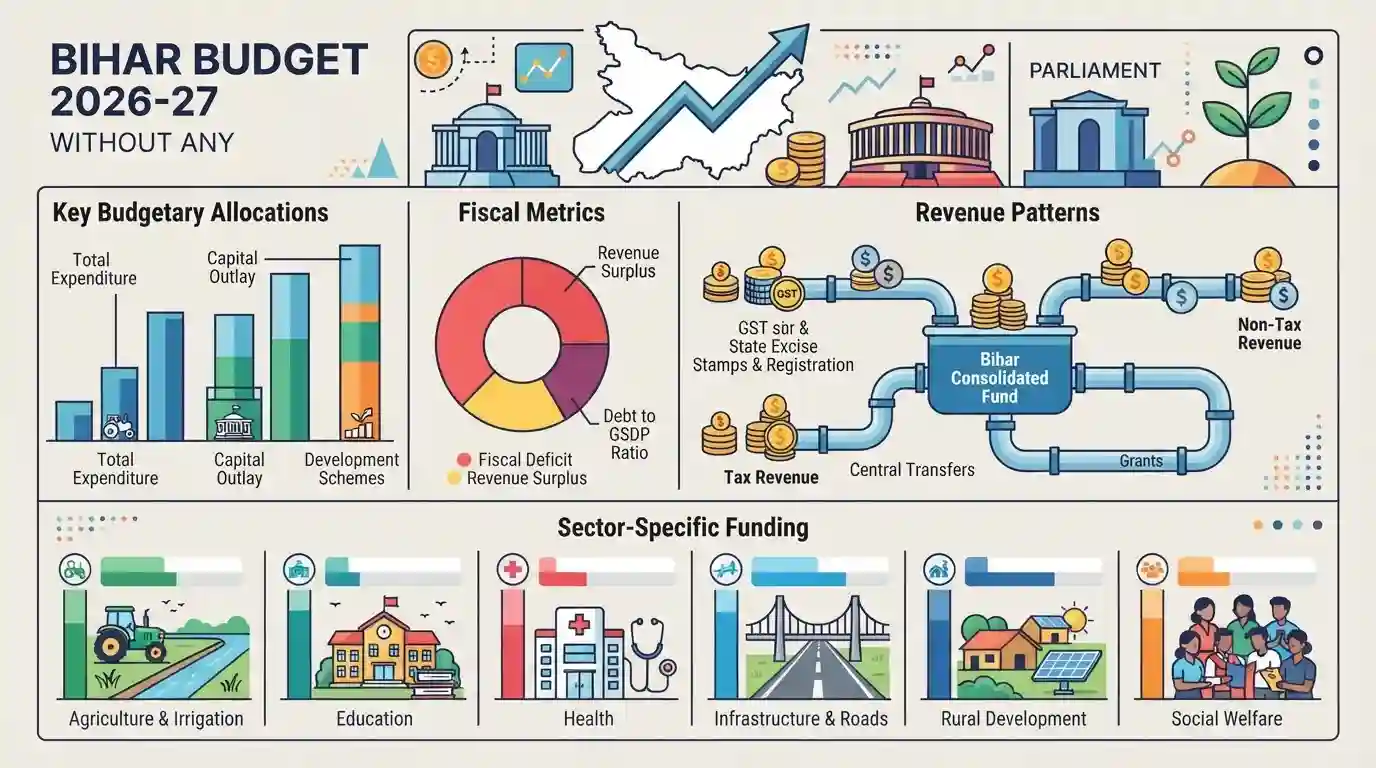
The article provides a comprehensive overview and analysis of the Bihar Budget for the financial year 2026-27, detailing key budgetary allocations, fiscal metrics, revenue patterns, and sector-specific funding crucial for competitive exams like BPSC Prelims.
Key Points
- Analysis of the Bihar Budget 2026-27 highlighting major financial allocations, fiscal indicators like fiscal deficit, and revenue receipts.
- Sector-wise expenditure breakdown focusing on key developmental priorities such as education, infrastructure, and social welfare in Bihar.
- GSDP growth projections and tax-to-GDP performance trends for the state of Bihar in the fiscal year 2026-27.
Important Terms
Saat Nishchay-3

The state's multi-year development policy framework (2025–2030) prioritizing inclusive growth, employment generation, women empowerment, farmer support, and infrastructure to transform Bihar.
UPSC context
BPSC Paper II (Governance/Economy): Tests knowledge of state-led welfare roadmaps, policy frameworks, and socio-economic targets for Bihar.
Government of Bihar
The executive authority in Bihar responsible for formulating state economic policies, preparing annual financial statements, and executing statutory development budgets under constitutional provisions.
UPSC context
BPSC General Studies / State Administration: Tests awareness of executive governance, policy implementation, and fiscal administration in Bihar.
Fiscal Deficit
The difference between total revenue receipts and total expenditure, projected around 3% of GSDP for Bihar in 2026-27, reflecting fiscal discipline and borrowing limits.
UPSC context
BPSC Paper II (Indian Economy and Bihar Economy): Evaluates understanding of state public finance metrics, FRBM compliance, and macroeconomic health.
Prelims Trap
Bihar's revenue receipts are primarily driven by its own-tax revenue generation rather than central transfers.
Aspirants often confuse Bihar's own tax revenue share with central tax devolution; central transfers constitute the majority of Bihar's total receipts.
Static Concepts Connected
What are the key statutory limits and norms governing state fiscal deficits under the FRBM Act?
- Fiscal Limit: The FRBM Act mandates states to generally maintain their fiscal deficit within 3 percent of their respective Gross State Domestic Product (GSDP).
- Additional Headroom: Additional borrowing headroom is often permitted by the Centre to states meeting specific power-sector or capital expenditure performance benchmarks.
- Transparency: States are required to table medium-term fiscal policy statements along with the annual budget to ensure transparency and debt sustainability.
Cross-Topic Patterns
Bihar Budget & SDG Human Capital Index
State budget allocations for education link directly to central human capital metrics and SDG India Index performance for Bihar.
FRBM Act & State Fiscal Federalism
State fiscal deficits capped under FRBM connect macro-fiscal federalism with the 15th/16th Finance Commission devolution principles.

Expect a direct match-the-following or data-based MCQ on Bihar budget sector-wise allocation percentages and fiscal deficit targets.
Linked PYQs · 3
Linked PYQs · 3
- 2022BPSC_PRELIMSGS1
The fiscal deficit in Bihar during 2021-22 is estimated as
- 2022BPSC_PRELIMSGS1
According to the 15th Finance Commission's recommendations, how much share will Bihar receive in divisible pool of Central taxes from 2021-26?
- 2024-EBPSC_PRELIMSGS1
Which sector received the highest allocation in the Bihar Budget 2024-25?
