Bihar Crime Control Bill and Legal Penalties for Exam Leaks
Source:etvbharat ↗
Why It Matters
These legislative changes in Bihar are highly relevant for BPSC Prelims and Mains (Polity and Governance), reflecting the state's proactive stance on contemporary challenges like exam paper leaks, cyber-bullying, local body financial empowerment, and industrial investment.
Summary
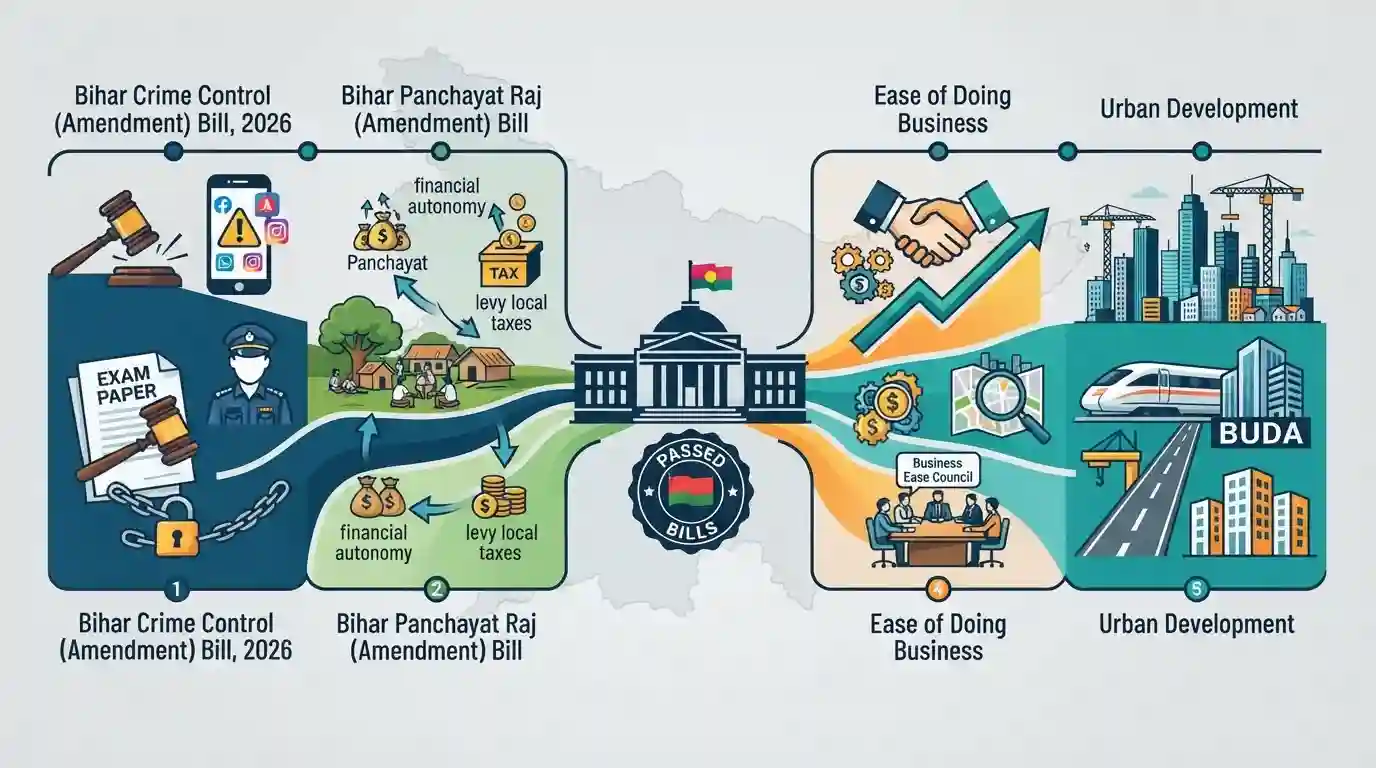
The Bihar Legislative Assembly has passed five significant bills to revamp state governance, law and order, and economic infrastructure. Notably, the Bihar Crime Control (Amendment) Bill, 2026, categorises exam paper leaks as organised crime and criminalises the misuse of social media platforms. The Bihar Panchayat Raj (Amendment) Bill grants financial autonomy to village panchayats by allowing them to levy local taxes. Additionally, new bills for Ease of Doing Business and Urban Development seek to streamline investments via a Chief Minister-led Business Ease Council and expedite infrastructure projects through a newly constituted Bihar Urban Development Authority.
Key Points
- The Bihar Legislative Assembly passed multiple pivotal bills aimed at crime control, local governance, and economic growth in July 2026.
- The Bihar Crime Control (Amendment) Bill designates exam paper leaks as 'organised crime' and penalises social media misuse with 6 months to 1 year of imprisonment.
- The Bihar Panchayat Raj (Amendment) Bill financially empowers village panchayats to collect holding tax, professional tax, and fees on hoardings to achieve self-reliance.
- The Bihar Ease of Doing Business Bill creates a Business Ease Council headed by the Chief Minister and an Invest Bihar Secretariat to offer single-window clearances for investors.
- The Bihar Urban Development Bill establishes a new Urban Development Authority headed by the Chief Secretary to replace the existing corporation and push PPP-based urban infrastructure projects.
Important Terms
Bihar Crime Control (Amendment) Bill, 2026

A 2026 state law that classifies examination paper leaks as organized crime and introduces strict penalties for the misuse of social media, aiming to curb modern cyber and organized offenses.
UPSC context
GS-2 (State Legislation); GS-3 (Internal Security, Cybercrime). Tests understanding of legislative responses to emerging digital and organized crimes.
Bihar Panchayat Raj (Amendment) Bill, 2026
A legislative amendment granting village panchayats the financial autonomy to levy and collect local taxes, such as holding taxes and advertisement fees, to foster rural self-reliance.
UPSC context
GS-2 (Panchayati Raj Institutions). Crucial for analyzing the devolution of financial powers to local self-government bodies.
Bihar Ease of Doing Business Bill, 2026
A state legislation aimed at simplifying industrial approvals through a single-window clearance system, mandating that all investment-related proposals be processed and disposed of within 30 days.
UPSC context
GS-3 (Economic Growth, Investment). Highlights state-level regulatory reforms designed to attract private capital and improve business environments.
Bihar Urban Development Authority
A statutory body headed by the state Chief Secretary, established to systematically oversee infrastructure projects, manage urban planning, and develop new greenfield satellite townships across Bihar.
UPSC context
GS-1 (Urbanization); GS-2 (Governance). Demonstrates institutional mechanisms for addressing haphazard urban expansion and upgrading civic infrastructure.
Business Ease Council
An apex executive committee chaired by Bihar’s Chief Minister to oversee the implementation of the Ease of Doing Business framework and ensure swift, single-window clearances for investors.
UPSC context
GS-2 (Governance) and GS-3 (Investment Promotion). Illustrates top-level political oversight mechanisms in regional economic administration.
Prelims Trap
"The 73rd Constitutional Amendment directly empowers Gram Panchayats to levy local taxes to ensure financial autonomy."
Article 243H leaves it entirely to the State Legislature to authorize Panchayats to levy taxes; the power is discretionary, not automatically or directly granted by the Constitution.
Static Concepts Connected
What is the constitutional provision for the financial autonomy of Panchayats?
- Article 243H: Empowers the State Legislature to authorize Panchayats to levy, collect, and appropriate taxes, duties, tolls, and fees.
- State Finance Commission: Under Article 243-I, it reviews the financial position of Panchayats and recommends the distribution of tax revenues between the State and PRIs.
- Grants-in-aid: The Constitution allows the State Legislature to make provisions for Grants-in-aid to Panchayats from the Consolidated Fund of the State.
Under which 7th Schedule lists do "Criminal Law" and "Public Order" fall?
- State List: "Public Order" and "Police" are subjects under List II, giving states primary responsibility for local crime control and municipal governance.
- Concurrent List: "Criminal Law" and "Criminal Procedure" fall under List III, allowing both Parliament and State Legislatures to enact laws (like paper leak penalties).
- Presidential Assent: State laws modifying Central criminal laws require the President's assent under Article 254 to prevail over the central statute.
Cross-Topic Patterns
PRI Own-Source Revenue (OSR) deficit
Bihar's push addresses a chronic issue highlighted in recent RBI reports—Panchayats rely overwhelmingly on central/state grants, with OSR forming less than 5% of their total receipts.
State vs Central Anti-Leak Laws
Bihar designating exam leaks as 'organised crime' adds state teeth to the Central Public Examination (Prevention of Unfair Means) Act, 2024, showing a policy consensus on treating leaks as severe economic offenses.
Land Conversion & Ease of Doing Biz
Removing land-use conversion mandates for agricultural land touches upon a core Mains Paper 3 theme: regulatory bottlenecks in land acquisition and industrialization.

Expect a 2026 Prelims question linking PRI own-source revenue generation, Article 243H, and State Legislature discretionary powers.
Linked PYQs · 4
Linked PYQs · 4
- 2020BPSC_PRELIMSGS1
Bihar Government has introduced the Comprehensive Financial Management System (CFMS) on 1st April, 2019. This system
- 2025BPSC_PRELIMSGS1
What is the main purpose of Panchayati Raj?
- 2025BPSC_PRELIMSGS1
Who is empowered to review the financial position of the Panchayats?
- 2023BPSC_PRELIMSGS1
In the year 2020, Bihar gained the __ rank out of 36 States in the Ease of Doing Business, awarded by Business Reforms Action Plan (BRAP).
