Supreme Court Criticism over Reinstatement of Suspended Officers
Source:Indian Express ↗
Why It Matters
This issue highlights a critical intersection of GS2 (Governance, Accountability, Judiciary) and GS3 (Infrastructure, Disaster Management). It demonstrates systemic apathy in administration where disciplinary action is used merely to manage public perception. Furthermore, it exemplifies the role of PILs and the judiciary in enforcing structural safety audits when the executive fails to ensure the quality of public goods.
Summary
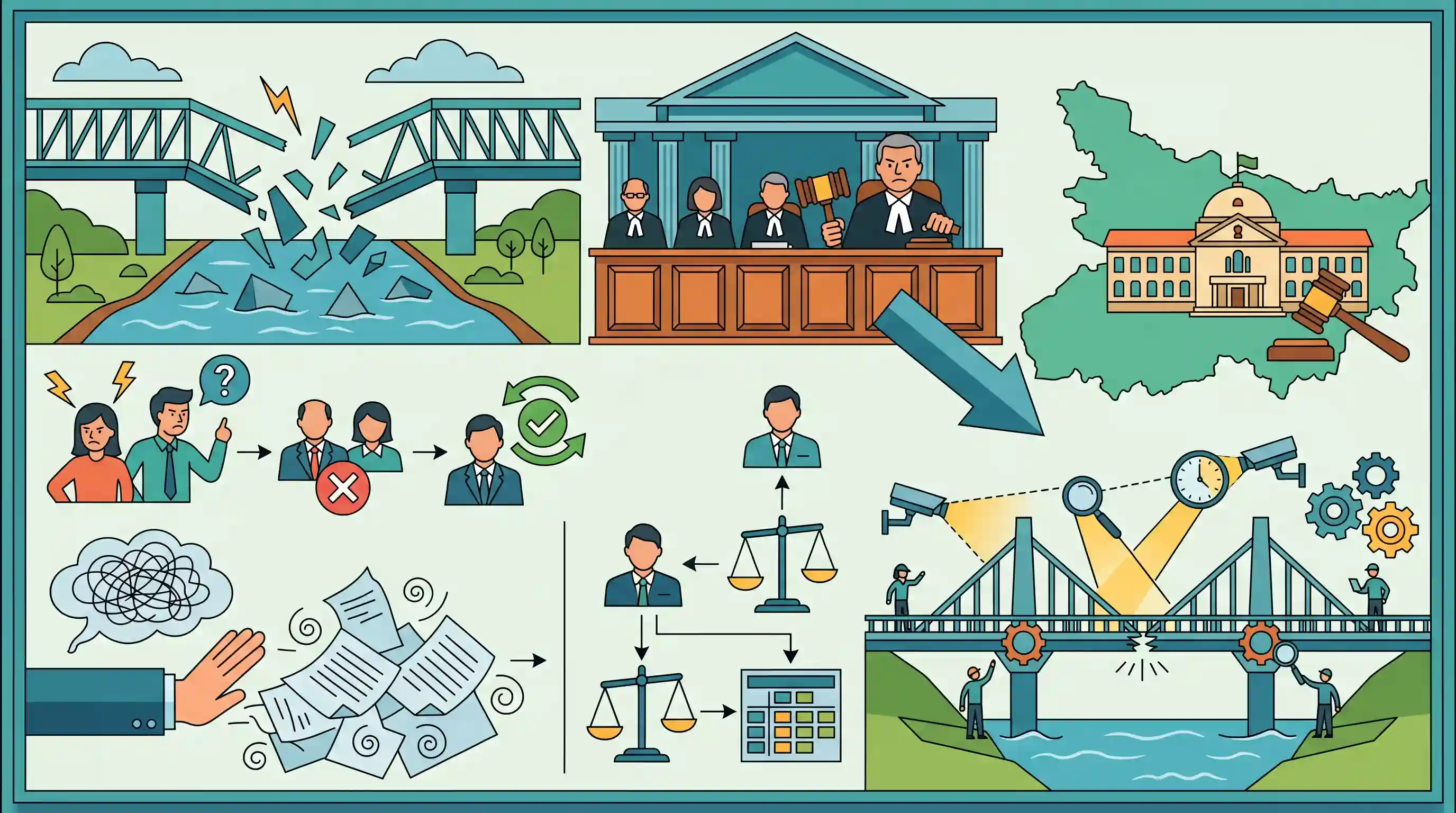
The Supreme Court heavily criticized the Bihar government for quietly reinstating officers who had been suspended following multiple bridge collapses, noting that the disciplinary actions were merely temporary measures to defuse public outrage. While hearing a Public Interest Litigation (PIL) demanding structural audits of bridges in the flood-prone state, the SC reprimanded the government for submitting a voluminous but evasive affidavit that failed to address the root causes of the collapses or establish accountability. The Court ultimately transferred the matter to the Patna High Court, reasoning that the local judiciary is better positioned to continuously monitor the state's public infrastructure safety and ensure administrative accountability.
Key Points
- The Supreme Court criticized the Bihar government for reinstating officers previously suspended over a series of bridge collapses, calling the disciplinary action a mere 'eyewash' meant to pacify public anger.
- The Court rebuked the state for filing a bulky, 400-page affidavit that listed generic schemes and policies instead of providing concrete reasons or fixing accountability for the infrastructure failures.
- The PIL, which sought a comprehensive structural audit of bridges and the formation of an expert panel, was transferred to the Patna High Court for more effective local monitoring.
- At least 10 bridge collapse incidents were reported in Bihar between May and July the previous year, underscoring systemic vulnerabilities in public infrastructure and quality control.
Important Terms
Public Interest Litigation (PIL)

A legal mechanism allowing any public-spirited individual to approach the court for the protection of public interest, relaxing traditional rules of standing.
UPSC context
GS Paper 2 (Judiciary/Polity); tests judicial activism and the court's role in enforcing socio-economic rights and executive transparency.
Administrative Accountability
The obligation of public officials and government bodies to be answerable for their decisions, actions, and the effective use of public funds.
UPSC context
GS Paper 2 (Governance/Probity); essential for questions on civil service reforms, ethics, and checking corruption in public infrastructure projects.
Judicial Monitoring
The process where a court supervises the implementation of its orders over a period to ensure long-term compliance by executive authorities.
UPSC context
GS Paper 2 (Judiciary); tests understanding of the judiciary's role in governance and the boundaries between activism and executive function.
Structural Audit
A systematic technical assessment of an engineering structure to verify its safety, identify damages, and suggest necessary repairs or preventive measures.
UPSC context
GS Paper 3 (Infrastructure/Disaster Management); concerns public safety protocols and the prevention of man-made disasters in disaster-prone regions.
Supreme Court of India
The apex judicial body of India, serving as the final court of appeal and the guardian of the Constitution.
UPSC context
GS Paper 2 (Constitutional Bodies); tests knowledge of original, appellate, and advisory jurisdictions and the power of judicial review.
Patna High Court
The highest court in the state of Bihar, exercising appellate and supervisory jurisdiction over the state's administration and lower judiciary.
UPSC context
GS Paper 2 (Federalism/High Courts); relevant for discussions on localized judicial oversight and the decentralization of accountability mechanisms.
Prelims Trap
Suspension of a civil servant pending a departmental inquiry is classified as a formal penalty under the Civil Services Rules.
Suspension is neither a major nor a minor penalty. It is merely an interim administrative measure to prevent the officer from interfering with an ongoing investigation.
Static Concepts Connected
What is 'Continuing Mandamus' in the context of Indian judicial oversight?
- Definition: A writ issued by a court requiring ongoing compliance and periodic reporting from authorities, rather than a single, final directive.
- Origin & Application: Popularized in the Vineet Narain case, it is frequently used in complex PILs (environment, infrastructure) to ensure executive accountability over a sustained period.
How is suspension governed under the Civil Services (Classification, Control and Appeal) Rules?
- Interim Measure: Suspension is an administrative tool, not a penal action. It keeps the official away from their post to ensure a fair, unhindered inquiry process.
- Mandatory Review: Suspensions cannot be indefinite. They must be periodically assessed by Review Committees; failure to do so within strict timelines leads to automatic revocation.
Cross-Topic Patterns
GS4: Bureaucratic Evasion & Ethics
Submitting 400-page generic affidavits to bypass specific responsibility illustrates bureaucratic apathy and a stark lack of foundational values like integrity and accountability in governance.
Disaster Resilient Infrastructure (CDRI)
Repeated river-bridge failures in flood-prone states necessitate integrating localized structural audits with global climate adaptation frameworks like the Coalition for Disaster Resilient Infrastructure (CDRI).

Expect a GS2 or GS4 question evaluating administrative suspensions vs systemic structural audits to enforce genuine bureaucratic accountability.
Linked PYQs · 4
Linked PYQs · 4
- 2024MainsGS2
Explain the reasons for the growth of public interest litigation in India. As a result of it, has the Indian Supreme Court emerged as the world's most powerful judiciary ?
- 2024MainsGS2
The Doctrine of Democratic Governance makes it necessary that the public perception of the integrity and commitment of civil servants becomes absolutely positive. Discuss.
- 2023MainsGS3
Dam failures are always catastrophic, especially on the downstream side, resulting in a colossal loss of life and property. Analyze the various causes of dam failures. Give two examples of large dam failures.
- 2021MainsGS4
Identify five ethical traits on which one can plot the performance of a civil servant. Justify their inclusion in the matrix.
